 Indietro
Viruses: Structure, Classification, and Multiplication in Microbiology
Guida di studio - Note intelligenti
 Appunti personalizzati basati sui tuoi materiali, ampliati con definizioni chiave, esempi e contesto.
Viruses in the Biological Spectrum
Introduction to Viruses
Viruses are unique biological entities capable of infecting all forms of life, including bacteria, algae, fungi, protozoa, plants, and animals. Their discovery and study have significantly shaped our understanding of infectious diseases and the microbial world.
Viruses are obligate intracellular parasites, meaning they require a host cell to replicate.
They are not classified as living organisms because they cannot carry out metabolic processes independently.
Viruses are best described as active or inactive rather than alive or dead.

Historical Discoveries
The study of viruses began in the late 19th century with the work of several pioneering scientists:
Louis Pasteur postulated that rabies was caused by an agent smaller than bacteria and developed the first rabies vaccine.
Dmitri Ivanovski and Martinus Beijerinck demonstrated that tobacco mosaic disease was caused by a filterable agent, later identified as a virus.
Friedrich Loeffler and Paul Frosch discovered the first animal virus (foot-and-mouth disease virus).




Properties and Classification of Viruses
General Properties
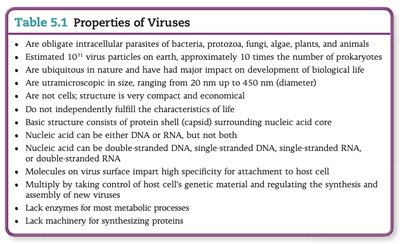
Viruses are characterized by their small size, simple structure, and dependence on host cells for replication.
They range in size from 20 nm to 450 nm in diameter.
Viruses lack the cellular machinery for metabolism and protein synthesis.
Their structure is compact and economical, consisting mainly of a protein shell (capsid) and nucleic acid.
Classification Criteria
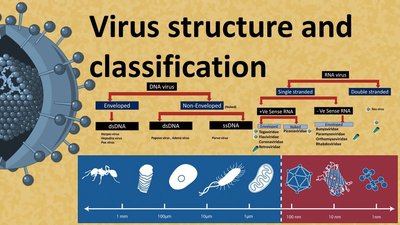
Viruses are classified based on their structure, chemical composition, and genetic makeup.
Major groups include DNA viruses and RNA viruses, which can be further divided by strandedness (single or double) and sense (positive or negative for RNA).
General Structure of Viruses
Size Range
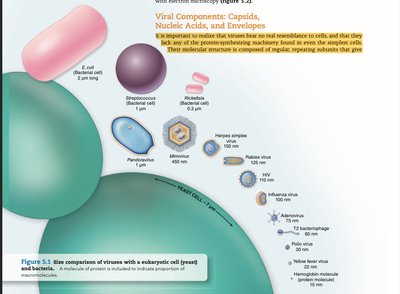
Viruses are the smallest infectious agents, with some as small as 20 nm and others approaching the size of small bacteria.
Viral Components: Capsids, Nucleic Acids, and Envelopes
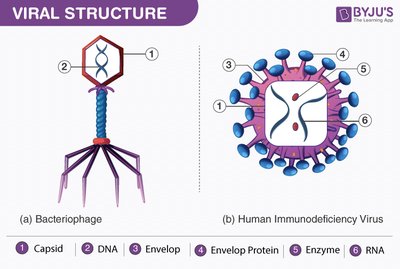
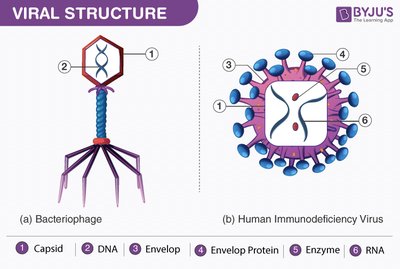
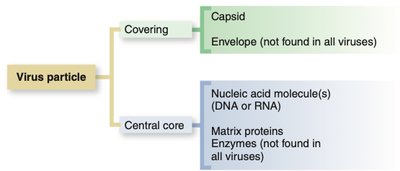
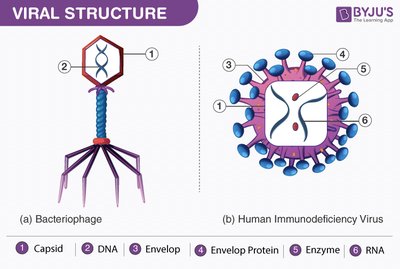
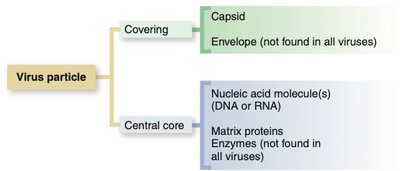
All viruses contain a nucleic acid core (DNA or RNA) surrounded by a protein capsid. Some viruses also possess an envelope derived from the host cell membrane.
Capsid: Protein shell composed of capsomers.
Nucleocapsid: Combination of nucleic acid and capsid.
Envelope: Lipid membrane present in some viruses, often with glycoprotein spikes for host cell attachment.
Naked viruses: Lack an envelope.
Spikes: Surface proteins that facilitate attachment to host cells.
Virion: A fully formed, infectious virus particle.
Capsid Shapes
Helical: Rod-shaped capsomers form a hollow tube (e.g., tobacco mosaic virus).
Icosahedral: 20-sided structure with 12 corners (e.g., adenovirus, herpes simplex virus).
Nucleic Acids
Viruses contain either DNA or RNA, but never both. The genome can be single- or double-stranded, linear or circular, and may be segmented.
DNA viruses: May be single- or double-stranded.
RNA viruses: Usually single-stranded; can be positive-sense (ready for translation) or negative-sense (must be converted before translation).
Retroviruses: RNA viruses that use reverse transcriptase to synthesize DNA from RNA.
Other Viral Components
Some viruses carry enzymes necessary for their replication, such as reverse transcriptase in retroviruses. However, they lack metabolic enzymes and machinery for protein synthesis.
Viral Multiplication Cycles
General Phases in Animal Viruses
The multiplication cycle of animal viruses includes several distinct steps:
Adsorption: Virus attaches to specific host cell receptors.
Penetration and Uncoating: Virus or its nucleic acid enters the host cell; uncoating releases the viral genome.
Synthesis: Viral genome is replicated and viral proteins are produced.
Assembly: New viral particles are assembled from synthesized components.
Release: New virions exit the host cell, often destroying it.
Host Range and Adsorption
The host range of a virus is determined by the presence of compatible receptors on the host cell surface. This specificity limits the types of cells a virus can infect.
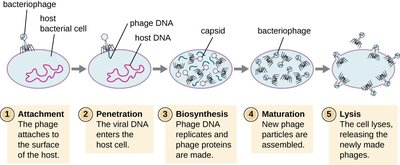
Penetration and Uncoating
Viruses enter host cells by endocytosis or direct fusion with the cell membrane. Uncoating releases the viral genome for replication.
Synthesis: Replication and Protein Production
Viral DNA is typically replicated in the nucleus, while RNA viruses often replicate in the cytoplasm. The synthesis phase is divided into early (enzyme production) and late (structural protein production) phases.
Assembly and Release
New virions are assembled and released from the host cell by budding (enveloped viruses) or cell lysis (naked viruses).
Effects of Viral Infection
Cytopathic Effects (CPEs) and Persistent Infections
Viruses can cause visible damage to host cells, known as cytopathic effects. Some infections become persistent, with the virus remaining in the host cell for extended periods, sometimes integrating into the host genome as a provirus.
Viruses and Cancer
Some viruses are oncogenic, meaning they can induce cancer by altering the host cell's genetic material. These viruses are called oncoviruses.
Bacteriophages and Lysogeny
Bacteriophage Life Cycles
Bacteriophages are viruses that infect bacteria. They can undergo a lytic cycle (destroying the host cell) or a lysogenic cycle (integrating into the host genome as a prophage).
Lysogenic Conversion
Sometimes, phage genes confer new properties to the bacterial host, such as toxin production, a phenomenon known as lysogenic conversion.
Other Noncellular Infectious Agents
Prions
Prions are infectious proteins that cause neurodegenerative diseases by inducing abnormal folding of normal proteins in the brain.
Satellite Viruses and Viroids
Satellite viruses: Require a helper virus for replication; example: Hepatitis D virus.
Viroids: Infectious RNA molecules that affect plants and lack a protein coat.
Techniques in Cultivating and Identifying Animal Viruses
Methods of Cultivation
In vivo: Inoculation of laboratory animals or embryonated bird eggs.
In vitro: Cell or tissue culture techniques, where animal cells are grown in monolayers to support viral multiplication.
Plaque Assay
Viral growth in cell cultures can be detected by the formation of plaques—clear zones where cells have been destroyed by viral infection.
Viruses and Human Health
Impact and Treatment
Viruses are responsible for numerous acute and chronic diseases in humans. Because they lack the structures targeted by antibiotics, antiviral drugs must specifically inhibit viral replication, often with significant side effects.
