Discuss the usual mode of entry of bacteria into the skin. Compare bacterial skin infections with infections caused by fungi and viruses with respect to mode of entry.
Ch. 21 - Microbial Diseases of the Skin and Eyes

Tortora14th EditionMicrobiology: An IntroductionISBN: 9780138200398Non è quello che usi tu?Cambia libro di testo
Tutti i libri di testo
Tortora 14th Edition
Ch. 21 - Microbial Diseases of the Skin and Eyes
Problema 1
Tortora 14th Edition
Ch. 21 - Microbial Diseases of the Skin and Eyes
Problema 1Capitolo 17, Problema 1
A 6-year old girl was taken to the physician for evaluation of a slowly growing bump on the back of her head. The bump was a raised, scaling lesion 4 cm in diameter. A fungal culture of material from the lesion was positive for a fungus with numerous conidia.
The girl’s disease was
a. Rubella.
b. Candidiasis.
c. Dermatomycosis.
d. A cold sore.
e. None of the above.
Guida verificata passo dopo passo1
Step 1: Identify the key clinical features described: a slowly growing bump on the scalp of a child, raised and scaling, measuring 4 cm in diameter.
Step 2: Note the laboratory finding: a fungal culture from the lesion was positive and showed numerous conidia, which are asexual spores typical of many fungi.
Step 3: Understand the options given: rubella (a viral rash), candidiasis (yeast infection), dermatomycosis (fungal infection of the skin), cold sore (caused by herpes simplex virus), and none of the above.
Step 4: Recognize that the presence of a fungal culture with conidia and a scaling lesion on the scalp suggests a fungal skin infection, which is consistent with dermatomycosis (a dermatophyte infection).
Step 5: Conclude that the girl's disease is most consistent with dermatomycosis based on the clinical presentation and positive fungal culture.

Risposta video verificata per un problema simile:
Questa soluzione video è stata consigliata dai nostri tutor come utile per risolvere questo problema.
Durata del video:
1mConcetti chiave
Ecco i concetti essenziali che devi comprendere per rispondere correttamente alla domanda.
Dermatomycosis
Dermatomycosis refers to fungal infections of the skin, hair, or nails caused by dermatophytes or other fungi. These infections often present as scaling, raised lesions and can produce conidia, which are asexual fungal spores. Recognizing dermatomycosis is key to differentiating it from viral or bacterial skin conditions.
Fungal Conidia
Conidia are asexual spores produced by many fungi, serving as a means of reproduction and dissemination. Their presence in a culture indicates fungal growth and helps identify fungal infections. Detecting numerous conidia in a lesion sample supports a diagnosis of a fungal skin infection.
Video consigliato:
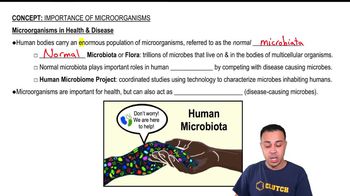
Microorganisms in Health & Disease
Differential Diagnosis of Skin Lesions
Differential diagnosis involves distinguishing between diseases with similar symptoms. In this case, differentiating fungal infections (dermatomycosis) from viral infections like rubella or cold sores, and candidiasis, is essential. Clinical features, lesion appearance, and laboratory tests guide accurate diagnosis.
Video consigliato:
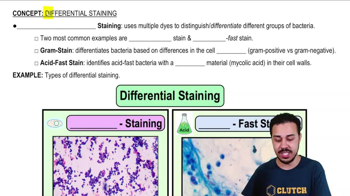
Differential Staining
Pratica correlata
Domanda del libro di testo
991
views
Domanda del libro di testo
On the following figure, show the sites of the following infections: impetigo, folliculitis, acne, warts, shingles, sporotrichosis, pediculosis.
<IMAGE>
1217
views
Domanda del libro di testo
What bacteria are identified by a positive coagulase test? What bacteria are characterized as group A beta-hemolytic?
1583
views
Domanda del libro di testo
A 6-year old girl was taken to the physician for evaluation of a slowly growing bump on the back of her head. The bump was a raised, scaling lesion 4 cm in diameter. A fungal culture of material from the lesion was positive for a fungus with numerous conidia.
Besides the scalp, this disease can occur on all of the following except
a. Feet.
b. Nails.
c. The groin.
d. Subcutaneous tissue.
e. The disease can occur on all of these areas.
1219
views