 Indietro
Chapter 1: The Principles and Practice of Economics – Microeconomics Study Notes
Guida di studio - Note intelligenti
 Appunti personalizzati basati sui tuoi materiali, ampliati con definizioni chiave, esempi e contesto.
Chapter 1: The Principles and Practice of Economics
Learning Objectives
Understand the scope of economics and its foundational principles.
Explain the three core principles of economics: Optimization, Equilibrium, and Empiricism.
Distinguish between positive and normative economics.
Apply economic reasoning to real-world choices and trade-offs.
The Scope of Economics
What is Economics?
Economics is the study of how individuals, firms, and governments make choices when faced with scarce resources. The central focus is on choice, not just money, and how these choices affect society as a whole.
Scarcity: The condition where wants exceed the available resources. Scarcity forces agents to make choices.
Economic Agent: Any individual or group that makes choices, such as consumers, firms, parents, politicians, etc.
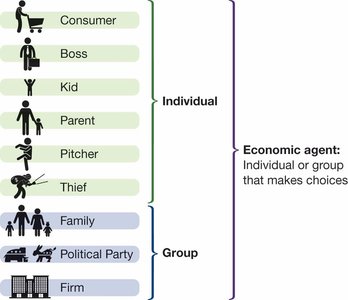
Microeconomics studies the behavior of individuals, firms, and governments, while macroeconomics examines the economy as a whole.
Positive vs. Normative Economics
Economics distinguishes between describing what is and recommending what ought to be:
Positive Economics: Describes what people actually do (objective analysis).
Normative Economics: Recommends what people, including society, ought to do (subjective judgments).
Normative analysis is often used to generate advice for public policy.
Three Principles of Economics
Overview
Optimization: Making the best possible choice with the given information.
Equilibrium: A situation where everyone is optimizing and no one would be better off with a different choice.
Empiricism: Using data to test theories and answer economic questions.
The First Principle: Optimization
Trade-offs and Budget Constraints
Optimization involves making the best choice possible, given the available information and constraints. All optimization problems involve trade-offs, where some benefits must be given up to gain others.
Budget Constraint: The set of things a person can choose to do or buy without exceeding their budget.
Opportunity Cost: The value of the best alternative forgone when making a choice.
Economists often assign a monetary value to opportunity cost to facilitate comparison.
Example: If you spend 1 hour per day on social media, and your time is valued at $13/hour, the annual opportunity cost is:
$1 \text{ hour/day} \times 365 \text{ days/year} \times 13 \text{ dollars/hour} = 4,745 \text{ dollars/year}$

Evaluating Trade-offs
Trade-offs can be difficult to evaluate due to the many options available. Economists use the concept of opportunity cost to clarify the real cost of choices.
Example: The opportunity cost of seeing a two-hour movie, if the next best alternative is working at $10/hour, is:
$10 \text{ dollars/hour} \times 2 \text{ hours} = 20 \text{ dollars}$
The Second Principle: Equilibrium
Definition and Application
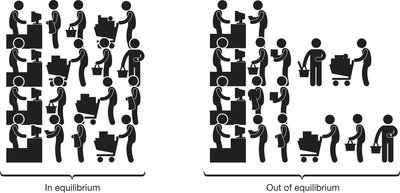
Equilibrium is a situation in which no individual would benefit by changing their behavior, given the choices of others. In equilibrium, everyone is optimizing, and there are no incentives to change.

The Free Rider Problem
The free rider problem occurs when individuals or groups enjoy the benefits of a situation without incurring the costs. This can prevent the group from reaching equilibrium.
To address free riders, groups must decide what is fair and apply pressure to encourage conformity.
Markets do not inherently provide mechanisms for fairness.
The Third Principle: Empiricism
Evidence-Based Economics
Empiricism refers to the use of data to test economic theories and determine if they match actual human behavior. Economists use evidence-based analysis to refine models and improve predictions.
Example: Observing that crowded beaches and hot temperatures go together does not mean that preventing people from going to the beach will make it cooler. Empirical analysis helps avoid such logical errors.
Is Economics Good for You?
Costs and Benefits of Studying Economics
Studying economics involves weighing the costs (tuition, time, stress) against the benefits (graduation, knowledge, higher earnings potential, and learning to think like an economist).
Summary Table: Examples of Economic Agents
Individual | Group |
|---|---|
Consumer, Boss, Kid, Parent, Pitcher, Thief | Family, Political Party, Firm |
Economic agent: Individual or group that makes choices.
Key Terms and Concepts
Scarcity: Unlimited wants in a world of limited resources.
Optimization: Choosing the best feasible option.
Equilibrium: No agent can improve their outcome by changing behavior.
Empiricism: Using data to test and refine economic theories.
Opportunity Cost: The value of the next best alternative forgone.
Positive Economics: Describes what is.
Normative Economics: Prescribes what ought to be.
