 Indietro
Chapter 3: Optimization – Doing the Best You Can
Guida di studio - Note intelligenti
 Appunti personalizzati basati sui tuoi materiali, ampliati con definizioni chiave, esempi e contesto.
Optimization: Trying to Choose the Best Feasible Option
Introduction to Optimization
Optimization is a central concept in microeconomics, describing how economic agents (individuals, firms, or governments) make choices to achieve the best possible outcome given their constraints. This process involves comparing the costs and benefits of different options and selecting the one that maximizes net benefit.
Optimization means picking the most preferred option that fits within available resources (such as time and money).
Scarcity of resources leads to trade-offs, requiring careful analysis of alternatives.
Economists do not assume perfect optimization but that people attempt to optimize given their information and experience.
Behavioral economics studies when and why people deviate from optimal choices.

Key Methods of Optimization
Total Value Optimization: Calculate the total value (benefit minus cost) for each feasible option and choose the one with the highest net benefit.
Marginal Analysis: Evaluate the change in net benefit when moving from one option to another. Choose the option where moving further would decrease net benefit.
Both methods yield the same optimal choice.
Optimization Application: Renting the Optimal Apartment
Setting Up the Problem
Suppose you have accepted a new job in a city center and must choose among four apartments that differ only in location and rent. Apartments closer to the city center have higher rents but lower commuting times, while those farther away are cheaper but require longer commutes.

Calculating Total Costs
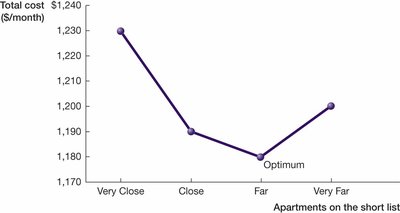
To optimize, translate all costs and benefits into a common unit (dollars per month). The main costs are rent and the opportunity cost of commuting time. Assume the opportunity cost of time is $10/hour.
Apartment | Commuting Time (hours/month) | Commuting Cost ($/month) | Rent ($/month) | Total Cost ($/month) |
|---|---|---|---|---|
Very Close | 5 | 50 | 1,180 | 1,230 |
Close | 10 | 100 | 1,090 | 1,190 |
Far | 15 | 150 | 1,030 | 1,180 |
Very Far | 20 | 200 | 1,000 | 1,200 |
Optimal Choice: The apartment with the lowest total cost is 'Far' ($1,180/month).
Effect of Changing Opportunity Cost
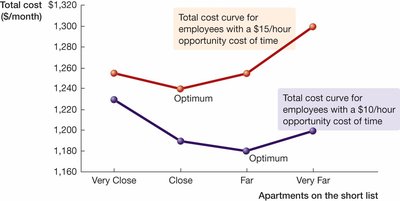
If your opportunity cost of time increases to $15/hour, recalculate commuting costs and total costs:
Apartment | Commuting Time (hours/month) | Commuting Cost ($/month) | Rent ($/month) | Total Cost ($/month) |
|---|---|---|---|---|
Very Close | 5 | 75 | 1,180 | 1,255 |
Close | 10 | 150 | 1,090 | 1,240 |
Far | 15 | 225 | 1,030 | 1,255 |
Very Far | 20 | 300 | 1,000 | 1,300 |
Optimal Choice: Now, 'Close' is the cheapest ($1,240/month).
Optimization Using Marginal Analysis
Marginal Analysis Explained
Marginal analysis breaks decisions into a series of 'yes' or 'no' questions: Should you do one more unit of an activity? Continue as long as the marginal benefit exceeds the marginal cost. The optimum is the last 'yes' before the first 'no'.
Marginal Benefit: Additional benefit from one more unit of activity.
Marginal Cost: Additional cost from one more unit of activity.
Marginal Net Benefit: Additional net benefit from one more unit.

Applying Marginal Analysis to Apartment Choice
Calculate the marginal cost of moving between apartment options. The optimum is where marginal total cost stops decreasing and starts increasing.
Apartment | Commuting Cost ($/month) | Marginal Commuting Cost ($/month) | Rental Cost ($/month) | Marginal Rental Cost ($/month) | Total Cost ($/month) | Marginal Total Cost ($/month) |
|---|---|---|---|---|---|---|
Very Close | 50 | 50 | 1,180 | -90 | 1,230 | -40 |
Close | 100 | 50 | 1,090 | -60 | 1,190 | -10 |
Far | 150 | 50 | 1,030 | -30 | 1,180 | 20 |
Very Far | 200 | 50 | 1,000 | 1,200 |
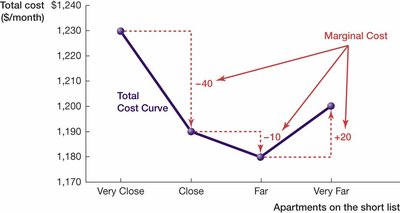
Conclusion: The optimal apartment is where marginal total cost is lowest before it starts to increase (in this case, 'Far').
Evidence-Based Economics: Location and Rent
How Location Affects Rental Costs
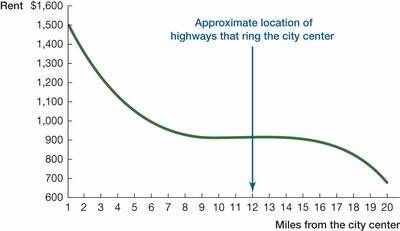
Empirical studies show that, in most cities, rental costs decrease as distance from the city center increases, holding apartment quality constant. For example, in Portland, Oregon, rents fall by 33% as you move 6 miles out from the city center.
Case Study: Boston's Red Line
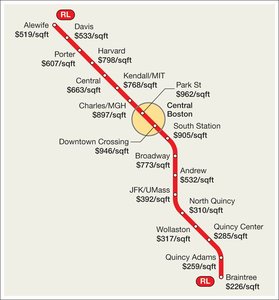
Rental prices per square foot vary by subway stop, with the highest prices at central locations (e.g., Park Street) and lower prices farther out.
Optimization Summary
Optimization is the process of choosing the best feasible option given constraints.
Total value and marginal analysis are two equivalent methods for finding the optimum.
Changes in opportunity cost or other constraints can shift the optimal choice.
Empirical evidence supports the economic prediction that location affects rental costs.
Practice Questions
A restaurant considers staying open an extra hour. Marginal cost is $200. If marginal revenue is $250, should it stay open? (Profit increases by $50.) What if marginal revenue is $100? (Profit decreases by $100.) What marginal revenue would make 9:00 p.m. the ideal closing time? (When marginal revenue equals marginal cost.)
Choosing an airport: Calculate total cost (including travel time valued at your wage) for each airport and select the one with the lowest total cost.
Road trip speed: Consider the trade-off between time saved (benefit) and increased fuel/accident risk (cost) when choosing optimal driving speed.
