 Indietro
Comparative Advantage and Trade: Microeconomics Study Notes
Guida di studio - Note intelligenti
 Appunti personalizzati basati sui tuoi materiali, ampliati con definizioni chiave, esempi e contesto.
Exchange & Trade
Introduction to Exchange
Exchange and trade are fundamental concepts in microeconomics, allowing individuals and nations to benefit from specialization and the movement of goods and services. The process of exchange enables participants to obtain goods they do not produce themselves, increasing overall welfare.
Benefit from Exchange: Both parties can gain from trade if each specializes in the production of goods for which they have a comparative advantage.
Mutual Gains: When two individuals or countries trade, both expect to gain.
Trade as a Means of Specialization
Trade allows for specialization, where each party focuses on producing goods in which they are most efficient. This increases total output and enables both parties to consume more than they could in isolation.
Specialization: Each party produces what they are best at.
Increased Output: Specialization and trade lead to higher overall production.
Comparative Advantage
Definition and Importance
Comparative advantage is the ability of a party to produce a good at a lower opportunity cost than another. It is the foundation for mutually beneficial trade, even when one party has an absolute advantage in all goods.
Opportunity Cost: The value of the next best alternative foregone when making a choice.
Absolute vs. Comparative Advantage: Absolute advantage refers to being able to produce more of a good with the same resources, while comparative advantage focuses on lower opportunity cost.
Examples and Applications
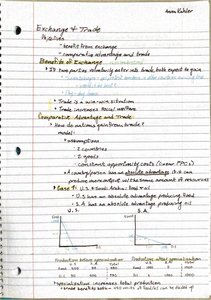
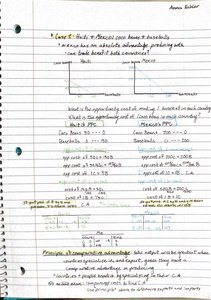
Consider two countries, the U.S. and Mexico, each producing wheat and autos. Even if the U.S. has an absolute advantage in both, trade can still be beneficial if each specializes according to comparative advantage.
Case 1: U.S. has an absolute advantage in both goods, but trade is still beneficial if Mexico has a lower opportunity cost in producing one of the goods.
Case 2: Both countries benefit from trade by specializing in the good for which they have a comparative advantage.
Principle of Comparative Advantage
How Comparative Advantage Drives Trade
The principle of comparative advantage states that each party should specialize in the production of goods for which they have the lowest opportunity cost. This maximizes total output and allows for gains from trade.
Trade Based on Comparative Advantage: Countries export goods in which they have a comparative advantage and import goods in which they do not.
Mutual Gains: Both parties can consume beyond their individual production possibilities.
Comparative Advantage & Trade: Example Calculations
Calculating Opportunity Costs
To determine comparative advantage, calculate the opportunity cost for each good in each country. The country with the lower opportunity cost for a good should specialize in its production.
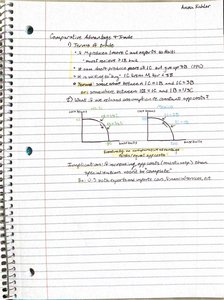
Example: If the U.S. can produce 10 autos or 20 tons of wheat, the opportunity cost of 1 auto is 2 tons of wheat. If Mexico can produce 5 autos or 15 tons of wheat, the opportunity cost of 1 auto is 3 tons of wheat. The U.S. has a comparative advantage in autos, and Mexico in wheat.
Implications for International Trade
Comparative advantage explains why countries trade and how they benefit from it. By specializing and trading, countries can achieve higher levels of consumption and economic welfare.
Key Takeaway: Comparative advantage, not absolute advantage, determines the pattern of trade.
Formula: Opportunity cost of Good A = (Units of Good B foregone) / (Units of Good A produced)
Additional info: These notes cover the core microeconomic concepts of comparative advantage, specialization, and gains from trade, which are essential for understanding international trade and market efficiency.
