 Indietro
Consumer Choice: Maximizing Utility Subject to Income Constraints
Guida di studio - Note intelligenti
 Appunti personalizzati basati sui tuoi materiali, ampliati con definizioni chiave, esempi e contesto.
Consumer Choice: Maximizing Utility Subject to Income Constraints
Overview
This unit explores how consumers maximize their utility given budget constraints, focusing on three types of preferences: standard convex preferences, perfect substitutes, and perfect complements. The analysis combines utility theory and budget constraints to derive optimal consumption bundles and introduces generalized demand functions for efficient problem-solving.
Optimal Consumption Choices for Three Types of Preferences
Standard Preferences (e.g., Cobb-Douglas Utility)
Consumers with standard convex preferences maximize utility by equating the marginal rate of substitution (MRS) to the price ratio. The Cobb-Douglas utility function is a common example:
Utility Function: , where ,
Budget Constraint:
Solution Steps:
Set the slope of the indifference curve equal to the slope of the budget constraint:
Plug the relationship equation into the budget constraint and solve for one variable.
Substitute back to find the other variable.
Economic Intuition: At the optimal point, the marginal benefit per dollar spent is equalized across all goods.
Graphical Representation: The optimal bundle is where the highest attainable indifference curve is tangent to the budget line.
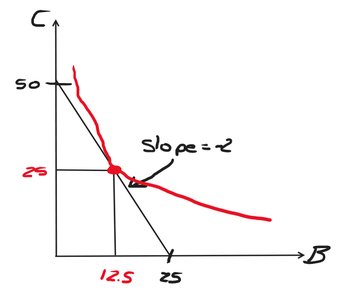
Example: Carter's Utility Maximization
Utility Function:
Budget Constraint:
Optimal Consumption: , ,
Graph Interpretation: The optimal bundle is at the tangency point, with the slope of the indifference curve equal to the slope of the budget constraint ().
Perfect Substitutes
With perfect substitutes, the utility function is linear, and consumers typically choose a corner solution—consuming only the good with the highest marginal utility per dollar spent.
Utility Function:
Budget Constraint:
Solution Method:
If , consume only .
If , consume only .
If equal, any combination on the budget line is optimal.
Economic Intuition: The consumer allocates all income to the good with the highest utility per dollar.
Example: Ida's Candy Choices
Utility Function:
Budget Constraint:
Optimal Consumption: Since and , Ida buys only M&Ms: , .
Perfect Complements (Leontief Preferences)
For perfect complements, consumers always consume goods in fixed proportions, as specified by the utility function. The indifference curves are right angles, and the optimal bundle is determined by the minimum function.
Utility Function:
Budget Constraint:
Solution Steps:
Set the arguments of the minimum function equal:
Plug into the budget constraint and solve for and .
Economic Intuition: Consuming more of one good without the other does not increase utility.
x | y | U | Expenditure |
|---|---|---|---|
1 | 2 | 2 | 3 |
1 | 5 | 2 | 6 |
1 | 10 | 2 | 11 |
1 | 20 | 2 | 21 |
5 | 2 | 2 | 7 |
10 | 2 | 2 | 12 |
40 | 2 | 2 | 42 |
Additional info: Table illustrates that utility does not increase unless goods are consumed in the fixed ratio.
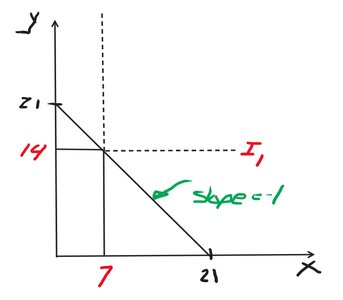
Example: Leontief Utility
Utility Function:
Budget Constraint:
Optimal Consumption: , ,
Generalized Demand Functions
Standard Convex Preferences (Cobb-Douglas)
For Cobb-Douglas preferences, the generalized demand functions are:
where and is income. These formulas allow quick calculation of optimal demands as functions of prices, income, and preference parameters.
Perfect Complements
For perfect complements, the generalized demand functions are:
These formulas show that optimal consumption is positively related to income and negatively related to both prices.
Summary Table: Comparison of Preferences
Preference Type | Utility Function | Optimal Consumption Rule |
|---|---|---|
Standard (Cobb-Douglas) | Equalize and | |
Perfect Substitutes | Corner solution: all of one good | |
Perfect Complements | Consume in fixed proportions |
