 Indietro
Elasticity in Microeconomics: Concepts, Calculation, and Applications
Guida di studio - Note intelligenti
 Appunti personalizzati basati sui tuoi materiali, ampliati con definizioni chiave, esempi e contesto.
Elasticity
Introduction to Elasticity
Elasticity is a fundamental concept in microeconomics used to quantify how one variable responds to changes in another. It is especially important for understanding how price changes affect consumer and producer behavior in markets. Economists use elasticity to measure the responsiveness of quantity demanded or supplied to changes in price, income, or the price of related goods.
Price Elasticity of Demand
Definition and Basic Formula
Price elasticity of demand is the ratio of the percentage change in quantity demanded to the percentage change in price. It measures how sensitive consumers are to price changes.
Formula:
Elasticity is typically negative due to the downward slope of the demand curve, but is often discussed in absolute value.
Slope vs. Elasticity
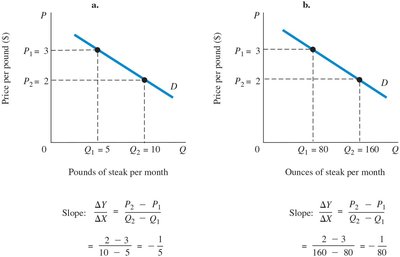
The slope of the demand curve is not a reliable measure of responsiveness because changing the unit of measurement alters the numerical value of the slope, even if buyer behavior remains unchanged.
Types of Elasticity
Perfectly Inelastic and Perfectly Elastic Demand
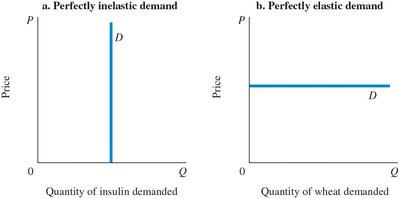
There are two extreme cases of elasticity:
Perfectly inelastic demand: Quantity demanded does not change at all when price changes. Elasticity is zero.
Perfectly elastic demand: Quantity demanded drops to zero with any increase in price. Elasticity is infinite.
Elastic, Inelastic, and Unitary Elasticity
Elastic demand: The percentage change in quantity demanded is greater than the percentage change in price (absolute value > 1).
Inelastic demand: The percentage change in quantity demanded is less than the percentage change in price (absolute value between 0 and 1).
Unitary elasticity: The percentage change in quantity demanded equals the percentage change in price (absolute value = 1).
Calculating Elasticities
Percentage Change Calculation
Percentage changes are calculated using the initial value as the base:
The Midpoint Formula
The midpoint formula provides a more precise calculation by using the average of the initial and final values as the base:
(for quantity), (for price)
Point Elasticity
Point elasticity uses calculus to measure elasticity at a specific point on the demand curve:
Alternatively,
Elasticity Changes Along a Straight-Line Demand Curve
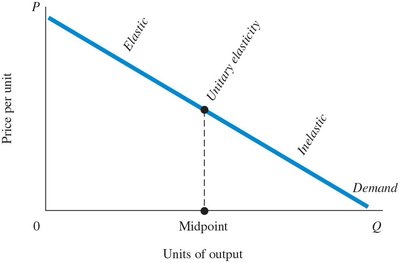
Elasticity varies along a linear demand curve, being more elastic at higher prices and less elastic at lower prices. The midpoint marks unitary elasticity.
Elasticity and Total Revenue
Relationship Between Price, Quantity, and Total Revenue
Total revenue (TR) is the product of price and quantity sold:
When price increases, quantity demanded usually decreases, and vice versa.
The effect of price changes on total revenue depends on the elasticity of demand:
If demand is inelastic, a price increase raises total revenue.
If demand is elastic, a price increase lowers total revenue.
If demand is elastic, a price cut increases total revenue.
If demand is inelastic, a price cut decreases total revenue.
The Determinants of Demand Elasticity
Key Factors Affecting Elasticity
Availability of substitutes: More substitutes make demand more elastic.
Budget share: Goods that are a small part of the budget tend to have inelastic demand.
Luxuries vs. necessities: Luxuries are more elastic; necessities are more inelastic.
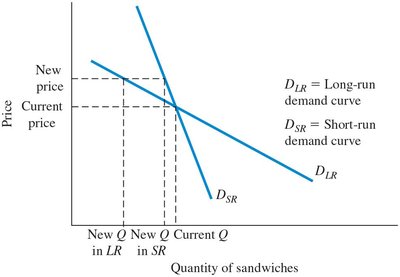
Time horizon: Demand is more elastic in the long run as consumers adjust and substitutes emerge.
Other Important Elasticities
Income Elasticity of Demand
Income elasticity of demand measures how quantity demanded responds to changes in consumer income:
Normal goods have positive income elasticity; inferior goods have negative income elasticity.
Cross-Price Elasticity of Demand
Cross-price elasticity of demand measures how the quantity demanded of one good responds to changes in the price of another good:
Substitutes have positive cross-price elasticity; complements have negative cross-price elasticity.
Elasticity of Supply
Elasticity of supply measures how quantity supplied responds to changes in price:
Elasticity of labor supply measures the response of labor supplied to changes in wage rate.
Elasticity and Taxation
Excise Taxes and Market Equilibrium
An excise tax is a per-unit tax on a specific good. The effect of such a tax depends on the elasticity of demand and supply. When a tax is imposed, the supply curve shifts upward by the amount of the tax, resulting in a new equilibrium price and quantity.
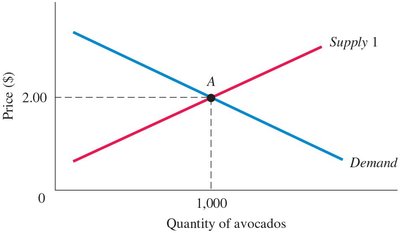
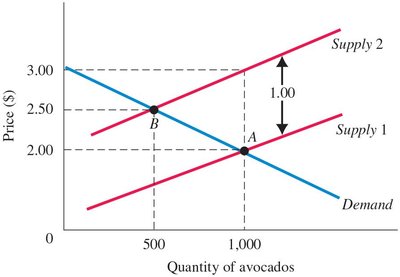
After a $1.00 tax per avocado, the equilibrium quantity falls and the price rises, but the full tax is not necessarily passed on to consumers.
The division of the tax burden depends on the relative elasticities of demand and supply.
