 Indietro
Elasticity: Measuring Responsiveness in Microeconomics
Guida di studio - Note intelligenti
 Appunti personalizzati basati sui tuoi materiali, ampliati con definizioni chiave, esempi e contesto.
Elasticity in Microeconomics
Introduction to Elasticity
Elasticity is a fundamental concept in microeconomics that measures how much the quantity demanded or supplied of a good responds to changes in price, income, or the price of related goods. Understanding elasticity helps businesses and policymakers predict consumer behavior and make informed decisions about pricing, taxation, and production.
Price Elasticity of Demand
Definition and Calculation
Price elasticity of demand quantifies the responsiveness of the quantity demanded of a good to a change in its price. It is calculated as:
Formula:
For example, if a 2% increase in price leads to a 0.02% decrease in quantity demanded, the elasticity is 0.02.
Types of Price Elasticity of Demand
Inelastic Demand: Elasticity < 1. Quantity demanded changes little when price changes. Example: Insulin for diabetics, where consumers have low willingness to shop elsewhere.
Elastic Demand: Elasticity > 1. Quantity demanded changes significantly with price changes. Example: Blue earbuds, where consumers can easily switch brands.
Example: The demand for insulin is inelastic, while the demand for earbuds is elastic.


Extreme Cases of Elasticity
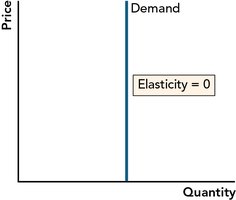
Perfectly Inelastic Demand: Elasticity = 0. Quantity demanded does not change regardless of price. The demand curve is vertical.
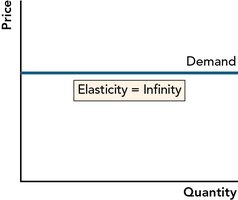
Perfectly Elastic Demand: Elasticity = ∞. Any price increase causes quantity demanded to drop to zero. The demand curve is horizontal.
Determinants of Price Elasticity of Demand
Availability of Substitutes: More substitutes make demand more elastic.
Time to Adjust: Demand is more elastic over longer time periods.
Proportion of Income: Goods that take up a larger share of income tend to have more elastic demand.
Elasticity and Total Revenue
Relationship Between Elasticity and Total Revenue
Total revenue is the total amount received from sales, calculated as price per unit multiplied by quantity sold (). The effect of price changes on total revenue depends on the elasticity of demand:
For elastic demand (elasticity > 1), lowering price increases total revenue.
For inelastic demand (elasticity < 1), raising price increases total revenue.
Example: Movie theaters charge high prices for popcorn because the demand for refreshments is inelastic within the theater setting, maximizing total revenue.

Elasticity Along the Demand Curve
Elasticity is not constant along a straight-line demand curve. As you move down the curve:
Elasticity decreases from elastic to unit elastic to inelastic.
Total revenue increases, reaches a maximum at unit elasticity (elasticity = 1), then decreases.

Price Elasticity of Supply
Definition and Calculation
Price elasticity of supply measures how much the quantity supplied of a good responds to a change in its price. It is calculated as:
Formula:
Types of Price Elasticity of Supply
Inelastic Supply: Elasticity < 1. Quantity supplied changes little when price changes. Example: Gold mining, where increasing production is difficult and expensive.
Elastic Supply: Elasticity > 1. Quantity supplied changes significantly with price changes. Example: Snow-shoveling services, where production can be increased easily.
Extreme Cases of Elasticity of Supply
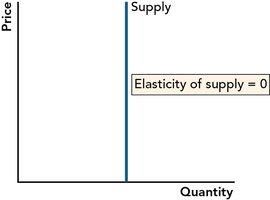
Perfectly Inelastic Supply: Elasticity = 0. Quantity supplied does not change regardless of price. The supply curve is vertical.
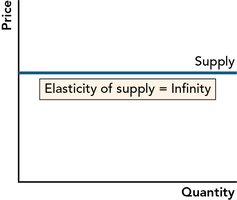
Perfectly Elastic Supply: Elasticity = ∞. Any price decrease causes quantity supplied to drop to zero. The supply curve is horizontal.
Determinants of Price Elasticity of Supply
Availability of Additional Inputs: More available inputs make supply more elastic.
Time to Adjust: Supply is more elastic when producers have more time to adjust production.
Other Elasticities of Demand
Cross Elasticity of Demand
Cross elasticity of demand measures the responsiveness of the demand for one good to a change in the price of another good. It is calculated as:
Formula:
For substitutes, cross elasticity is positive. The larger the number, the closer the goods are as substitutes.
For complements, cross elasticity is negative. The larger the absolute value, the closer the goods are as complements.


Income Elasticity of Demand
Income elasticity of demand measures the responsiveness of demand to changes in consumer income. It is calculated as:
Formula:
For normal goods, income elasticity is positive. Demand increases as income rises.
For inferior goods, income elasticity is negative. Demand decreases as income rises.
Income inelastic demand: Elasticity between 0 and 1, typical for necessities.
Income elastic demand: Elasticity greater than 1, typical for luxuries.
Tax Incidence and Government Policy
Tax Incidence
Tax incidence refers to how the burden of a tax is divided between buyers and sellers. The division depends on the relative elasticities of demand and supply:
The more inelastic the demand, the greater the tax burden on buyers.
The more inelastic the supply, the greater the tax burden on sellers.
Governments often tax goods with inelastic demand or supply to maximize revenue.
Summary Table: Types of Elasticity
Elasticity Type | Definition | Formula | Interpretation |
|---|---|---|---|
Price Elasticity of Demand | Responsiveness of quantity demanded to price change | >1: Elastic, <1: Inelastic, =1: Unit elastic | |
Price Elasticity of Supply | Responsiveness of quantity supplied to price change | >1: Elastic, <1: Inelastic, =1: Unit elastic | |
Cross Elasticity of Demand | Responsiveness of demand for one good to price change of another | + for substitutes, - for complements | |
Income Elasticity of Demand | Responsiveness of demand to income change | + for normal goods, - for inferior goods |
