 Indietro
Microeconomics Multiple Choice Study Guide with Step-by-Step Guidance
Guida di studio - Note intelligenti
 Appunti personalizzati basati sui tuoi materiali, ampliati con definizioni chiave, esempi e contesto.
Q1. If Sam is producing at a point on his production possibilities frontier, then he:
Background
Topic: Production Possibilities Frontier (PPF)
This question tests your understanding of opportunity cost and efficiency when producing on the PPF.
Key Terms:
Production Possibilities Frontier (PPF): A curve showing the maximum attainable combinations of two products that may be produced with available resources and technology.
Opportunity Cost: The value of the next best alternative forgone when making a choice.
Efficiency: Producing on the PPF means resources are fully and efficiently utilized.
Step-by-Step Guidance
Recall that any point on the PPF represents efficient production—resources are fully used.
Consider what happens if you want to increase the production of one good while staying on the PPF.
Think about the concept of opportunity cost: what must be given up to produce more of one good?
Eliminate options that suggest inefficiency or unattainable points.
Try solving on your own before revealing the answer!
Final Answer: B) can increase the production of one good only by sacrificing the production of other good.
On the PPF, increasing production of one good requires reducing production of the other due to limited resources—this is the essence of opportunity cost and efficiency.
Q2. In Figure 1, when 2,000 bicycles are produced each month:
Background
Topic: Marginal Cost, Marginal Benefit, and Efficiency
This question asks you to interpret a graph showing marginal cost and marginal benefit to determine efficiency at a given output level.
Key Terms and Concepts:
Marginal Benefit (MB): The additional benefit received from producing one more unit of a good.
Marginal Cost (MC): The additional cost incurred from producing one more unit of a good.
Efficiency: Achieved when MB = MC.
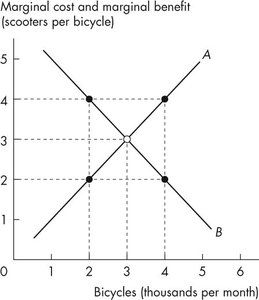
Step-by-Step Guidance
Locate the quantity of 2,000 bicycles (which is 2 on the x-axis, since the units are in thousands).
Find the corresponding points for marginal cost and marginal benefit at this quantity on the graph.
Compare the values of marginal benefit and marginal cost at this output level.
Recall that efficiency occurs where marginal benefit equals marginal cost.
Try solving on your own before revealing the answer!
Final Answer: B) the marginal benefit of the 2,000th bicycle is greater than the marginal cost of the 2,000th bicycle.
At 2,000 bicycles, the marginal benefit curve is above the marginal cost curve, indicating MB > MC. This means producing more bicycles would increase efficiency until MB = MC.
Q3. For which one of the following is demand likely to be most price elastic?
Background
Topic: Price Elasticity of Demand
This question tests your understanding of what makes demand more or less sensitive to price changes.
Key Terms:
Price Elasticity of Demand: A measure of how much quantity demanded of a good responds to a change in price.
Elastic Demand: Quantity demanded changes significantly with price changes (elasticity > 1).
Inelastic Demand: Quantity demanded changes little with price changes (elasticity < 1).
Step-by-Step Guidance
Recall that goods with many substitutes or that are luxuries tend to have more elastic demand.
Consider which of the options is a luxury or has many substitutes.
Think about which goods are necessities (less elastic) versus luxuries (more elastic).
Eliminate options that are basic necessities.
Try solving on your own before revealing the answer!
Final Answer: D) exotic vacations
Exotic vacations are a luxury with many substitutes, so their demand is most price elastic compared to necessities like bread or milk.
Q4. If Mr. Brown's income increases by 12 percent and his quantity demanded of bus rides decreases by 24 percent, what is the income elasticity of demand for bus rides?
Background
Topic: Income Elasticity of Demand
This question tests your ability to calculate and interpret income elasticity of demand.
Key Formula:
Step-by-Step Guidance
Identify the percentage change in quantity demanded (-24%) and the percentage change in income (+12%).
Set up the formula for income elasticity of demand using these values.
Remember to keep the sign (negative or positive) for each value.
Divide the percentage change in quantity demanded by the percentage change in income.
Try solving on your own before revealing the answer!
Final Answer: C) -2
The negative sign indicates bus rides are an inferior good for Mr. Brown (demand falls as income rises).
Q6. The price of a good will rise if:
Background
Topic: Market Equilibrium, Surplus, and Shortage
This question tests your understanding of how market forces affect price changes.
Key Terms:
Surplus: When quantity supplied exceeds quantity demanded at a given price.
Shortage: When quantity demanded exceeds quantity supplied at a given price.
Equilibrium Price: The price at which quantity demanded equals quantity supplied.
Step-by-Step Guidance
Recall what happens to price when there is a shortage in the market.
Think about the effect of increased supply or decreased demand on price.
Eliminate options that would cause price to fall, not rise.
Focus on the option that describes a situation where demand exceeds supply.
Try solving on your own before revealing the answer!
Final Answer: D) there is a shortage of the good.
When there is a shortage, buyers compete for the limited supply, causing the price to rise until equilibrium is restored.
Q8. Which of the following is a microeconomic topic?
Background
Topic: Microeconomics vs. Macroeconomics
This question tests your ability to distinguish between microeconomic and macroeconomic topics.
Key Terms:
Microeconomics: The study of individual markets, firms, and consumers.
Macroeconomics: The study of the economy as a whole (e.g., inflation, unemployment, GDP).
Step-by-Step Guidance
Identify which options focus on individual choices or markets.
Eliminate options that discuss aggregate or national-level phenomena.
Look for the option that describes the behavior of a single consumer or firm.
Try solving on your own before revealing the answer!
Final Answer: E) the reasons why a consumer buys less honey
This is a microeconomic topic because it focuses on the decision-making of an individual consumer.
Q9. Refer to Table 1. Suppose the cost of production rises and supply decreases by 100 units at each price. The new equilibrium price is $________.
Background
Topic: Shifts in Supply and Market Equilibrium
This question tests your ability to analyze how a decrease in supply affects equilibrium price and quantity using a supply and demand table.
Key Steps:
Identify the original equilibrium where quantity demanded equals quantity supplied.
Adjust the supply schedule by subtracting 100 units from quantity supplied at each price.
Find the new price where the adjusted quantity supplied equals quantity demanded.
Step-by-Step Guidance
Locate the original equilibrium in the table (where Qd = Qs).
Subtract 100 from each quantity supplied value to get the new supply schedule.
Compare the new supply values to the quantity demanded at each price.
Find the price where the new quantity supplied equals the quantity demanded.
Try solving on your own before revealing the answer!
Final Answer: E) 80
After adjusting the supply, the new equilibrium occurs at $80, where the new quantity supplied matches the quantity demanded.
Q12. The cost of producing aspirin increases at the same time as doctors discover that taking one aspirin per day reduces the risk of heart attacks. As a result, the:
Background
Topic: Simultaneous Shifts in Supply and Demand
This question tests your understanding of how simultaneous changes in supply and demand affect equilibrium price and quantity.
Key Concepts:
Increase in Cost of Production: Shifts supply curve left (decreases supply).
Positive Health News: Shifts demand curve right (increases demand).
Equilibrium Effects: Both price and quantity may change; direction depends on magnitude of shifts.
Step-by-Step Guidance
Think about how an increase in production cost affects the supply curve.
Consider how positive health information affects the demand curve.
Recall what happens to equilibrium price and quantity when both curves shift.
Eliminate options that do not match the expected direction of both shifts.
Try solving on your own before revealing the answer!
Final Answer: B) supply of aspirin decreases and the demand for aspirin increases.
Supply decreases due to higher costs, and demand increases due to new health benefits.
Q13. The most anyone is willing to pay for another purse is $30. Currently the price of a purse is $40, and the cost of producing another purse is $50. The marginal benefit of a purse is:
Background
Topic: Marginal Benefit and Marginal Cost
This question tests your understanding of marginal benefit, which is the maximum amount a consumer is willing to pay for an additional unit.
Key Terms:
Marginal Benefit: The maximum price a consumer is willing to pay for one more unit of a good.
Marginal Cost: The cost of producing one more unit of a good.
Step-by-Step Guidance
Identify the value representing the maximum willingness to pay for another purse.
Distinguish between the price, marginal cost, and marginal benefit in the scenario.
Recall that marginal benefit is not the market price or the cost of production, but the highest amount someone would pay.
Match this value to the correct answer choice.
Try solving on your own before revealing the answer!
Final Answer: B) $30
The marginal benefit is the maximum amount anyone is willing to pay for another purse, which is $30 in this scenario.
Q11. X has an absolute advantage in producing administrative services when she:
Background
Topic: Absolute Advantage
This question tests your understanding of the definition of absolute advantage in production.
Key Terms:
Absolute Advantage: The ability to produce more of a good or service with the same amount of resources than others.
Comparative Advantage: The ability to produce a good at a lower opportunity cost than others.
Step-by-Step Guidance
Recall the definition of absolute advantage (focus on total output, not opportunity cost).
Eliminate options that refer to opportunity cost or comparative advantage.
Look for the option that describes producing more with the same resources.
Match this to the correct answer choice.
Try solving on your own before revealing the answer!
Final Answer: D) can produce more administrative services than anyone else, using the same quantity of inputs.
Absolute advantage is about producing more output with the same resources, not about lower opportunity cost.
