 Indietro
Microeconomics Review: Study Guidance and Practice
Guida di studio - Note intelligenti
 Appunti personalizzati basati sui tuoi materiali, ampliati con definizioni chiave, esempi e contesto.
Q1. Define the following terms: Scarcity, Land, Labor, Capital, Entrepreneurship.
Background
Topic: Factors of Production & Basic Economic Concepts
This question tests your understanding of the fundamental resources used in economics and the concept of scarcity.
Key Terms:
Scarcity: The limited nature of resources.
Land: Natural resources used in production.
Labor: Human effort used in production.
Capital: Tools, machinery, and buildings used to produce goods and services.
Entrepreneurship: The initiative to combine resources and create goods/services.
Step-by-Step Guidance
Start by identifying what each term means in the context of economics.
Think about examples for each factor of production (e.g., land could be forests, labor could be factory workers).
Consider how scarcity affects the availability of these resources.
Reflect on how entrepreneurship differs from the other factors.
Try solving on your own before revealing the answer!
Final Answer:
Scarcity: The condition where unlimited wants exceed limited resources.
Land: All natural resources used to produce goods and services.
Labor: The effort people contribute to the production of goods and services.
Capital: Manufactured goods used to produce other goods and services.
Entrepreneurship: The ability to organize land, labor, and capital to create new products or businesses.
Q2. What is human capital?
Background
Topic: Factors of Production
This question is about the skills, knowledge, and experience possessed by individuals, which contribute to economic productivity.
Key Term:
Human Capital: The economic value of a worker's experience and skills.
Step-by-Step Guidance
Think about what makes workers more productive (education, training, skills).
Consider how investing in human capital can benefit an economy.
Reflect on examples of human capital in real life (e.g., a doctor’s medical training).
Try solving on your own before revealing the answer!
Final Answer:
Human capital refers to the skills, knowledge, and experience possessed by individuals, which can be used to create economic value.
Q3. What are the key qualities for each of the following economic systems: Command Economy and Market Economy?
Background
Topic: Economic Systems
This question tests your understanding of how different economies allocate resources and make decisions.
Key Terms:
Command Economy: An economy where the government makes all decisions.
Market Economy: An economy where decisions are made by individuals and businesses.
Step-by-Step Guidance
Identify who makes decisions in each system (government vs. individuals).
Think about how resources are allocated (central planning vs. supply and demand).
Consider examples of each system (e.g., North Korea for command, USA for market).
Try solving on your own before revealing the answer!
Final Answer:
Command Economy: Centralized decision-making, government ownership of resources, planned production.
Market Economy: Decentralized decision-making, private ownership, allocation by supply and demand.
Q4. What are private property rights in a market economy?
Background
Topic: Market Economy Characteristics
This question is about the importance of property rights in market economies.
Key Term:
Private Property Rights: The legal right to own and use property.
Step-by-Step Guidance
Think about why property rights are important for economic activity.
Consider how property rights encourage investment and innovation.
Reflect on the difference between private and public property.
Try solving on your own before revealing the answer!
Final Answer:
Private property rights allow individuals to own, use, and transfer property, which is essential for a functioning market economy.
Q5. Define explicit cost and implicit cost. What is opportunity cost?
Background
Topic: Costs and Opportunity Cost
This question tests your understanding of different types of costs and the concept of opportunity cost in decision-making.
Key Terms:
Explicit Cost: Direct, out-of-pocket expenses.
Implicit Cost: Indirect, non-monetary opportunity costs.
Opportunity Cost: The value of the next best alternative foregone.
Step-by-Step Guidance
Identify examples of explicit costs (e.g., tuition, rent).
Think about implicit costs (e.g., foregone wages).
Consider how opportunity cost combines both explicit and implicit costs.
Reflect on why opportunity cost is important in economic decision-making.
Try solving on your own before revealing the answer!
Final Answer:
Explicit Cost: Direct payments for resources (e.g., tuition).
Implicit Cost: The value of resources used without direct payment (e.g., foregone salary).
Opportunity Cost: The value of the next best alternative that is given up when making a choice.
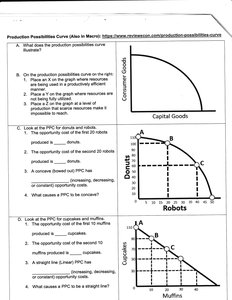
Q6. What does the production possibilities curve (PPC) illustrate?
Background
Topic: Production Possibilities Curve
This question is about understanding the PPC and what it shows about trade-offs and efficiency.
Key Terms:
Production Possibilities Curve (PPC): A graph showing the maximum possible output combinations of two goods.
Step-by-Step Guidance
Identify what the axes represent (usually two goods).
Think about what points on, inside, and outside the curve mean (efficiency, inefficiency, impossibility).
Consider how the curve shows opportunity cost and trade-offs.
Try solving on your own before revealing the answer!
Final Answer:
The PPC illustrates the trade-offs between two goods, showing the maximum combinations that can be produced with available resources and technology. It also demonstrates opportunity cost and efficiency.
