Indietro
Microeconomics Study Notes: Chapters 1 & 2 (Scarcity, Choices, Goods, and Demand)
Guida di studio - Note intelligenti
 Appunti personalizzati basati sui tuoi materiali, ampliati con definizioni chiave, esempi e contesto.
Scarcity and the Economic Problem
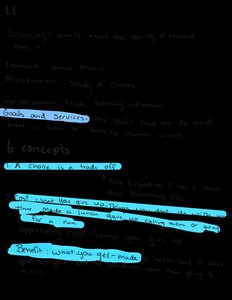
Scarcity
Scarcity refers to the fundamental economic problem of having limited resources to meet unlimited wants. Because resources are finite, individuals and societies must make choices about how to allocate them.
Scarcity: The condition where wants exceed the ability of resources to satisfy them.
Economics: The study of how societies manage scarce resources.
Microeconomics: The branch of economics that studies individual choices and market behavior.
Goods and Services
Goods and services are the products and actions that satisfy human wants. Goods are tangible items, while services are activities performed by others.
Goods: Physical items such as food, clothing, and cars.
Services: Actions like teaching, banking, or cleaning.
Key Economic Concepts
Trade-Offs and Choices
Every choice involves a trade-off, meaning that selecting one option requires giving up another. This is a central concept in economics.
Trade-Off: The idea that choosing one thing means losing another.
Opportunity Cost: The value of the next best alternative forgone when making a decision.
Benefit: What you gain from making a choice.
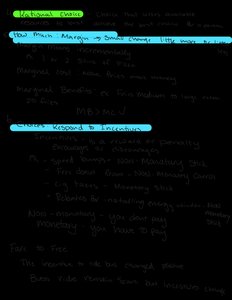
Rational Choice
Rational choice is the process of making decisions by comparing costs and benefits. Individuals aim to maximize their benefit while minimizing cost.
Rational Choice: Choosing the option that provides the greatest benefit for the lowest cost.
Marginal Cost: The additional cost of one more unit.
Marginal Benefit: The additional benefit from one more unit.
Responding to Incentives
Economic agents respond to incentives, which are rewards or penalties that influence behavior. Incentives can be monetary or non-monetary.
Incentive: Something that motivates a person to act.
Examples: Lower prices encourage buying; higher wages encourage working.
Economic Models
What Are Economic Models?
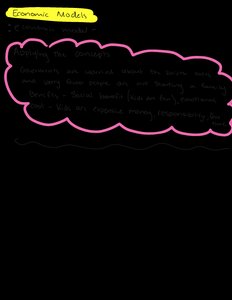
Economic models are simplified representations of reality used to analyze and predict economic behavior. They help economists understand complex systems by focusing on essential relationships.
Model: A theoretical framework for analyzing economic phenomena.
Application: Models are used to study how people and firms make decisions, such as maximizing benefits or minimizing costs.
What, How, and For Whom?
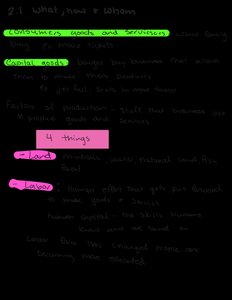
Consumers, Goods, and Services
Economics examines what goods and services are produced, how they are produced, and for whom they are produced. These questions are answered by analyzing the factors of production and the distribution of income.
Consumers: Individuals who buy goods and services.
Capital Goods: Goods used to produce other goods and services.
Factors of Production
Factors of production are the resources used to produce goods and services. They include land, labor, capital, and entrepreneurship.
Land: Natural resources used in production.
Labor: Human effort, including skills and abilities.
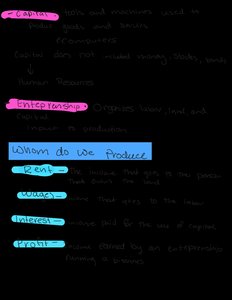
Capital: Tools, machines, and buildings used to produce goods and services.
Entrepreneurship: The organization and management of the other factors to create goods and services.
For Whom Do We Produce?
The distribution of goods and services depends on how income is distributed among individuals. Income is earned through rent, wages, interest, and profit.
Rent: Income earned from land.
Wages: Income earned from labor.
Interest: Income earned from capital.
Profit: Income earned by entrepreneurs.
Distribution of Income
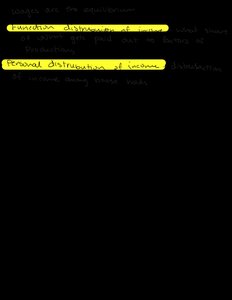
Income can be distributed functionally (by factor of production) or personally (among individuals).
Functional Distribution: How income is divided among land, labor, capital, and entrepreneurship.
Personal Distribution: How income is distributed among individuals or households.
Markets and Demand
Market and Competitive Market
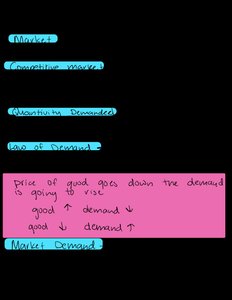
A market is a place where buyers and sellers interact to exchange goods and services. A competitive market has many buyers and sellers, so no single participant can influence the price.
Market: Any arrangement that allows buyers and sellers to exchange goods and services.
Competitive Market: A market with many buyers and sellers.
Quantity Demanded and Law of Demand
Quantity demanded is the amount of a good that buyers are willing and able to purchase at a specific price. The law of demand states that, all else equal, as the price of a good falls, the quantity demanded rises, and vice versa.
Quantity Demanded: The specific amount of a good buyers will purchase at a given price.
Law of Demand: As price decreases, demand increases; as price increases, demand decreases.
Example: If the price of apples falls, more people will buy apples. If the price rises, fewer people will buy apples.
Market Demand
Market demand is the total quantity demanded by all buyers in the market at each price.
Market Demand: The sum of individual demands for a good or service.
Change in Demand vs. Change in Quantity Demanded
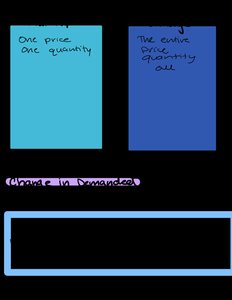
A change in quantity demanded refers to movement along the demand curve due to a price change. A change in demand refers to a shift of the entire demand curve, caused by factors other than price (e.g., income, preferences).
Change in Quantity Demanded: Movement along the demand curve (one price, one quantity).
Change in Demand: Shift of the entire demand curve (all prices, all quantities).
Change in Quantity Demanded: One price, one quantity.
Change in Demand: The entire price-quantity relationship shifts.
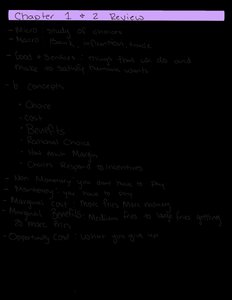
Chapter 1 & 2 Review
This section summarizes the main concepts from Chapters 1 and 2, including scarcity, goods and services, opportunity cost, rational choice, marginal analysis, and incentives.
Scarcity: Limited resources, unlimited wants.
Goods & Services: What we do and make to satisfy wants.
Choice: Every decision involves a trade-off.
Cost: What you give up.
Benefit: What you gain.
Rational Choice: Maximizing benefit, minimizing cost.
Marginal Cost & Benefit: Additional cost/benefit from one more unit.
Incentives: Rewards or penalties that influence choices.