 Indietro
Price Controls: Rent Ceilings and Minimum Wage in Microeconomics
Guida di studio - Note intelligenti
 Appunti personalizzati basati sui tuoi materiali, ampliati con definizioni chiave, esempi e contesto.
Price Controls in Microeconomics
Introduction to Price Controls
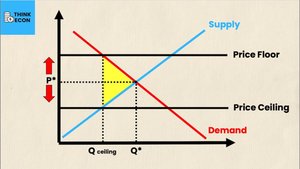
Price controls are government-imposed limits on the prices that can be charged for goods and services in a market. They are a direct contradiction to the laissez-faire principle advocated by Adam Smith, which suggests that markets should be free from government intervention. Price controls are typically implemented as either price ceilings (maximum allowable prices) or price floors (minimum allowable prices).
Price Ceilings
Rent Ceilings in the Housing Market
A price ceiling is a government regulation that makes it illegal to charge a price higher than a specified level. When applied to the housing market, it is known as a rent ceiling. The effects of a price ceiling depend on its relation to the equilibrium price:
Price ceiling above equilibrium: No effect, as market forces prevail.
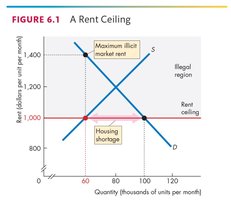
Price ceiling below equilibrium: Powerful effects, as it prevents the price from regulating the quantities demanded and supplied, leading to market frustration.
Effects of a Rent Ceiling Below Equilibrium
Housing Shortage: Occurs when quantity demanded exceeds quantity supplied.
Increased Search Activity: More time and resources are spent searching for housing. Opportunity cost includes both rent and search time:
Illegal Market: Develops when the equilibrium price exceeds the price ceiling. The strength of the illegal market depends on enforcement.
Inefficiency of Rent Ceilings
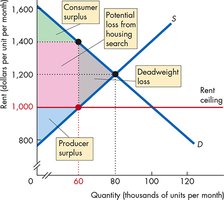
A rent ceiling set below equilibrium results in inefficient underproduction of housing services. Marginal social benefit exceeds marginal social cost, creating deadweight loss (DWL).
Reduced Consumer Surplus: (Green Area)
Reduced Producer Surplus: (Blue Area)
Deadweight Loss: (Grey Area)
Potential Loss from Housing Search: (Pink Area)
Fairness of Rent Ceilings
Rent ceilings raise questions of fairness, as allocation may occur through lotteries, first-come-first-served, or discrimination based on friendship, family ties, race, gender, etc.
Price Floors
Minimum Wage in the Labour Market
A price floor is a government regulation that makes it illegal to charge a price lower than a specified level. When applied to the labour market, it is known as the minimum wage. The effects of a price floor depend on its relation to the equilibrium price:
Price floor below equilibrium: No effect, as market forces prevail.
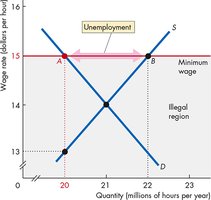
Price floor above equilibrium: Powerful effects, as it prevents the price from regulating the quantities demanded and supplied.
Effects of Minimum Wage Above Equilibrium
Excess Supply: Occurs when quantity supplied exceeds quantity demanded.
Unemployment: In the labour market, excess supply of labour is unemployment.
Inefficiency of Minimum Wage
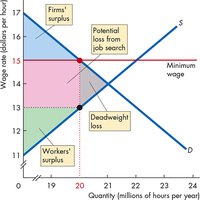
A minimum wage set above equilibrium results in fewer workers employed than the efficient quantity, creating deadweight loss (DWL) in the labour market.
Firm's Surplus: (Blue Area)
Worker's Surplus: (Green Area)
Deadweight Loss: (Grey Area)
Potential Loss from Job Search: (Pink Area)
Fairness of Minimum Wage
The minimum wage also raises questions of fairness, as it may affect different groups of workers unequally and lead to increased unemployment among low-skilled workers.
Type of Price Control | Market | Effect if Below Equilibrium | Effect if Above Equilibrium |
|---|---|---|---|
Price Ceiling | Housing (Rent Ceiling) | No effect | Shortage, search activity, illegal market, inefficiency |
Price Floor | Labour (Minimum Wage) | No effect | Surplus (unemployment), inefficiency |
Additional info: The notes expand on the effects of price controls, including the calculation of surpluses and deadweight loss, and the social implications of fairness in allocation.
