 Indietro
Tax Incidence and Elasticity: Microeconomics Study Notes
Guida di studio - Note intelligenti
 Appunti personalizzati basati sui tuoi materiali, ampliati con definizioni chiave, esempi e contesto.
Tax Incidence and Elasticity
Introduction
This section explores the effects of taxation on market participants, focusing on who bears the burden of a tax, how taxes affect supply and demand, and the role of elasticity in determining tax incidence. The concepts are central to understanding efficiency and welfare in microeconomic markets.
Tax Incidence
Tax incidence refers to the division of the tax burden between buyers and sellers. The proportion of the tax paid by each group depends on the elasticity of demand and supply.
Definition: Tax incidence is the study of who ultimately pays the tax—consumers or producers.
Key Point: The more inelastic a side of the market (demand or supply), the greater the tax burden it bears.
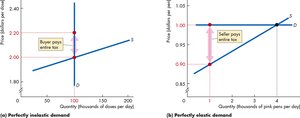
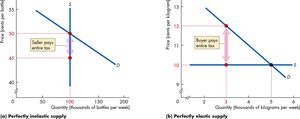
Example: If demand is perfectly inelastic, buyers pay the entire tax. If supply is perfectly inelastic, sellers pay the entire tax.
Equivalence of a Tax: Tax on Sellers vs. Tax on Buyers
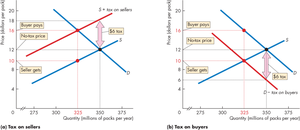
Taxes can be imposed on either sellers or buyers, but the economic outcome is similar. The supply or demand curve shifts depending on who is taxed.
Tax on Sellers: A tax on producers shifts the supply curve left/upward, reducing quantity supplied at each price.
Tax on Buyers: A tax on consumers shifts the demand curve left/downward, reducing quantity demanded at each price.
Tax Wedge
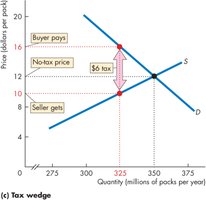
A tax wedge is the difference between the price buyers pay and the price sellers receive, created by the imposition of a tax. The size of the wedge equals the tax amount.
Formula:
Where: is the price paid by buyers, is the price received by sellers.
Example: If a $6 tax is imposed, buyers pay $6 more than sellers receive.
Tax and Market Efficiency
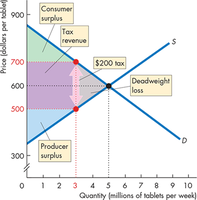
Taxes affect market efficiency by causing underproduction and reducing both consumer and producer surplus. Tax revenue is generated, but deadweight loss (DWL) occurs, representing lost welfare.
Marginal Social Benefit vs. Marginal Social Cost: Taxes make marginal social benefit exceed marginal social cost, leading to underproduction.
Consumer Surplus (CS):
Producer Surplus (PS):
Tax Revenue:
Deadweight Loss (DWL):
Tax Incidence and Elasticity of Demand
The elasticity of demand determines how the tax burden is shared between buyers and sellers.
Perfectly Inelastic Demand: Buyers pay 100% of the tax.
Perfectly Elastic Demand: Sellers pay 100% of the tax.
Inelastic Demand: Buyers pay a larger proportion of the tax.
Unit Elastic Demand: Tax is split equally between buyers and sellers.
Elastic Demand: Sellers pay a larger proportion of the tax.
Tax Incidence and Elasticity of Supply
The elasticity of supply also affects tax incidence.
Perfectly Inelastic Supply: Sellers pay 100% of the tax.
Perfectly Elastic Supply: Buyers pay 100% of the tax.
Inelastic Supply: Sellers pay a larger proportion of the tax.
Unit Elastic Supply: Tax is split equally between buyers and sellers.
Elastic Supply: Buyers pay a larger proportion of the tax.
Summary Table: Tax Incidence and Elasticity
Elasticity | Who Pays More of the Tax? |
|---|---|
Perfectly Inelastic Demand | Buyer |
Perfectly Elastic Demand | Seller |
Inelastic Demand | Buyer |
Elastic Demand | Seller |
Perfectly Inelastic Supply | Seller |
Perfectly Elastic Supply | Buyer |
Inelastic Supply | Seller |
Elastic Supply | Buyer |
Conclusion
Understanding tax incidence and elasticity is crucial for analyzing the effects of taxes on market outcomes, efficiency, and welfare. The burden of a tax depends on the relative elasticities of demand and supply, and taxes inevitably create deadweight loss, reducing total welfare in the market.
