 Indietro
The Economic Problem: Production Possibilities, Opportunity Cost, and Gains from Trade
Guida di studio - Note intelligenti
 Appunti personalizzati basati sui tuoi materiali, ampliati con definizioni chiave, esempi e contesto.
The Economic Problem
Introduction to the Production Possibilities Frontier (PPF)
The Production Possibilities Frontier (PPF) is a fundamental concept in microeconomics that illustrates the maximum combinations of two goods or services that can be produced with available resources and technology. The PPF helps us understand the concepts of scarcity, choice, and opportunity cost.
PPF Definition: The boundary between combinations of goods and services that can be produced and those that cannot.
Model Assumption: Focuses on two goods, holding all else constant (ceteris paribus).
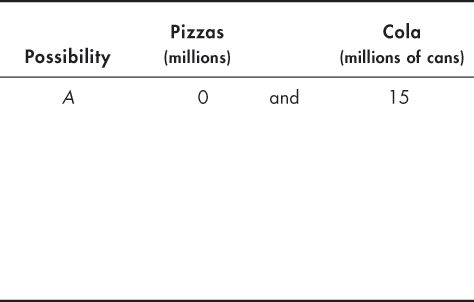
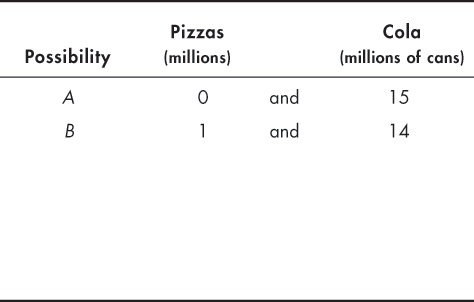
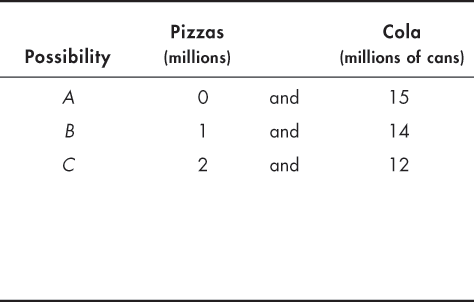
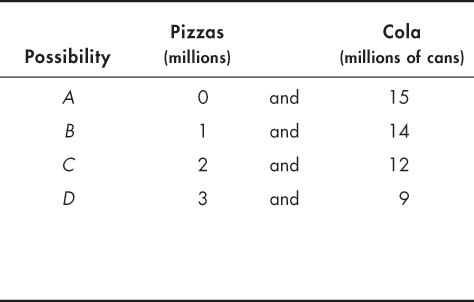
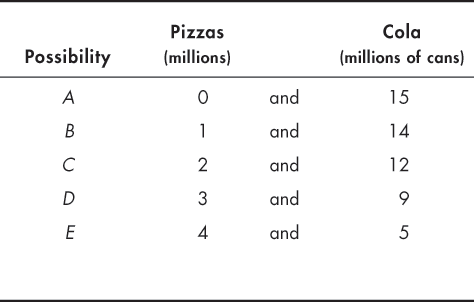
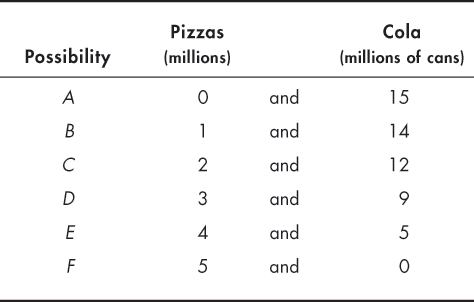
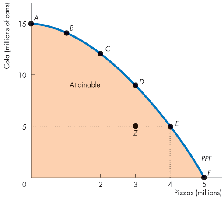
Attainable and Unattainable Points
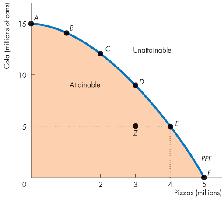
Points on or inside the PPF are attainable, while points outside are unattainable given current resources and technology.
Efficient Production: All points on the PPF are efficient; resources are fully utilized.
Inefficient Production: Points inside the PPF indicate underutilized or misallocated resources.
Production Efficiency
Production efficiency is achieved when it is impossible to produce more of one good without producing less of another. All points on the PPF are efficient, while points inside are inefficient.
Tradeoffs and Opportunity Cost
Every choice along the PPF involves a tradeoff. The opportunity cost of a good is the value of the next best alternative forgone to obtain it.
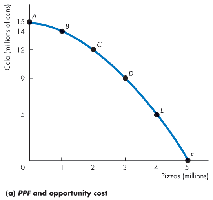
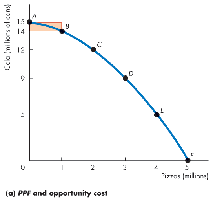
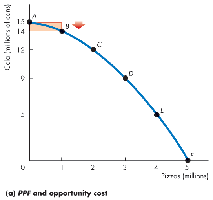
Moving along the PPF, producing more of one good requires sacrificing some of the other.
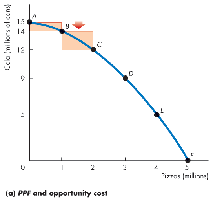
Opportunity cost is measured as a ratio: the amount of one good forgone to produce an additional unit of another.
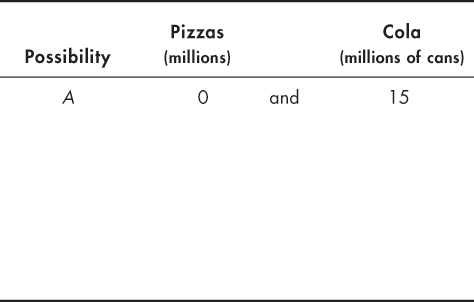
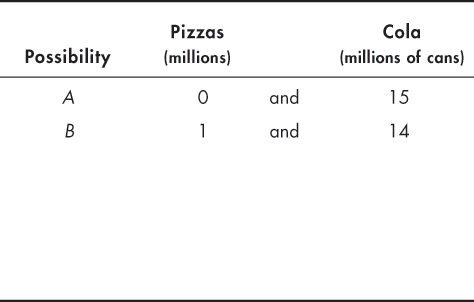
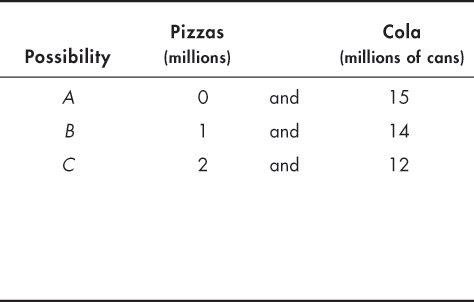
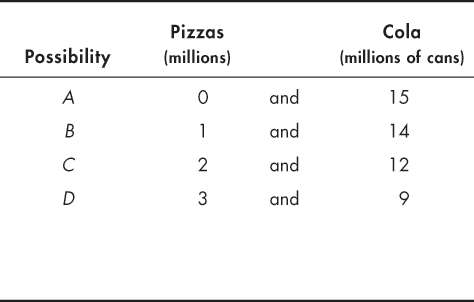
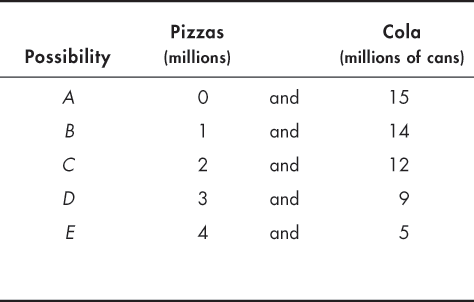
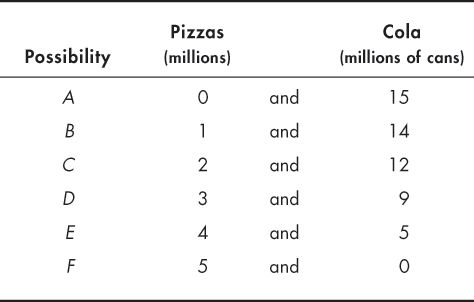
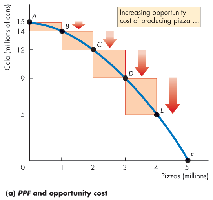
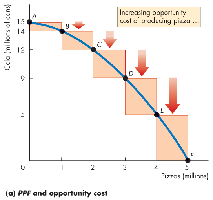
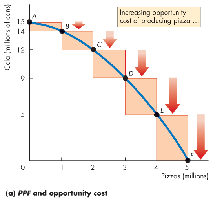
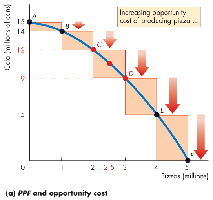
Increasing Opportunity Cost
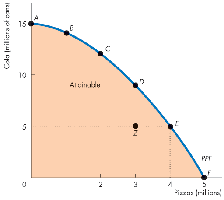
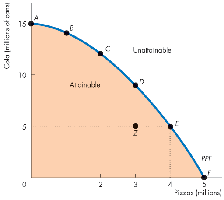
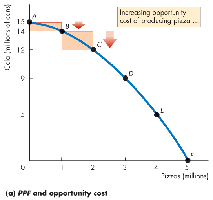
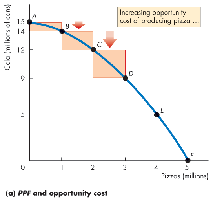
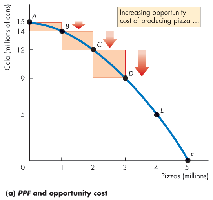
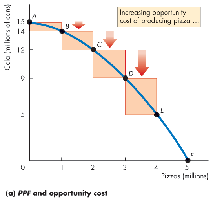
The PPF is typically bowed outward due to increasing opportunity cost: as more of one good is produced, the opportunity cost of producing additional units rises because resources are not equally efficient in all uses.
For example, as more pizzas are produced, increasingly less suitable resources must be used, raising the opportunity cost.
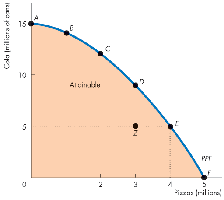
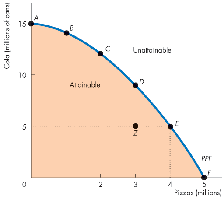
Marginal Cost and the PPF
The marginal cost of a good is the opportunity cost of producing one more unit of it. The PPF determines the marginal cost, which typically increases as production expands.
Marginal cost is represented by the slope of the PPF at any given point.
Preferences and Marginal Benefit
Preferences describe a person's likes and dislikes. The marginal benefit of a good is the benefit received from consuming one more unit, measured by the maximum amount a person is willing to pay for it. The marginal benefit curve shows the relationship between marginal benefit and quantity consumed.
Principle of decreasing marginal benefit: The more we have of a good, the less we are willing to pay for an additional unit.
Allocative Efficiency
Allocative efficiency is achieved when resources are used to produce the mix of goods and services most highly valued by society. This occurs at the point on the PPF where marginal benefit equals marginal cost.
At this point, the value placed on the last unit produced equals the cost of producing it.
Comparative and Absolute Advantage
Comparative advantage exists when a person can produce a good at a lower opportunity cost than another. Absolute advantage refers to higher productivity. Comparative advantage is the basis for specialization and trade.
Example: Joe and Liz operate smoothie bars. Joe's opportunity cost of a salad is lower than Liz's, so he has a comparative advantage in salads. Liz's opportunity cost of a smoothie is lower, so she has a comparative advantage in smoothies.
Gains from Trade
When individuals or nations specialize in the production of goods for which they have a comparative advantage and trade, both can achieve consumption levels outside their individual PPFs.
Example: After specializing and trading, both Joe and Liz can consume more smoothies and salads than they could without trade.
Economic Growth
Economic growth is the expansion of production possibilities, often resulting from technological change and capital accumulation. Economic growth shifts the PPF outward, allowing more of both goods to be produced in the future.
The opportunity cost of economic growth is less current consumption, as resources are diverted to investment in capital and technology.
Economic Coordination
To realize the gains from trade and specialization, economic decisions must be coordinated. Four key institutions facilitate this coordination:
Firms: Organize production and hire factors of production.
Markets: Enable buyers and sellers to exchange goods, services, and resources.
Property Rights: Define ownership and use of resources.
Money: Serves as a medium of exchange, facilitating trade.
Circular Flow Model
The circular flow model illustrates how households and firms interact in markets for goods, services, and factors of production. Goods and services flow in one direction, while money flows in the opposite direction.
Coordinating Decisions Through Markets
Markets coordinate individual decisions through price adjustments, ensuring that resources are allocated efficiently in response to changes in supply and demand.
