 Indietro
The Economic Problem: Scarcity, Choice, and Opportunity Cost
Guida di studio - Note intelligenti
 Appunti personalizzati basati sui tuoi materiali, ampliati con definizioni chiave, esempi e contesto.
The Economic Problem: Scarcity and Choice
Scarcity, Choice, and Opportunity Cost
Economics is fundamentally concerned with how societies allocate scarce resources to satisfy unlimited wants. The core economic problem is scarcity, which forces individuals and societies to make choices about what to produce, how to produce, and who receives the output. These choices are guided by opportunity cost, which is the value of the next best alternative forgone when a decision is made.
Scarcity: The condition that arises because resources are limited while wants are unlimited.
Choice: The act of selecting among alternatives due to scarcity.
Opportunity Cost: The value of the best alternative forgone in making any choice.
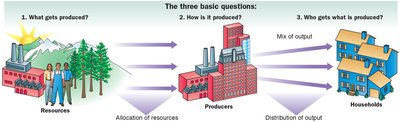
Key Economic Questions:
What gets produced?
How is it produced?
Who gets what is produced?
Factors of Production and Production
Definitions and Roles
Production involves transforming scarce resources into goods and services. The resources used in production are called factors of production, which include land, labor, capital, and entrepreneurship.
Capital: Goods produced to aid in further production (e.g., machinery, factories).
Factors of Production: Inputs used in the production process (land, labor, capital, entrepreneurship).
Inputs/Resources: Anything provided by nature or previous generations that can be used to satisfy human wants.
Outputs: Goods and services produced for consumption by households.
Scarcity and Choice in Different Economies
One-Person Economy
Even in a simple, one-person economy, choices must be made about what, how, and when to produce. The concept of opportunity cost is central, as every choice involves forgoing another option.
Economy of Two or More: Specialization, Exchange, and Comparative Advantage
When more than one person is involved, specialization and exchange can increase overall production. The theory of comparative advantage states that all parties can benefit from trade if they specialize in producing goods for which they have the lowest opportunity cost, even if one party is absolutely more efficient in all activities.
Absolute Advantage: The ability to produce more of a good with the same resources than another producer.
Comparative Advantage: The ability to produce a good at a lower opportunity cost than another producer.
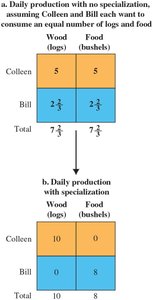
Example: Colleen and Bill can both produce wood and food. Without specialization, they split their time and produce less overall. With specialization, each focuses on the good for which they have a comparative advantage, increasing total output.
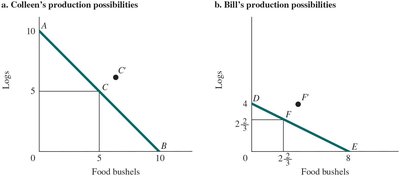
Specialization and trade allow both individuals to consume beyond their individual production possibilities.
The Production Possibility Frontier (PPF)
Definition and Interpretation
The Production Possibility Frontier (PPF) is a graph that shows all combinations of two goods that can be produced using all available resources efficiently. The PPF illustrates concepts such as opportunity cost, efficiency, and economic growth.
Opportunity Cost: Moving along the PPF shows the trade-off between the two goods; producing more of one requires sacrificing some of the other.
Marginal Rate of Transformation (MRT): The slope of the PPF, representing the opportunity cost of one good in terms of the other.
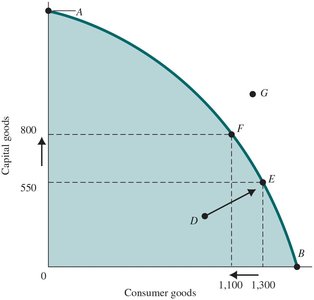
Example: Moving from point E to F on the PPF increases capital goods but decreases consumer goods, illustrating opportunity cost.
The Law of Increasing Opportunity Cost
As production of one good increases, the opportunity cost of producing additional units rises. This is reflected in the bowed-out shape of the PPF.
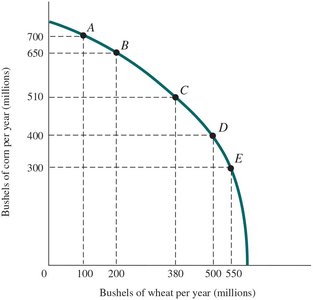
Example: In the production of corn and wheat, shifting resources from wheat to corn increases the opportunity cost per bushel of corn as more wheat is forgone for each additional unit of corn produced.
Production Possibility Schedule
The following table summarizes the production possibilities for corn and wheat in Ohio and Kansas:
Point on PPF | Total Corn Production (Millions of Bushels/Year) | Total Wheat Production (Millions of Bushels/Year) |
|---|---|---|
A | 700 | 100 |
B | 650 | 200 |
C | 510 | 380 |
D | 400 | 500 |
E | 300 | 550 |
Additional info: The table demonstrates increasing opportunity cost as more corn is produced and less wheat is available.
Economic Growth and Shifts in the PPF
Economic growth occurs when an economy's capacity to produce goods and services increases, shifting the PPF outward. Growth can result from acquiring more resources or improving technology.
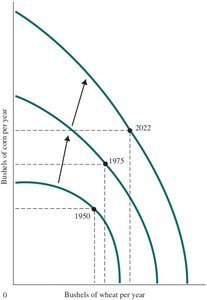
Example: Increases in productivity, especially in corn production, have shifted the U.S. PPF outward over time.
Productivity Trends Table
Period | Corn Yield per Acre (Bushels) | Wheat Yield per Acre (Bushels) |
|---|---|---|
1935–1939 | 26.1 | 13.2 |
1945–1949 | 36.1 | 16.9 |
1955–1959 | 48.7 | 22.3 |
1965–1969 | 78.5 | 27.5 |
1975–1979 | 95.3 | 31.3 |
1981–1985 | 107.2 | 36.9 |
1985–1990 | 112.8 | 38.9 |
1990–1995 | 120.6 | 38.1 |
1998 | 134.4 | 43.2 |
2001 | 138.2 | 43.5 |
2006 | 145.6 | 42.3 |
2007 | 152.8 | 40.6 |
2008 | 153.9 | 44.9 |
2009 | 164.9 | 44.3 |
2010 | 152.8 | 46.4 |
2011 | 147.2 | 43.7 |
2012 | 123.4 | 46.3 |
2013 | 158.8 | 47.2 |
2014 | 171.0 | 43.7 |
2015 | 168.4 | 43.6 |
2016 | 174.6 | 55.3 |
2017 | 176.6 | 50.2 |
2018 | 176.4 | 47.9 |
2019 | 167.6 | 53.6 |
2020 | 172.0 | 50.9 |
2021 | 177.0 | 50.2 |
2022 | 178.4 | 48.0 |
Additional info: The table shows significant increases in productivity, especially for corn, over the decades.
Economic Systems and the Role of Government
Types of Economic Systems
Societies use different systems to answer the three basic economic questions. The two main types are command economies and laissez-faire (free market) economies, but in practice, all economies are mixed to some degree.
Command Economy: The government makes all decisions about production and distribution.
Laissez-Faire Economy: Decisions are made by individuals and firms with minimal government intervention.
Market: The institution where buyers and sellers interact to exchange goods and services.
Consumer Sovereignty: In a market economy, consumers determine what is produced by their purchasing choices.
Free Enterprise: Producers decide how to organize production based on their own interests.
Distribution of Output: Determined by household income, which depends on wages, salaries, and other earnings.
Price Theory: Prices coordinate the decisions of buyers and sellers in a free market, allocating resources efficiently without central direction.
Mixed Economies: All real-world economies combine elements of command and market systems.
Summary
This chapter introduces the fundamental economic problem of scarcity and the necessity of choice. It explains how opportunity cost, specialization, and comparative advantage shape production and trade. The production possibility frontier is used to illustrate efficiency, opportunity cost, and economic growth. Finally, the chapter outlines different economic systems and the role of government in answering the basic economic questions.
