 Indietro
Thinking Like an Economist: Principles and Foundations of Microeconomics
Guida di studio - Note intelligenti
 Appunti personalizzati basati sui tuoi materiali, ampliati con definizioni chiave, esempi e contesto.
Principles of Economics
Scarcity and Resource Allocation
Microeconomics begins with the fundamental concept of scarcity, which refers to the limited nature of society's resources. Because resources are finite, societies must decide how to allocate them efficiently to produce goods and services that satisfy human wants. Economics is the study of how society manages its scarce resources, often through the combined actions of households and firms.
Scarcity: Limited resources prevent society from producing all goods and services people desire.
Resource Allocation: Decisions about what, how, and for whom goods and services are produced.
Two Big Economic Questions
What, How, and For Whom?
Economists seek to answer two major questions: (1) How do choices determine what, how, and for whom goods and services are produced? (2) When do choices made in pursuit of self-interest also promote the social interest?
What? Refers to the types and quantities of goods and services produced in an economy.
How? Refers to the methods and resources used in production.
For Whom? Refers to the distribution of goods and services among individuals and groups.
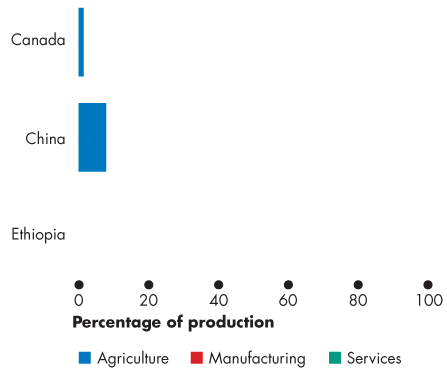
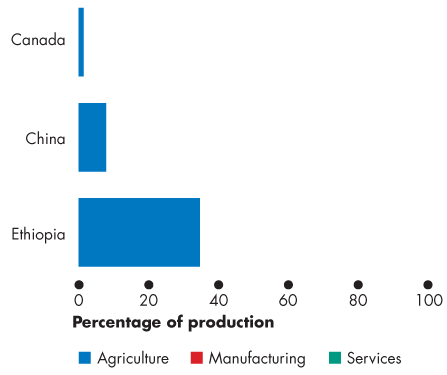
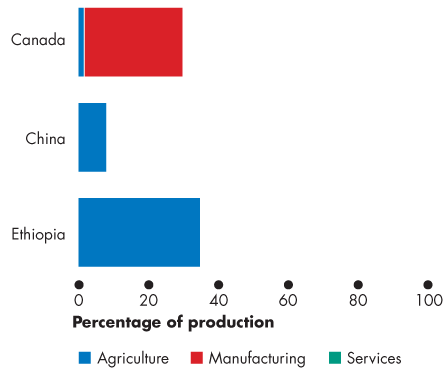
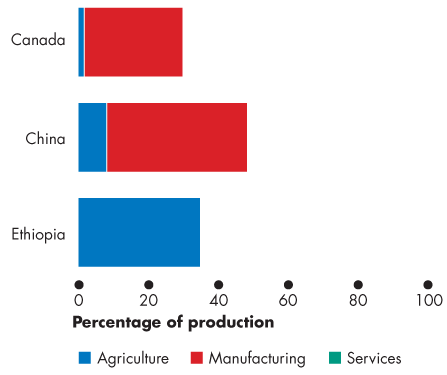
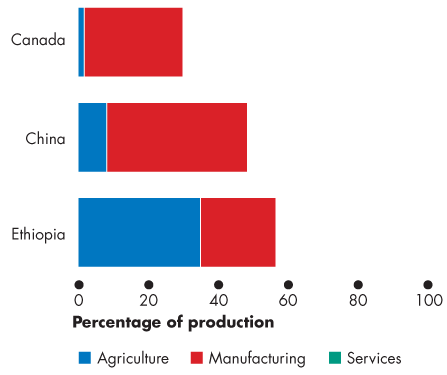
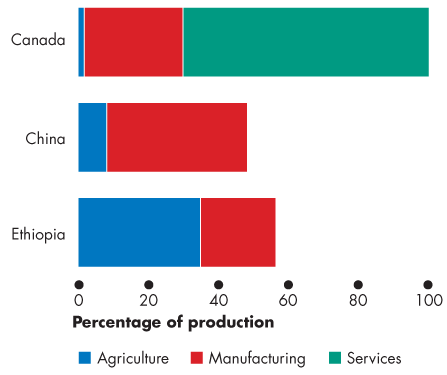
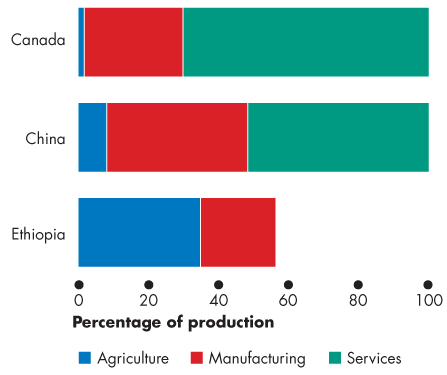
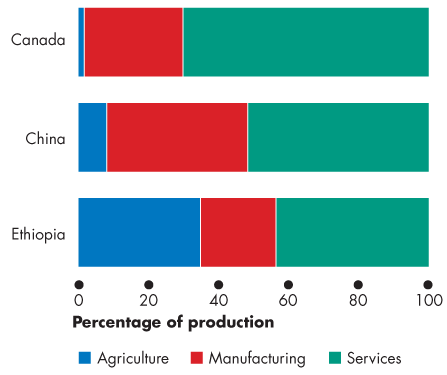
Production patterns differ across countries. For example, in Canada, agriculture is a small part of production, while services dominate. In Ethiopia, agriculture is much more significant.
Factors of Production
Goods and services are produced using factors of production, which are grouped into four categories:
Land: The "gifts of nature" used to produce goods and services.
Labour: The work time and effort devoted to production.
Capital: Tools, machines, buildings, and other constructions used in production.
Entrepreneurship: The human resource that organizes land, labour, and capital.
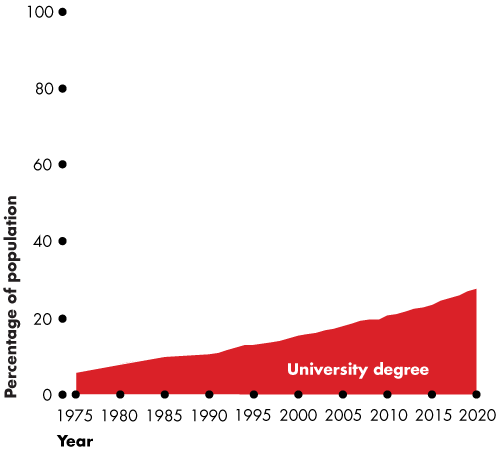
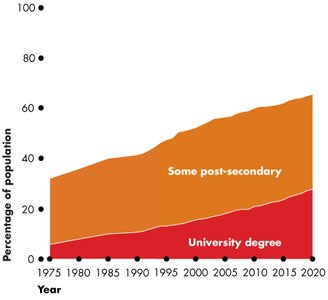
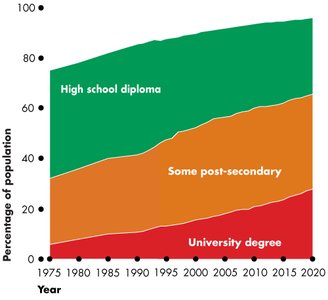
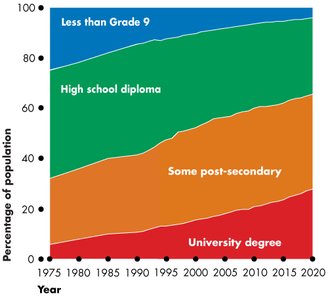
The quality of labour depends on human capital, which is the knowledge and skills acquired through education, training, and experience. Trends in human capital can be observed through educational attainment in the population.
Distribution of Income
Who gets the goods and services depends on the incomes earned from the factors of production:
Land earns rent.
Labour earns wages.
Capital earns interest.
Entrepreneurship earns profit.
Self-Interest vs. Social Interest
Efficiency and Equity
Choices made in pursuit of self-interest may or may not promote the social interest. Efficiency means that resources are used in such a way that it is impossible to make someone better off without making someone else worse off. Equity refers to fairness in the distribution of economic prosperity.
Efficiency: Maximizing the value from scarce resources.
Equity: Fair distribution of resources and outcomes.
How People Make Decisions
Principle 1: People Face Tradeoffs
Every choice involves tradeoffs. Because resources are limited, choosing one option means giving up another. This principle is often summarized as "There ain't no such thing as a free lunch."
Efficiency: Getting the most from scarce resources.
Equity: Distributing prosperity fairly among society's members.
Principle 2: The Cost of Something Is What You Give Up to Get It
The opportunity cost of an item is what must be given up to obtain it. Opportunity cost is a central concept in economics, guiding rational decision-making.
Opportunity Cost: The value of the next best alternative foregone.
Principle 3: Rational People Think at the Margin
Rational people systematically and purposefully do the best they can to achieve their objectives. They make decisions by evaluating marginal changes, which are small incremental adjustments to a plan of action.
Marginal Analysis: Comparing marginal benefits and marginal costs to make decisions.
Example: If repairing a car's transmission costs $600 and increases its value by $800, it is rational to repair it. If the value increase is only $500, it is not worthwhile.
Principle 4: People Respond to Incentives
An incentive is something that induces a person to act. Changes in costs or benefits can alter people's behavior.
Incentives: Rewards or penalties that influence choices.
How People Interact
Principle 5: Trade Can Make Everyone Better Off
Trade allows countries and individuals to specialize in what they do best and enjoy a greater variety of goods and services. Trade between two countries can make each country better off.

Principle 6: Markets Are Usually a Good Way to Organize Economic Activity
A market economy allocates resources through the decentralized decisions of many firms and households as they interact in markets for goods and services. Markets coordinate the activities of buyers and sellers.
Market Economy: Decentralized resource allocation through voluntary exchange.
Principle 7: Governments Can Sometimes Improve Market Outcomes
Governments are needed to enforce property rights and intervene in cases of market failure to promote efficiency and equity.
Property Rights: The ability of individuals to own and control resources.
Market Failure: When markets fail to allocate resources efficiently.
Externality: The impact of one person's actions on the well-being of a bystander.
Market Power: The ability of a single economic actor or group to influence market prices.
Summary Table: Factors of Production and Income
Factor of Production | Income Earned |
|---|---|
Land | Rent |
Labour | Wages |
Capital | Interest |
Entrepreneurship | Profit |
Key Formulas
Opportunity Cost:
Marginal Benefit vs. Marginal Cost:
Additional info: Academic context was added to clarify the role of human capital, marginal analysis, and market failure, as well as to provide examples and formulas for opportunity cost and marginal decision-making.
