 Indietro
Trade-offs, Comparative Advantage, and the Market System: Chapter 2 Study Notes
Guida di studio - Note intelligenti
 Appunti personalizzati basati sui tuoi materiali, ampliati con definizioni chiave, esempi e contesto.
Scarcity and Trade-offs
Understanding Scarcity
Scarcity is a fundamental concept in economics, referring to the situation where unlimited wants exceed the limited resources available to fulfill those wants. Because resources are finite, individuals and societies must make choices about how to allocate them most effectively.
Scarcity: The condition that arises because resources are limited while human wants are unlimited.
Trade-offs: The necessity to choose between competing alternatives due to scarcity.
Example: If Tesla allocates more workers and machinery to produce Model 3s, fewer resources are available for other models.
Production Possibilities Frontiers and Opportunity Costs
Production Possibilities Frontier (PPF)
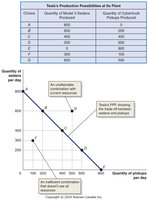
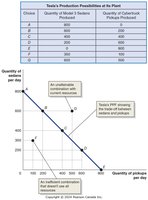
The Production Possibilities Frontier (PPF) is a curve that illustrates the maximum attainable combinations of two goods that can be produced with available resources and current technology. The PPF is a positive tool, showing "what is" rather than "what should be." It helps analyze opportunity costs and trade-offs.
Points on the PPF: Attainable and efficient combinations of goods.
Points below the PPF: Inefficient use of resources.
Points above the PPF: Unattainable with current resources.
Opportunity Cost
Opportunity cost is the value of the next best alternative that must be forgone to undertake an activity. For example, if Tesla produces 200 more Cybertruck Pickups, it must produce 200 fewer Model 3 Sedans; the opportunity cost of producing more pickups is the sedans not produced.
Trade-offs in Health Care Spending
Governments also face trade-offs due to scarcity. During the COVID-19 pandemic, increased health care spending meant less funding for other services, such as education or road repairs. This illustrates how allocating resources to one area reduces availability for others.

Increasing Marginal Opportunity Costs
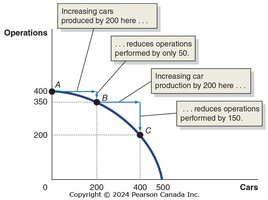
Opportunity costs are often increasing because some resources are better suited to one task than another. As more resources are devoted to an activity, the payoff to additional resources diminishes, leading to a bowed-out PPF.
Economic Growth and Technological Change
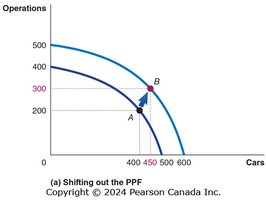
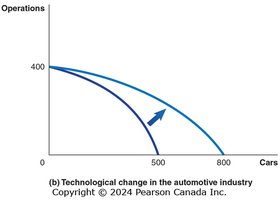
Economic growth occurs when the PPF shifts outward, allowing more production of both goods. Technological improvements in one industry can also shift the PPF outward for that industry, making previously unattainable combinations possible.
Comparative Advantage and Trade
Comparative Advantage
Comparative advantage is the ability to produce a good or service at a lower opportunity cost than others. It forms the basis for trade, allowing individuals, firms, or countries to specialize in what they do best and trade for other goods.
Absolute advantage: Producing more of a good with the same resources.
Comparative advantage: Producing a good at a lower opportunity cost.
Production Possibilities Without Trade
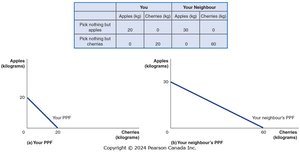
Consider two individuals: you and your neighbour. Each can pick apples or cherries, but the quantities differ. Without trade, each consumes only what they produce.
Specialization and Gains from Trade
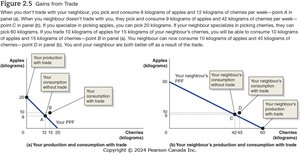
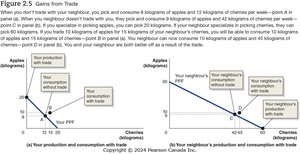
By specializing in the good for which each has a comparative advantage and trading, both parties can consume more than they could alone. Even if one party has an absolute advantage in both goods, trade can still be mutually beneficial.
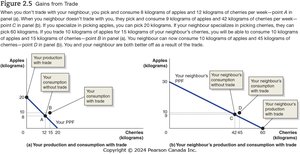
Opportunity Costs and the Basis for Trade
The basis for trade is comparative advantage, not absolute advantage. Specialization according to comparative advantage allows both parties to benefit.
Person | Opportunity Cost of Apples | Opportunity Cost of Cherries |
|---|---|---|
You | 1 kg cherries per 1 kg apples | 1 kg apples per 1 kg cherries |
Your neighbour | 2 kg cherries per 1 kg apples | 0.5 kg apples per 1 kg cherries |
Additional info: | Comparative advantage in apples (you) | Comparative advantage in cherries (neighbour) |
The Market System
How Markets Work
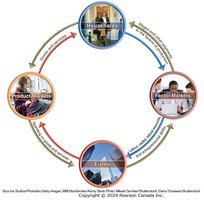
A market is a group of buyers and sellers of a good or service, and the institution or arrangement by which they come together to trade. The modern economy consists of households and firms interacting in product and factor markets.
Households: Provide factors of production (labour, capital, natural resources, entrepreneurial ability).
Firms: Supply goods and services to product markets; buy factors of production from households.
The Four Factors of Production
Labour: All types of work.
Capital: Physical capital used to produce goods.
Natural resources: Raw materials used in production.
Entrepreneurial ability: The skill to combine resources and produce goods/services.
The Circular-Flow Diagram
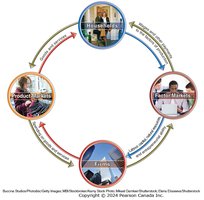
The circular-flow diagram illustrates how households and firms interact in the market system. Households provide factors of production to firms, and firms provide goods and services to households. Money flows in both directions, representing payments for factors and products.
The Gains from Free Markets
Free Markets and Living Standards
Free markets, with few government restrictions, have historically led to higher living standards compared to centrally planned economies. Adam Smith's concept of the "invisible hand" describes how individuals pursuing their own interests collectively satisfy consumer wants.
The Legal Basis of a Successful Market System
While free markets minimize government intervention, governments play a crucial role in protecting property rights and enforcing contracts. These legal foundations are essential for market transactions and economic growth.
Property rights: The exclusive right to use, buy, or sell property.
Enforcement of contracts: Ensures transactions across time are reliable.
Independent court system: Critical for upholding property rights and contracts.
Too Little of a Good Thing?
Both excessive central planning and insufficient government can lead to low living standards. Effective government is necessary for specialization, trade, and economic development.
Key Takeaways
The PPF should never bow inward; it reflects increasing opportunity costs.
The PPF shows what can be produced, not what should be produced.
Trade is beneficial even if one party is better at everything; comparative advantage is the basis for trade.
Free markets raise living standards, but governments must provide a sound legal environment for markets to succeed.
