 Indietro
Trade-Offs, Comparative Advantage, and the Market System: Microeconomics Chapter 2 Study Notes
Guida di studio - Note intelligenti
 Appunti personalizzati basati sui tuoi materiali, ampliati con definizioni chiave, esempi e contesto.
Chapter 2: Trade-Offs, Comparative Advantage, and the Market System
2.1 Production Possibilities Frontiers and Opportunity Costs
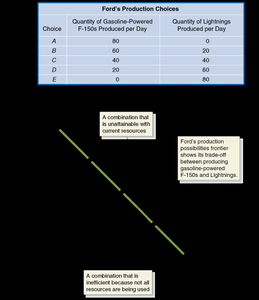
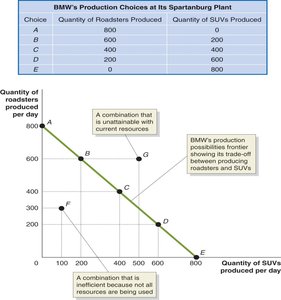
The Production Possibilities Frontier (PPF) is a fundamental model in microeconomics that illustrates the maximum attainable combinations of two goods that an economy can produce using available resources and technology. The PPF demonstrates the concepts of scarcity, choice, and opportunity cost.
Assumptions of the PPF:
Resources are fixed.
Technology is constant.
All resources are fully and efficiently utilized.
Opportunity Cost: The value of the next best alternative foregone when making a choice. On the PPF, moving from one point to another involves shifting resources and incurring opportunity costs.
Trade-Offs: Choosing more of one good means producing less of another due to limited resources.
Increasing Marginal Opportunity Costs
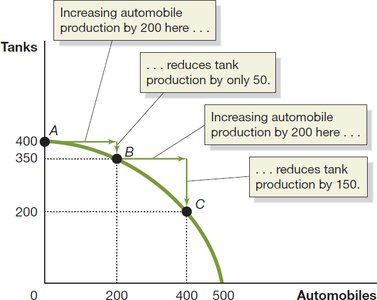
As more resources are allocated to the production of one good, the opportunity cost of producing additional units increases. This occurs because resources are not equally efficient in all uses.
The PPF is typically bowed outward, reflecting increasing opportunity costs.
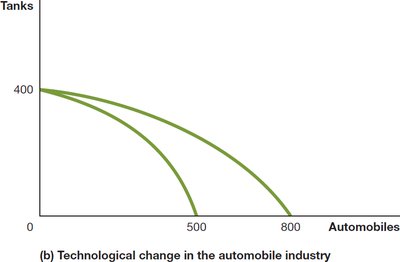
Example: As automobile production increases, the reduction in tank production becomes larger for each additional increment of automobiles produced.
Shifting the Production Possibilities Frontier
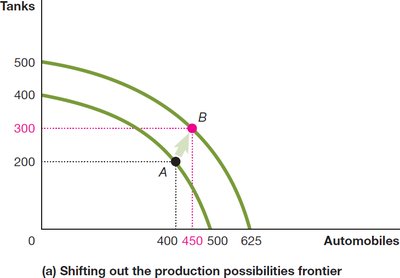
The PPF can shift outward due to economic growth, which may result from an increase in resources, technological advancements, or improvements in institutions. An outward shift represents the ability to produce more of both goods.
Economic Growth: Both sectors can produce more due to increased resources or better technology.
Technological Advancement: If technology improves in only one sector, the PPF pivots outward for that good.
2.2 Comparative Advantage and Trade
Trade allows individuals and nations to specialize in the production of goods for which they have a comparative advantage, leading to increased overall output and consumption possibilities.
Absolute Advantage: The ability to produce more of a good with the same resources compared to others.
Comparative Advantage: The ability to produce a good at a lower opportunity cost than others. This is the basis for mutually beneficial trade.
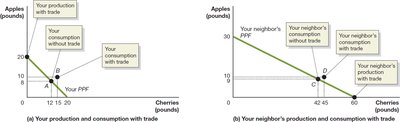
Specialization: By specializing according to comparative advantage, parties can trade to achieve consumption beyond their individual PPFs.
Trade Example: Apples and Cherries
Consider two individuals, each with different abilities to pick apples and cherries. Their PPFs illustrate their production capabilities and opportunity costs.
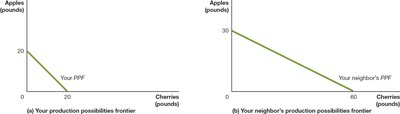
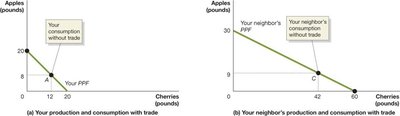
Without trade, each person's consumption is limited to their own PPF.
With trade, both can consume more than they could produce alone by specializing and exchanging goods.
Opportunity Costs and Gains from Trade
Calculating opportunity costs helps determine who should specialize in which good. The party with the lower opportunity cost for a good should specialize in its production.
Trade enables both parties to achieve higher consumption levels, demonstrating the gains from trade.
2.3 The Market System
The market system coordinates the allocation of resources through voluntary exchanges in product and factor markets. It relies on the price mechanism and the incentives provided by private property rights.
Product Market: Where goods and services are bought and sold.
Factor Market: Where resources (labor, capital, natural resources, entrepreneurial ability) are bought and sold.
Free Market: A market with minimal government intervention, allowing prices to allocate resources efficiently.
Invisible Hand: Adam Smith's concept that individuals seeking their own gain can benefit society as a whole through market mechanisms.
Knowledge and Competition: According to Friedrich Hayek, markets mobilize dispersed knowledge through competition, leading to better economic outcomes.
Foundations for a Market System
Entrepreneurs
Legal system
Protection of private property
Enforcement of contracts and property rights
Private Property Rights
Private property rights are essential for the functioning of a market system. They provide incentives for efficient resource use, stewardship, conservation, and accountability.
The right to exclusive use of property
Legal protection against trespass
The right to transfer, sell, exchange, or mortgage property
Summary
Use the PPF to analyze opportunity costs and trade-offs.
Understand comparative advantage as the basis for trade.
Explain the basics of how a market system works, including the role of property rights and the price mechanism.
