 Indietro
Fluid and Electrolyte Balance in Human Nutrition
Guida di studio - Note intelligenti
 Appunti personalizzati basati sui tuoi materiali, ampliati con definizioni chiave, esempi e contesto.
Fluid and Electrolyte Balance
Introduction
Fluid and electrolyte balance is a critical aspect of human nutrition, essential for maintaining homeostasis and supporting physiological functions. This topic explores the composition, distribution, and functions of body fluids and electrolytes, as well as the mechanisms by which the body gains and loses fluids.
Body Fluids: Location and Composition
Types and Distribution of Body Fluids
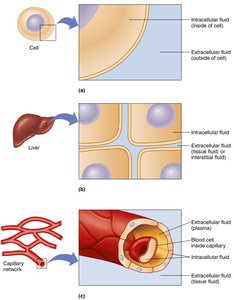
Body fluids are substances composed of freely moving molecules that adapt to the shape of their container. They are distributed throughout the body in two main compartments:
Intracellular Fluid (ICF): Fluid within cells; makes up about two-thirds of total body fluid.
Extracellular Fluid (ECF): Fluid outside cells; comprises one-third of total body fluid and includes:
Tissue (interstitial) fluid: Found between cells within tissues and organs.
Plasma: The fluid portion of blood that carries blood cells.
Lymph: Fluid in lymphatic vessels.
Factors Affecting Body Fluid Composition
Tissue Type: Lean tissue contains about 70% fluid, while fat tissue contains only 10–20%.
Sex: Males generally have more lean tissue and thus more body fluid than females.
Age: Lean tissue and body fluid decrease with age.
Solutes and Electrolytes in Body Fluids
Definition and Role of Solutes
Solutes are dissolved substances in body fluids, including ions, carbohydrates, amino acids, vitamins, and minerals. The most important solutes for fluid balance are electrolytes.
Electrolytes: Types and Distribution
Electrolytes are mineral salts that dissociate in water to form charged particles called ions, which can conduct electricity. The six major electrolytes are sodium, potassium, chloride, phosphorus, calcium, and magnesium.
Intracellular fluid: High in potassium (K+) and phosphate (PO43−).
Extracellular fluid: High in sodium (Na+) and chloride (Cl−).
The difference in ion concentrations across cell membranes creates an electrical gradient essential for cell function.
Functions of Body Fluids
Solubility and Transport
Water is an excellent solvent, allowing it to dissolve and transport a wide variety of substances, including nutrients and waste products, throughout the body.
Blood Volume and Blood Pressure
Blood volume is the amount of fluid in the blood.
Increased blood volume raises blood pressure (hypertension), while decreased blood volume lowers blood pressure.
Body Temperature Regulation
Water has a high heat capacity, helping to maintain stable body temperature. Sweating allows heat to be released from the body as water evaporates from the skin.

Tissue Protection and Lubrication
Cerebrospinal fluid: Protects the brain and spinal cord.
Amniotic fluid: Cushions the fetus during pregnancy.
Synovial fluid: Lubricates joints.
Pleural fluid: Allows lungs to expand and contract without friction.
Digestive secretions: Facilitate the movement of food through the digestive tract.
Functions of Electrolytes
Fluid Balance Regulation
Electrolytes help regulate the movement of water between body compartments by osmosis. Water moves toward areas with higher electrolyte concentration, allowing for controlled fluid movement into and out of cells.
Nerve Impulse Conduction
Electrolytes are essential for the generation and transmission of nerve impulses. The difference in ion concentrations across cell membranes creates an electrical potential that allows nerve cells to transmit signals.

Muscle Contraction
Electrolytes, particularly calcium, sodium, and potassium, are critical for muscle contraction. The movement of calcium into muscle cells triggers contraction, and its removal allows relaxation.
Mechanisms of Fluid Balance
Fluid Gain
Beverages: Main source of water intake.
Food: Many foods contain significant amounts of water.
Metabolic water: Produced as a byproduct of metabolic reactions (about 10–14% of daily water needs).

Fluid Loss
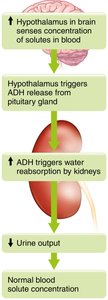
Sensible water loss: Observable loss through urine and sweat. The kidneys regulate urine output to maintain fluid balance.
Insensible water loss: Loss through evaporation from the skin, exhalation from the lungs, and feces.
Diuretics: Substances that increase urine production and fluid loss.
Thirst Mechanism
The thirst mechanism is controlled by the hypothalamus and is triggered by:
Increased concentration of solutes in the blood
Decreased blood volume and pressure
Dryness of mouth and throat tissues
Osmosis and Fluid Movement
Osmosis
Osmosis is the movement of water across a semipermeable membrane from an area of lower solute concentration to an area of higher solute concentration, continuing until equilibrium is reached.
Summary Table: Major Electrolytes and Their Functions
Electrolyte | Main Location | Primary Functions |
|---|---|---|
Sodium (Na+) | Extracellular fluid | Fluid balance, nerve impulse transmission, muscle contraction |
Potassium (K+) | Intracellular fluid | Fluid balance, nerve impulse transmission, muscle contraction |
Chloride (Cl−) | Extracellular fluid | Fluid balance, digestion (as part of stomach acid) |
Phosphorus (as phosphate, PO43−) | Intracellular fluid | Bone formation, energy metabolism, buffer in acid-base balance |
Calcium (Ca2+) | Both intra- and extracellular | Bone health, muscle contraction, nerve function, blood clotting |
Magnesium (Mg2+) | Intracellular fluid | Enzyme function, muscle contraction, nerve function |
Key Equations
Osmosis: Where J is the flux, D is the diffusion coefficient, and is the concentration gradient.
Water Balance:
Conclusion
Maintaining fluid and electrolyte balance is essential for health, supporting critical functions such as nutrient transport, temperature regulation, nerve signaling, and muscle contraction. Understanding these principles is fundamental for students of nutrition and health sciences.
