 Indietro
Acid-Base Chemistry in Organic Chemistry: Concepts, Trends, and Applications
Guida di studio - Note intelligenti
 Appunti personalizzati basati sui tuoi materiali, ampliati con definizioni chiave, esempi e contesto.
Acid-Base Chemistry
Definitions and Fundamental Concepts
Acid-base chemistry is central to organic reactions, influencing molecular structure, reactivity, and equilibrium. Three main definitions are used:
Arrhenius Acids/Bases: Acids produce hydronium ions (H3O+) in water; bases produce hydroxide ions (OH-).
Brønsted-Lowry Acids/Bases: Acids are proton donors; bases are proton acceptors. This definition is broader and includes reactions in non-aqueous solvents.
Lewis Acids/Bases: Lewis acids are electron pair acceptors (electrophiles); Lewis bases are electron pair donors (nucleophiles). All Brønsted-Lowry acids are Lewis acids, but not all Lewis acids are Brønsted-Lowry acids.
Nucleophiles (Lewis bases) donate electrons, while electrophiles (Lewis acids) accept electrons. Curved arrows in reaction mechanisms start at the nucleophile and point toward the electrophile.
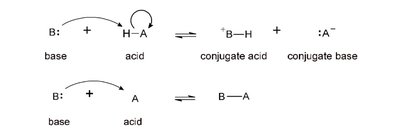
Acid and Base Strength
The strength of acids and bases is determined by their ability to donate or accept protons or electrons. Strong acids and bases dissociate completely in water, while weak acids and bases only partially dissociate.
Strong Acids: HNO3, H2SO4, HClO4, HCl, HBr, HI
Strong Bases: LiOH, NaOH, KOH, Ca(OH)2, Sr(OH)2, Ba(OH)2
Weak Acids/Bases: All others not listed above
Acid and base strength can be quantified using pKa values. Lower pKa indicates a stronger acid.
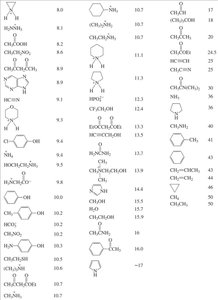
Trends Affecting Acid and Base Strength
Charge
Acids with a positive charge are generally stronger, and bases with a negative charge are generally stronger. For example:
H3O+ (pKa = -1.7) is a stronger acid than H2O (pKa = 15.7).
NH4+ (pKa = 9.26) is a stronger acid than NH3 (pKa = 36).
Electronegativity
Acidity increases with the electronegativity of the atom bonded to hydrogen. The more electronegative the atom, the more it stabilizes the negative charge on the conjugate base.
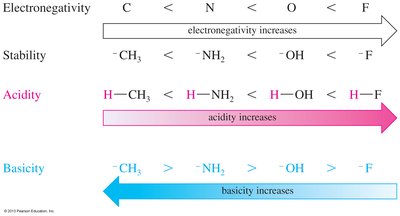
Size
As the size of the atom increases, the bond to hydrogen becomes weaker, making the acid stronger. This is especially important for halogens:
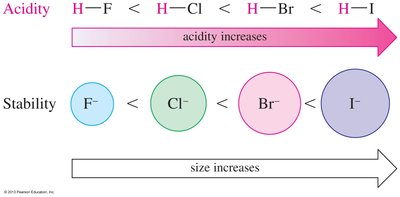
Resonance
Resonance stabilization of the conjugate base increases acidity. The more resonance structures available, the more stable the conjugate base, and the stronger the acid.
Inductive Effect
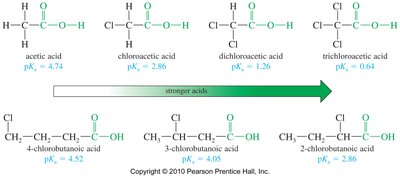
Electron-withdrawing groups (EWGs) increase acidity by stabilizing the conjugate base through the inductive effect. The closer the EWG to the acidic proton, the greater the effect.
Hybridization (s-Character)
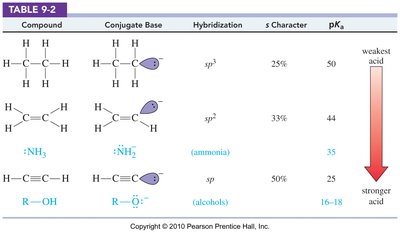
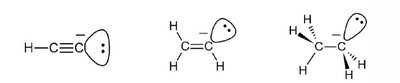
Acidity increases with greater s-character in the hybrid orbital holding the acidic proton. For example, sp-hybridized carbons (50% s-character) are more acidic than sp2 (33%) or sp3 (25%).
Solvation
Solvation stabilizes ions in solution. More highly solvated conjugate bases are more stable, increasing the acidity of the parent acid.
Covalent and Ionic Acids/Bases
Covalent Acids/Bases
Many organic compounds can act as both acids and bases, such as carboxylic acids, alcohols, and amines.
Ionic Bases
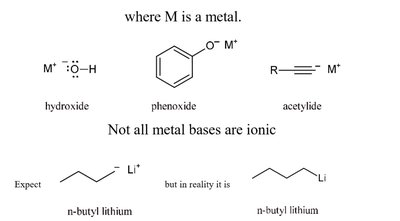
Metal bases can be ionic or covalent. Not all metal bases are purely ionic; for example, n-butyl lithium is covalent in reality.
Bond Types and Electronegativity Differences
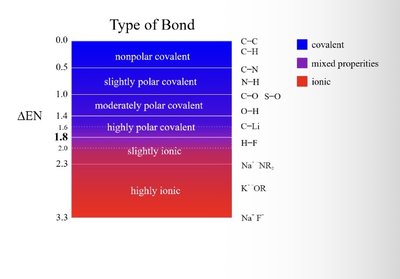
Classification of Bonds
Bonds are classified by the difference in electronegativity (ΔEN) between atoms:
Nonpolar covalent: ΔEN ≈ 0 (e.g., C–C, C–H)
Slightly polar covalent: ΔEN ≈ 0.5–1.4 (e.g., C–N, N–H, C–O)
Highly polar covalent: ΔEN ≈ 1.8 (e.g., H–F, C–Li)
Ionic: ΔEN > 2.3 (e.g., Na+F-)
Predicting Acid-Base Reactions
Equilibrium and Reaction Favorability
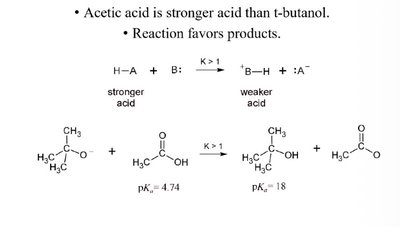
Acid-base reactions favor the formation of the weaker acid and base. The equilibrium constant (K) is greater than 1 when the reaction produces a more stable conjugate base.
Acetic acid (pKa = 4.74) is a stronger acid than t-butanol (pKa = 18), so the reaction favors products.
Summary Table: pKa Values and Acid Strength
The following table summarizes the relationship between hybridization, s-character, and pKa values for common organic acids:
Compound | Conjugate Base | Hybridization | s Character | pKa |
|---|---|---|---|---|
CH4 | CH3- | sp3 | 25% | 50 |
NH3 | NH2- | sp3 | 25% | 35 |
H2C=CH2 | H2C=CH- | sp2 | 33% | 44 |
HC≡CH | HC≡C- | sp | 50% | 25 |
R–OH | R–O- | sp3 | 25% | 16–18 |
Practice and Application
Resonance Practice
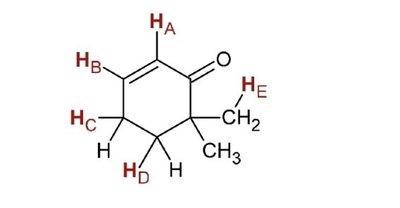
Identify the most acidic hydrogen in a molecule by considering resonance stabilization of the conjugate base.
Inductive Effect Practice
Compare the acidity of carboxylic acids substituted with electron-withdrawing groups at different positions.
Hybridization Practice
Compare the acidity of hydrocarbons based on hybridization and s-character.
Predicting Reaction Direction
Use pKa values to predict whether an acid-base reaction will favor products or reactants.
Additional info: These notes expand on the original content by providing definitions, context, and examples for each acid-base concept, ensuring a comprehensive and self-contained study guide for organic chemistry students.
