 Indietro
Alcohols and Alkyl Halides: Nomenclature, Properties, and Reaction Mechanisms
Guida di studio - Note intelligenti
 Appunti personalizzati basati sui tuoi materiali, ampliati con definizioni chiave, esempi e contesto.
Substituted Hydrocarbons and Nomenclature
Functional Groups and Substituents
Substituted hydrocarbons are organic molecules in which one or more hydrogen atoms are replaced by functional groups. The functional group is the reactive site on a hydrocarbon, while substituents are groups attached to the parent chain.
Carbonyls: Functional groups containing a C=O (carbon-oxygen double bond).
IUPAC Nomenclature
The International Union of Pure and Applied Chemistry (IUPAC) system provides rules for naming organic compounds based on their structure and substituents.
Substitutive nomenclature: Name the functional group as a substituent, then name the parent chain.
Priority order: OH > multiple bonds (MB) > halogens/alkyls (halogens named before alkyls).
If two substituents change the ending, fracture the name for clarity (e.g., #-[halo-root]-#-alken-#-ol).
Substitutive names are not affected by carbon class.
Alcohol Nomenclature
Alcohols are named by identifying the hydroxyl (-OH) group on the parent alkane chain, ensuring the lowest possible locant for the -OH group.
Name format: #-alkanol
Alkyl Halide Nomenclature
Alkyl halides are named as halogen substituents on an alkane, with the parent chain including the halogen or alkyl group at the lowest locant.
Priority: halogen = alkyl (halogens named first).
Name format: #[halo root]-#[alkyl]alkane
Functional Nomenclature
Used for small molecules, functional names are based on the carbon class at the attachment site. The parent chain is the longest alkyl group attached to the functional group.
Use locants for alkyl substituents.
Name the functional group.
Intermolecular Forces (IMFs) and Physical Properties
Types of Intermolecular Forces
IMFs are forces between molecules that affect physical properties such as melting and boiling points.
London dispersion forces: Induced dipoles present in all molecules.
Dipole-dipole: Attraction between polar molecules.
Dipole-induced dipole: Interaction between polar and nonpolar molecules (minor effect).
Hydrogen bonding: Strong interaction involving H bonded to N, O, or F.
IMF Effects on Physical Properties
Stronger IMFs result in higher melting and boiling points. Increased carbon atoms lead to greater polarizability (\( \alpha_e \)). Halogen substitution also affects polarizability and boiling points.
More carbons increase polarizability.
Halogens with greater polarizability have smaller radii; smaller halogens have weaker effects.
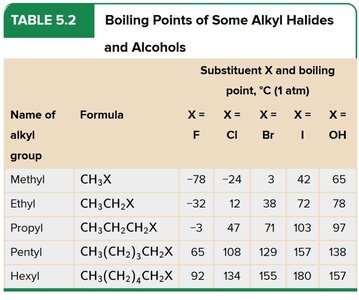
Boiling Points of Alkyl Halides and Alcohols
The boiling points of alkyl halides and alcohols depend on the nature of the substituent and the size of the alkyl group.
Name of alkyl group | Formula | X = F | X = Cl | X = Br | X = I | X = OH |
|---|---|---|---|---|---|---|
Methyl | CH3X | -78 | -24 | 3 | 42 | 65 |
Ethyl | CH3CH2X | -32 | 12 | 38 | 72 | 78 |
Propyl | CH3CH2CH2X | -3 | 47 | 103 | 97 | 97 |
Pentyl | CH3(CH2)3X | 108 | 129 | 151 | 173 | 137 |
Hexyl | CH3(CH2)4X | 92 | 134 | 155 | 180 | 157 |
Reaction Mechanisms: Substitution Reactions
Terminology and Steps
Substitution reactions involve replacing one group in a molecule with another. The mechanism describes the stepwise process of bond making and breaking.
Molecularity: Number of molecules involved in an elementary reaction (unimolecular or bimolecular).
Electrophile (E+): Electron-poor species (Lewis acid) that accepts electrons.
Nucleophile (Nu-): Electron-rich species (Lewis base) that donates electrons.
Mechanism: Stepwise description of electron movement (arrows show e- flow).
Concerted reaction: Bonds are broken and formed simultaneously.
Potential Energy Diagrams
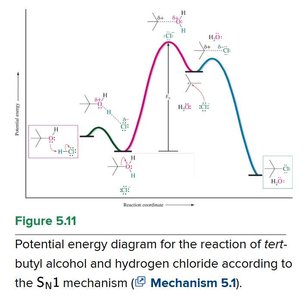
Potential energy (PE) diagrams illustrate the energy changes during a reaction. The activation energy (Ea) is the energy required for a reactant to react. The transition state is the highest energy point, while intermediates are troughs in the diagram.
Substitution Mechanisms: SN1 and SN2
SN1 Mechanism (Unimolecular Nucleophilic Substitution)
SN1 reactions proceed via a two-step mechanism, with the rate-determining step being unimolecular.
Step 1: Protonation of alcohol (R-OH) by hydrogen halide (H-X) to form alkyloxonium ion (R-OH2+).
Step 2: Formation of carbocation (C+) via dehydration.
Step 3: Nucleophile (X-) attacks carbocation, forming alkyl halide (R-X).
Carbocation rearrangement (hydride or alkyl shift) may occur to increase stability.
Stereochemistry: Configuration inverts if nucleophile attacks opposite the leaving group.
Carbocation Structure and Stability
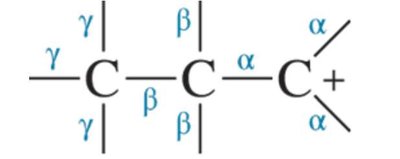
A carbocation is a positively charged carbon atom (C+), typically sp2 hybridized and trigonal planar. Stability increases with more alkyl groups due to electron-donating effects.
Inductive effect: Electron donation from adjacent (beta) carbons through sigma bonds.
Hyperconjugation: Delocalization of electrons from beta carbons into the empty p-orbital of the carbocation.
SN2 Mechanism (Bimolecular Nucleophilic Substitution)
SN2 reactions occur in a single concerted step, with the rate-determining step being bimolecular.
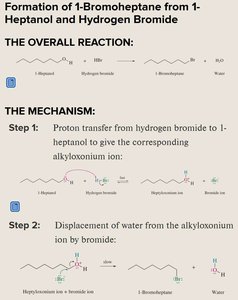
Step 1: Protonation of alcohol (R-OH) by hydrogen halide (H-X) to form alkyloxonium ion (R-OH2+).
Step 2: Nucleophile (X-) attacks the carbon opposite the leaving group, causing inversion of configuration.
No carbocation intermediate; no rearrangement occurs.
Summary Table: SN1 vs SN2 Mechanisms
Feature | SN1 | SN2 |
|---|---|---|
Molecularity | Unimolecular (rate depends on substrate) | Bimolecular (rate depends on substrate and nucleophile) |
Intermediate | Carbocation | None |
Stereochemistry | Racemization/inversion possible | Inversion of configuration |
Rearrangement | Possible (hydride/alkyl shift) | Not possible |
Substrate preference | 3° > 2° > 1° | 1° > 2° > 3° |
Key Equations
Activation energy:
Potential energy diagram:
Example: Formation of 1-bromoheptane from 1-heptanol and hydrogen bromide proceeds via proton transfer and displacement of water, illustrating the SN2 mechanism.
