 Indietro
Alcohols, Phenols, and Aromatic Compounds: Structure, Reactivity, and Key Transformations
Guida di studio - Note intelligenti
 Appunti personalizzati basati sui tuoi materiali, ampliati con definizioni chiave, esempi e contesto.
Alcohols, Phenols, and Aromatic Compounds
Introduction to Functional Groups and Reactivity
Organic molecules are classified by their functional groups, which determine their chemical reactivity and physical properties. This section focuses on alcohols, phenols, and aromatic compounds, which are central to organic synthesis and drug design.
Hydrocarbons: Non-polar, generally unreactive except under specific conditions.
Oxygen-containing groups: Include alcohols (–OH), ethers (R–O–R), aldehydes (–CHO), ketones (C=O), carboxylic acids (–COOH), and esters (–COOR).
Nitrogen-containing groups: Include amines (–NH2), which are basic, and amides (–CONH2), which are resonance-stabilized and less reactive than esters.
Physical Properties of Alcohols and Phenols
Polarity, Solubility, and Hydrogen Bonding
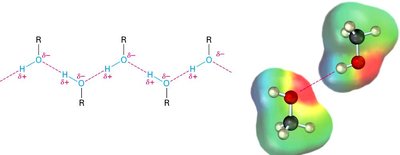
Alcohols and phenols are polar due to the presence of the hydroxyl group (–OH), which enables hydrogen bonding. This significantly affects their boiling points and solubility in water.
Hydrogen bonding: Leads to higher boiling points compared to hydrocarbons of similar molecular weight.
Solubility: Short-chain alcohols (e.g., ethanol) are miscible with water, while long-chain alcohols (e.g., decanol) are insoluble. Solubility can be increased by converting alcohols or phenols to their salts, which form ion-dipole interactions with water.
Acidity: Alcohols are weakly acidic; phenols are more acidic due to resonance stabilization of the phenoxide ion.
Preparation of Alcohols
Reduction of Carbonyl Compounds
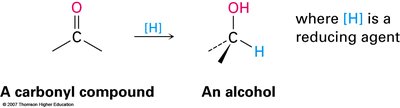
Alcohols can be synthesized by the reduction of various carbonyl-containing compounds. The type of alcohol produced depends on the starting material:
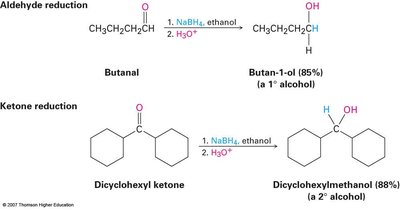
Aldehydes: Reduced to primary alcohols.
Ketones: Reduced to secondary alcohols.
Carboxylic acids and esters: Reduced to primary alcohols (usually requires a stronger reducing agent).

Reducing Agents
The most common reducing agents are sodium borohydride (NaBH4) and lithium aluminium hydride (LiAlH4):
NaBH4: Safe, easy to handle, and effective for reducing aldehydes and ketones.
LiAlH4: More reactive, used for reducing carboxylic acids and esters as well as aldehydes and ketones.
Mechanism of Reduction
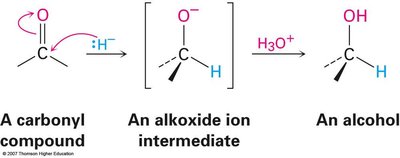
The reduction of carbonyl compounds to alcohols proceeds via nucleophilic addition of a hydride ion (H–) to the electrophilic carbonyl carbon, forming an alkoxide intermediate, which is then protonated to yield the alcohol.
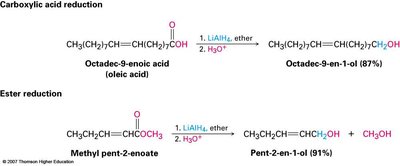
Reduction of Carboxylic Acids and Esters
Carboxylic acids and esters are reduced to primary alcohols, typically using LiAlH4 due to their lower reactivity compared to aldehydes and ketones.
Reactions of Alcohols
Key Transformations
Alcohols undergo a variety of important reactions in organic synthesis:
Dehydration: Removal of water to form alkenes.
Conversion to alkyl halides: Reaction with SOCl2, PCl5, or PBr3 to form alkyl chlorides or bromides.
Oxidation: Primary alcohols can be oxidized to aldehydes or carboxylic acids; secondary alcohols to ketones; tertiary alcohols are resistant to oxidation.
Esterification: Reaction with carboxylic acids to form esters.
Ether formation: Reaction with alkyl halides to form ethers.
Oxidation of Alcohols
Oxidation of alcohols is a key transformation in organic synthesis. The outcome depends on the type of alcohol and the oxidizing agent used:
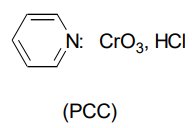
Primary alcohols: Oxidized to aldehydes (with PCC) or further to carboxylic acids (with K2Cr2O7/H2SO4).
Secondary alcohols: Oxidized to ketones.
Tertiary alcohols: Generally resistant to oxidation.
Aromatic Compounds and Benzene
Structure and Stability of Benzene
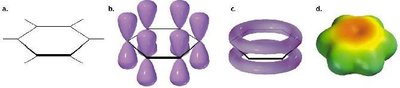
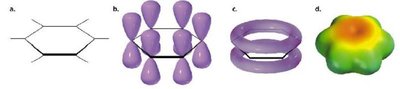
Benzene is the prototypical aromatic compound, characterized by a planar, cyclic structure with delocalized π-electrons. This delocalization confers exceptional stability, known as aromatic stabilization.
Delocalized π-system: Six π-electrons are shared equally over six carbon atoms, forming a continuous ring of electron density.
Stability: Benzene is less reactive than typical alkenes due to this delocalization.
Reactivity: Electrophilic Aromatic Substitution (EAS)
The characteristic reaction of benzene and other aromatic compounds is electrophilic aromatic substitution (EAS), where an electrophile replaces a hydrogen atom on the aromatic ring.
Common EAS reactions: Nitration, halogenation, sulfonation, Friedel–Crafts alkylation, and Friedel–Crafts acylation.
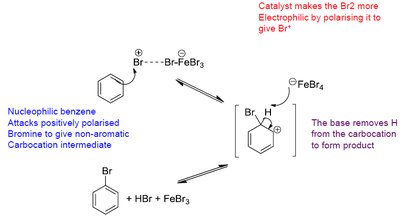
Mechanism: Involves generation of a strong electrophile, attack by the aromatic ring, and restoration of aromaticity.
Nitration of Benzene
Nitration involves the substitution of a hydrogen atom by a nitro group (–NO2) using a mixture of concentrated nitric and sulfuric acids. The active electrophile is the nitronium ion (NO2+).
Halogenation of Benzene
Halogenation (e.g., bromination or chlorination) requires a Lewis acid catalyst (e.g., FeBr3 or AlCl3) to generate the electrophilic halogen species.
Friedel–Crafts Alkylation and Acylation
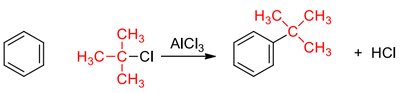
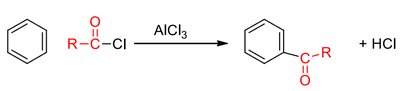
Friedel–Crafts reactions are important for forming new carbon–carbon bonds on aromatic rings:
Alkylation: Introduction of an alkyl group using an alkyl halide and a Lewis acid. Multiple alkylations can occur due to activation of the ring by the alkyl group.
Acylation: Introduction of an acyl group using an acyl chloride and a Lewis acid. The resulting ketone is deactivating, preventing further substitution.

Limitations of Friedel–Crafts Reactions
Only effective with activated aromatic rings (e.g., benzene, alkylbenzenes).
Strongly deactivated rings (e.g., nitrobenzene, benzenesulfonic acid) do not react.
Carbocation rearrangements can occur during alkylation, leading to unexpected products.
Polyalkylation is common in alkylation, but acylation avoids this due to the deactivating effect of the acyl group.
Summary Table: Key Reactions of Alcohols and Aromatic Compounds
Transformation | Reagents/Conditions | Product |
|---|---|---|
Reduction of aldehydes | NaBH4 or LiAlH4 | Primary alcohol |
Reduction of ketones | NaBH4 or LiAlH4 | Secondary alcohol |
Reduction of carboxylic acids/esters | LiAlH4 | Primary alcohol |
Oxidation of primary alcohols | PCC (to aldehyde), K2Cr2O7/H2SO4 (to acid) | Aldehyde or carboxylic acid |
Oxidation of secondary alcohols | K2Cr2O7/H2SO4 | Ketone |
Dehydration of alcohols | Acid catalyst, heat | Alkene |
Conversion to alkyl halides | SOCl2, PCl5, PBr3 | Alkyl halide |
Electrophilic aromatic substitution | Various (see above) | Substituted aromatic compound |
Conclusion
Understanding the structure, reactivity, and transformations of alcohols, phenols, and aromatic compounds is essential for predicting and designing synthetic routes in organic chemistry, especially in the context of drug synthesis. Mastery of these concepts enables the rational design of molecules with desired physical and chemical properties.
