 Indietro
Aldehydes and Ketones: Structure, Properties, and Reactions
Guida di studio - Note intelligenti
 Appunti personalizzati basati sui tuoi materiali, ampliati con definizioni chiave, esempi e contesto.
Chapter 14: Aldehydes and Ketones
Introduction to Aldehydes and Ketones
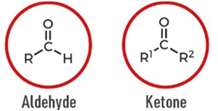
Aldehydes and ketones are organic compounds containing the carbonyl group (C=O). The carbonyl group is a defining feature that imparts unique chemical and physical properties to these molecules. Aldehydes have at least one hydrogen atom attached to the carbonyl carbon, while ketones have two alkyl or aryl groups attached to the carbonyl carbon.
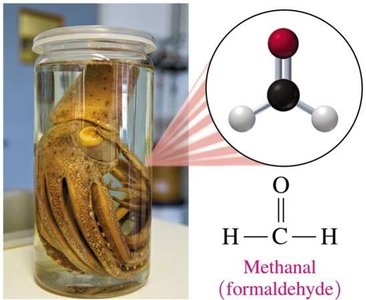
Formaldehyde (methanal) is the simplest aldehyde and is commonly used as a preservative in biological specimens.
The carbonyl group is planar, with bond angles of approximately 120°.
Structure of the Carbonyl Group
The carbonyl group consists of a carbon atom double-bonded to an oxygen atom.
In aldehydes, the carbonyl carbon is bonded to at least one hydrogen atom; in ketones, it is bonded to two alkyl or aryl groups.
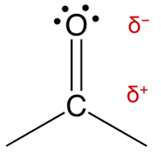
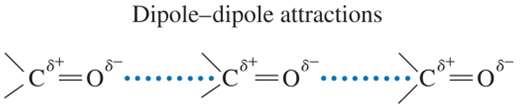
The oxygen atom is more electronegative than carbon, creating a polar bond with a partial negative charge (δ-) on oxygen and a partial positive charge (δ+) on carbon.
This polarity influences the reactivity and physical properties of aldehydes and ketones.
Nomenclature of Aldehydes and Ketones
Naming Aldehydes
Aldehydes are named by replacing the -e ending of the corresponding alkane with -al. The carbonyl carbon is always carbon 1 in the chain.
For cyclic aldehydes, the ring carbon with the aldehyde group is carbon 1.
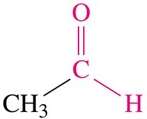
Common names are often used for aldehydes with 1-4 carbons (e.g., formaldehyde, acetaldehyde).
Benzaldehyde is the simplest aromatic aldehyde.
Naming Ketones
Ketones are named by replacing the -e ending of the corresponding alkane with -one. The chain is numbered from the end nearest the carbonyl group. Common names list the alkyl groups alphabetically followed by 'ketone'.
Acetone (propanone) is a commonly used name retained by IUPAC.
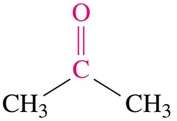
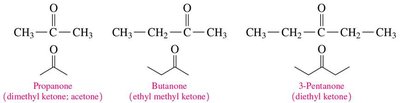
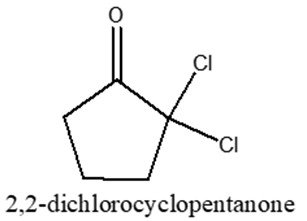
Naming Cyclic Ketones
The prefix 'cyclo-' is used, and the ring carbon with the carbonyl is numbered as carbon 1.
Substituents are numbered to give the lowest possible numbers.
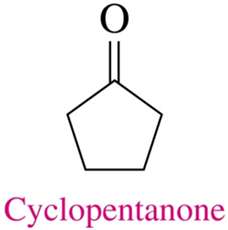
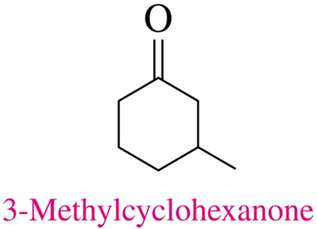
Physical Properties of Aldehydes and Ketones
Boiling Points
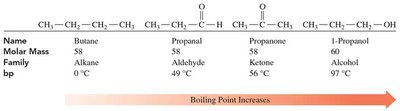
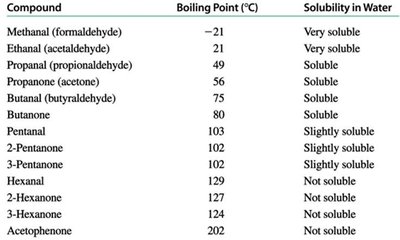
Aldehydes and ketones have higher boiling points than alkanes and ethers of similar molar mass due to dipole–dipole interactions between polar carbonyl groups. However, their boiling points are lower than those of alcohols, which can form hydrogen bonds with each other.
Boiling points increase with increasing molecular mass due to greater dispersion forces.
Solubility in Water
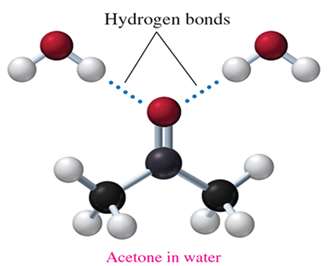
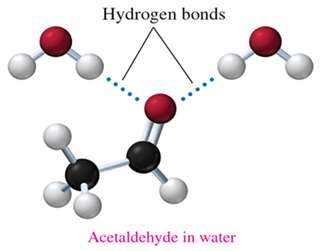
Aldehydes and ketones with one to four carbons are soluble in water due to hydrogen bonding between the carbonyl oxygen and water. Compounds with five or more carbons are less soluble.
Hydrogen bonds form between the carbonyl oxygen and water molecules.
Compound | Boiling Point (°C) | Solubility in Water |
|---|---|---|
Methanal (formaldehyde) | -21 | Very soluble |
Ethanol (acetaldehyde) | 21 | Very soluble |
Propanal (propionaldehyde) | 49 | Soluble |
Propanone (acetone) | 56 | Soluble |
Butanal (butyraldehyde) | 75 | Soluble |
Butanone | 80 | Soluble |
Pentanal | 103 | Slightly soluble |
2-Pentanone | 102 | Slightly soluble |
3-Pentanone | 102 | Slightly soluble |
Hexanal | 129 | Not soluble |
2-Hexanone | 127 | Not soluble |
3-Hexanone | 124 | Not soluble |
Acetophenone | 202 | Not soluble |
Chemical Properties and Reactions
Oxidation of Aldehydes and Ketones
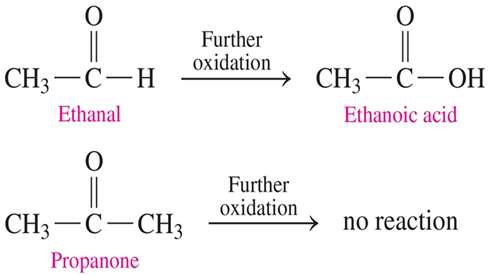
Aldehydes are readily oxidized to carboxylic acids, while ketones generally do not undergo oxidation under mild conditions.
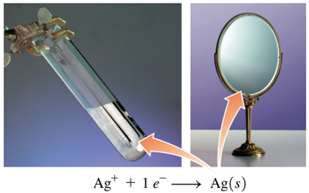
Tollens' Test: Used to distinguish aldehydes from ketones. Tollens' reagent (Ag+ in ammonia) oxidizes aldehydes, producing a silver mirror as Ag+ is reduced to metallic silver.
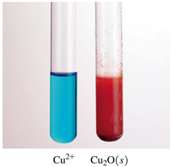
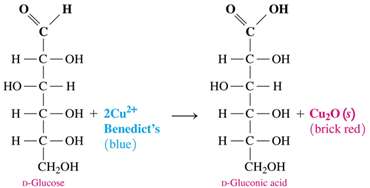
Benedict's Test: Used to detect aldehydes with an adjacent hydroxyl group (e.g., in sugars). A positive test forms a brick-red precipitate of Cu2O.


Reduction of Aldehydes and Ketones
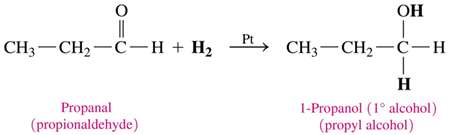
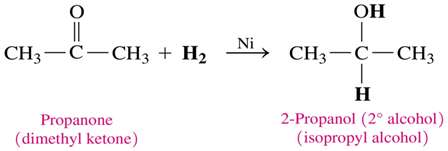
Aldehydes and ketones can be reduced to alcohols by hydrogenation (H2) in the presence of a metal catalyst (Ni, Pt, or Pd) or by sodium borohydride (NaBH4).
Aldehydes are reduced to primary (1°) alcohols.
Ketones are reduced to secondary (2°) alcohols.
Addition of Alcohols: Hemiacetals and Acetals
Hemiacetal and Acetal Formation
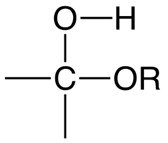
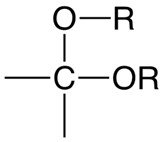
When an alcohol reacts with an aldehyde or ketone in the presence of an acid catalyst, a hemiacetal is formed. Hemiacetals contain both an –OH and an –OR group on the same carbon. Hemiacetals are generally unstable and react with a second molecule of alcohol to form a more stable acetal and water. Acetals contain two –OR groups on the same carbon atom.
The formation of hemiacetals and acetals is a reversible reaction.
Aldehydes are generally more reactive than ketones in these reactions due to less steric hindrance and a more positive carbonyl carbon.



Cyclic Hemiacetals and Acetals
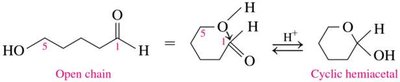
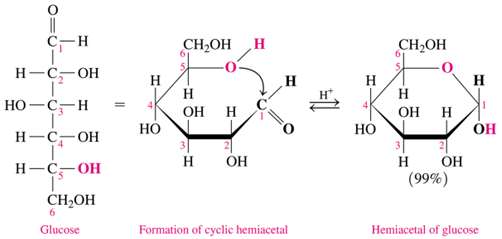
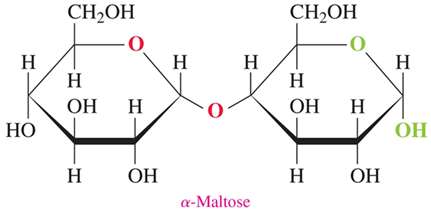
Cyclic hemiacetals form when the carbonyl group and a hydroxyl group are in the same molecule, typically resulting in five- or six-membered rings. These cyclic forms are more stable than their open-chain counterparts. Glucose, for example, forms a stable six-membered cyclic hemiacetal in aqueous solution.
An alcohol can add to a cyclic hemiacetal to form a cyclic acetal, a key reaction in the formation of disaccharides and polysaccharides.

Summary Table: Key Properties and Reactions of Aldehydes and Ketones
Property/Reaction | Aldehydes | Ketones |
|---|---|---|
General Structure | R-CHO | R1-CO-R2 |
Oxidation | Readily oxidized to carboxylic acids | Generally resistant to oxidation |
Reduction | Reduced to 1° alcohols | Reduced to 2° alcohols |
Tollens' Test | Positive (silver mirror) | Negative |
Benedict's Test | Positive for α-hydroxy aldehydes | Negative |
Boiling Point | Higher than alkanes, lower than alcohols | Higher than alkanes, lower than alcohols |
Solubility (C1–C4) | Soluble | Soluble |
