 Indietro
Alkadienes and Alkynes: Structure, Nomenclature, Preparation, and Reactions
Guida di studio - Note intelligenti
 Appunti personalizzati basati sui tuoi materiali, ampliati con definizioni chiave, esempi e contesto.
Alkadienes
Definition and Classification
Alkadienes are hydrocarbons containing two double bonds. Their structure and reactivity are central to understanding conjugated systems in organic chemistry.
Isolated dienes: Double bonds are separated by more than one single bond.
Conjugated dienes: Double bonds are separated by a single bond, allowing electron delocalization.
Cumulated dienes: Double bonds are adjacent, sharing a common carbon atom.
Nomenclature of Alkadienes
The nomenclature of alkadienes follows IUPAC rules, emphasizing the position and configuration of double bonds.
Select the longest chain containing both double bonds.
Replace the “ane” ending with “adiene.”
Number the chain to give the double bonds the lowest possible numbers.
Indicate substituents and their positions.
For geometrical isomers, specify the configuration (E/Z) for each double bond.
Example: 2-Methyl-1,3-butadiene; 2-Chloro-5-ethyl-1,3-heptadiene
Geometrical Isomerism
Alkadienes can exhibit geometrical (cis/trans or E/Z) isomerism when the double bonds are not at terminal positions.
Configuration is specified before the compound name, e.g., (Z,E)-5-chloro-2,4-pentadienoic acid.
Preparation of Alkadienes
Alkadienes are synthesized through various methods, especially for conjugated dienes.
Dehydrohalogenation of dihalides.
Dehydration of diols.
Other elimination reactions.
Conformations and Stability of Conjugated Dienes
Conjugated dienes, such as 1,3-butadiene, exhibit unique conformations and stability due to electron delocalization.
The s-trans conformation is predominant at room temperature.
Delocalization of π electrons across four carbon atoms increases stability.
Reactions of Alkadienes
Conjugated dienes undergo characteristic reactions, notably electrophilic addition and cycloaddition.
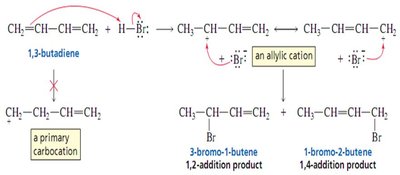
Electrophilic Addition: Addition of electrophiles (e.g., HBr) yields two products:
1,2-addition (direct addition)
1,4-addition (conjugate addition)
Product distribution is temperature-dependent:
Low temperature favors 1,2-addition.
High temperature favors 1,4-addition (more stable product).
Example: Addition of HBr to 1,3-butadiene yields 3-bromo-1-butene (1,2-addition) and 1-bromo-2-butene (1,4-addition).

Diels-Alder Reaction
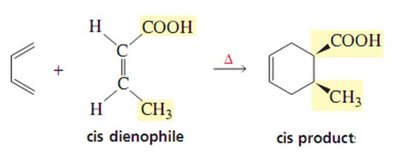
The Diels-Alder reaction is a cycloaddition between a conjugated diene (in s-cis conformation) and a dienophile, forming a six-membered ring.
Reaction is concerted (single step).
Syn addition; substituents retain their relative configuration (cis or trans).
Electron-withdrawing groups on the dienophile increase reactivity.
Example: Cis dienophile yields cis product; trans dienophile yields trans product.

Alkynes
Definition and Structure
Alkynes are hydrocarbons containing a carbon-carbon triple bond (C≡C). They are linear and sp-hybridized, and do not exhibit geometric isomerism.
General formula: CnH2n-2
Suffix: -yne

Nomenclature of Alkynes
Naming alkynes follows IUPAC rules, similar to alkenes.
Replace -ane with -yne.
Longest chain must include both carbons of the triple bond.
Number the chain to give the triple bond the lowest possible number.
If both double and triple bonds are present, double bond gets priority in numbering.
Example: 3,3-Dimethyl-1-butyne; 5-Ethyl-2-methyl-3-heptyne; 3-Methylpent-1-en-4-yne
Preparation of Alkynes
Alkynes are prepared by elimination reactions and dehalogenation.
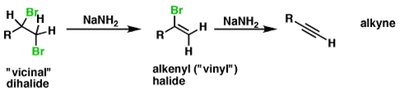
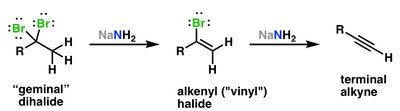
Elimination of dihalides (vicinal or geminal) using strong bases (e.g., NaNH2).
Double dehalogenation of tetrahalogenated compounds (e.g., Zn/acetic acid).
Dialkylation of acetylene to form higher alkynes.
Reactions of Alkynes
Alkynes undergo a variety of addition and substitution reactions.
Hydrogenation: Complete hydrogenation yields alkanes (Pd/C catalyst); partial hydrogenation yields cis-alkenes (Lindlar’s catalyst) or trans-alkenes (Na/NH3).
Addition of hydrogen halides: Follows Markovnikov’s rule to produce geminal dihalides; anti-Markovnikov addition occurs in presence of peroxides.
Halogenation: Addition of halogens forms dihaloalkenes or tetrahaloalkanes.
Hydration: Requires acid and mercuric ion; follows Markovnikov’s rule; enol intermediate rearranges to ketone (enol-keto tautomerization).
Diels-Alder reaction: Alkynes act as dienophiles to form cyclohexene derivatives.
Ozonolysis: Produces acid anhydrides or diketones; hydrolysis yields carboxylic acids.
Reactions due to acidity of terminal alkynes: Reaction with ammoniacal silver nitrate (Tollens reagent) distinguishes terminal alkynes; alkylation forms internal alkynes.











Summary Table: Types of Dienes
Type | Structure | Example |
|---|---|---|
Isolated | Double bonds separated by more than one single bond | CH2=CH-CH2-CH=CH2 |
Conjugated | Double bonds separated by one single bond | CH2=CH-CH=CH2 |
Cumulated | Double bonds adjacent (allene) | CH2=C=CH2 |
Additional info: The notes cover the structure, nomenclature, preparation, and reactions of alkadienes and alkynes, including mechanisms and stereochemistry. Images included are directly relevant to the described reactions and mechanisms.
