 Indietro
Exam 1 (PART 3)
Guida di studio - Note intelligenti
 Appunti personalizzati basati sui tuoi materiali, ampliati con definizioni chiave, esempi e contesto.
Alkanes and Cycloalkanes
Nomenclature of Alkanes
Alkanes are saturated hydrocarbons containing only single bonds between carbon atoms. Their general formula is . The systematic naming of alkanes follows IUPAC rules to ensure each compound has a unique name.
Longest Chain Rule: Identify the longest continuous chain of carbon atoms; this determines the parent name.
Branch Identification: Name and number substituents (branches) so that the sum of the numbers is minimized.
Alphabetical Order: List substituents alphabetically, ignoring prefixes like di-, tri-, tetra- for ordering.
Multiple Branches: Use prefixes (di-, tri-, tetra-) for identical substituents, but do not consider these prefixes for alphabetical order.
Special Branches: Common names include isopropyl, sec-butyl, isobutyl, tert-butyl, etc.
Example: 3-ethyl-2-methylpentane (ethyl and methyl branches on a pentane chain, numbered for lowest set of locants).
Nomenclature of Cycloalkanes
Cycloalkanes are ring-shaped saturated hydrocarbons with the general formula . The prefix 'cyclo' is added to the parent name. Numbering starts at a substituent and proceeds to give the lowest possible numbers to substituents.
Example: 1-ethyl-3-propylcyclohexane
Nomenclature of Functional Groups
Alkyl Halides (R-X): Prefixes: fluoro-, chloro-, bromo-, iodo-. Number the chain to give the halogen the lowest possible number.
Alcohols (R-OH): Suffix: -ol. Number the chain to give the hydroxyl group the lowest possible number. Priority is given to the alcohol group over alkyl or halide substituents.
Ethers (R-O-R'): Named as alkoxyalkanes in IUPAC (e.g., methoxyethane) or as alkyl alkyl ether in common nomenclature (e.g., ethyl methyl ether).
Amines (R-NH2, R2NH, R3N): Suffix: -amine. Use 'N-' to indicate substituents on nitrogen.
Conformational Analysis
Newman Projections and Rotational Conformations
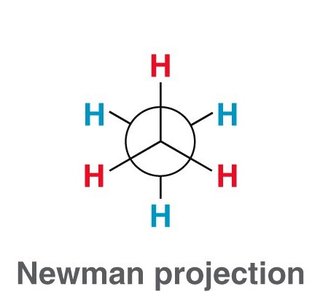
Newman projections are a way to visualize the spatial arrangement of bonds around a single bond, typically used to analyze conformational isomerism in alkanes.
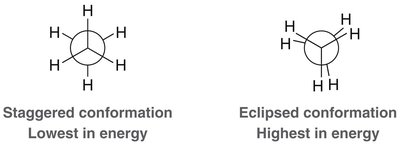
Staggered Conformation: Lowest energy; bonds on adjacent carbons are as far apart as possible.
Eclipsed Conformation: Highest energy; bonds on adjacent carbons align, increasing electron repulsion (torsional strain).
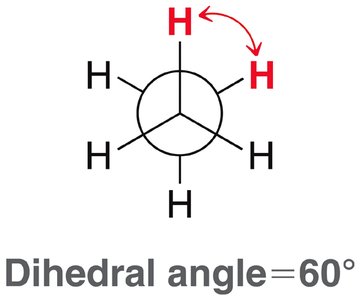
Dihedral Angle: The angle between two bonds on adjacent carbons; 60° for staggered, 0° for eclipsed.
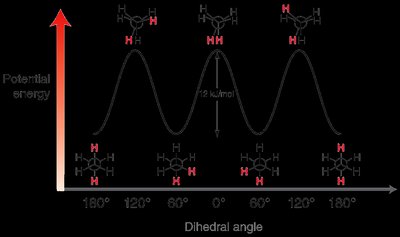
Energy Profile of Ethane Rotation
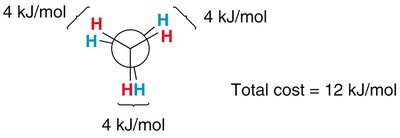
The energy difference between staggered and eclipsed conformations is called torsional strain. For ethane, the energy barrier is about 12 kJ/mol (4 kJ/mol per eclipsed interaction).
At room temperature, most ethane molecules are in the staggered conformation.
Butane Conformations
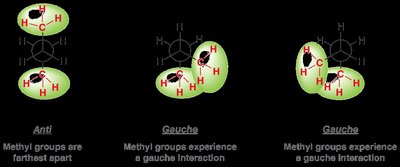
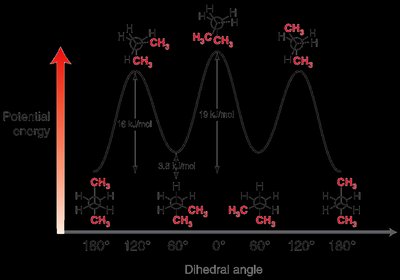
Butane exhibits more complex conformational behavior due to the presence of methyl groups. The anti conformation (methyl groups 180° apart) is the most stable, while gauche conformations (methyl groups 60° apart) are less stable due to steric hindrance.
Anti: Methyl groups are farthest apart (lowest energy).
Gauche: Methyl groups are 60° apart (higher energy due to steric strain).
Fully Eclipsed: Methyl groups overlap (highest energy).
Cycloalkanes: Structure and Strain
Ring Strain and Bond Angles
Cycloalkanes experience ring strain due to deviations from the ideal tetrahedral bond angle (109.5°) and torsional strain from eclipsed interactions. The amount of strain depends on ring size:
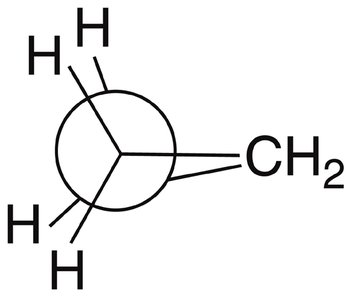
Cyclopropane: 60° bond angles, severe angle and torsional strain.
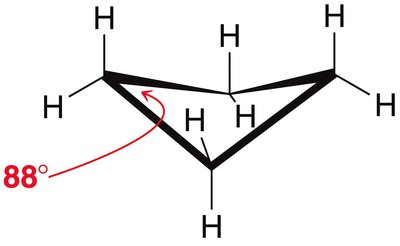
Cyclobutane: 88° bond angles, less angle strain but still significant torsional strain.
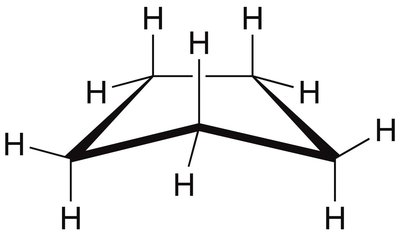
Cyclopentane: 108° bond angles, minimal angle strain, some torsional strain.
Cyclohexane: 109.5° bond angles in the chair conformation, minimal strain.

Cyclopropane
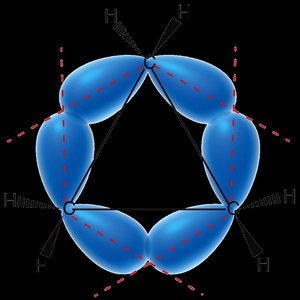
Cyclopropane is highly strained due to its small ring size, resulting in significant angle and torsional strain. The bonds are bent ('banana bonds') to reduce electron repulsion.
Cyclobutane and Cyclopentane
Cyclobutane adopts a puckered conformation to reduce torsional strain, while cyclopentane adopts an envelope conformation to minimize both angle and torsional strain.
Cyclohexane: Chair Conformation
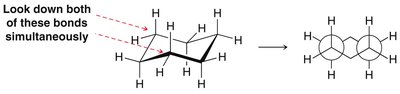
Cyclohexane is most stable in the chair conformation, which eliminates both angle and torsional strain. All bond angles are 109.5°, and all adjacent C-H bonds are staggered.
Axial and Equatorial Positions
In the chair conformation, six hydrogens are axial (perpendicular to the ring) and six are equatorial (around the equator of the ring). Proper drawing is essential for accurate analysis.

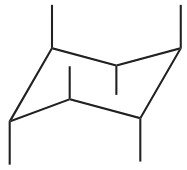

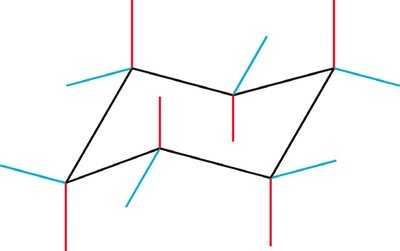
Ring Flips and Substituent Effects
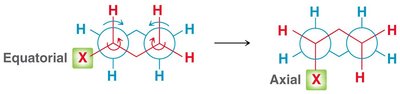
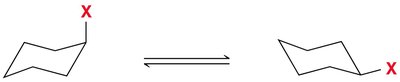
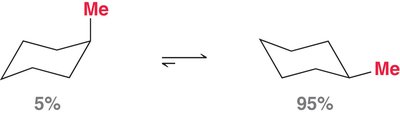
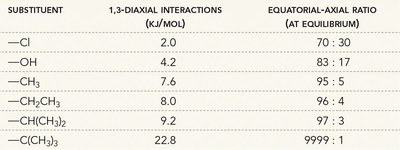
A ring flip interconverts axial and equatorial positions. Substituents prefer the equatorial position to minimize steric (1,3-diaxial) interactions. Larger groups have a stronger preference for the equatorial position.
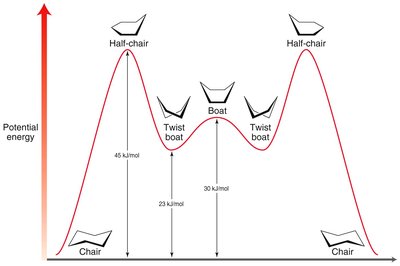
Gauche and 1,3-Diaxial Interactions
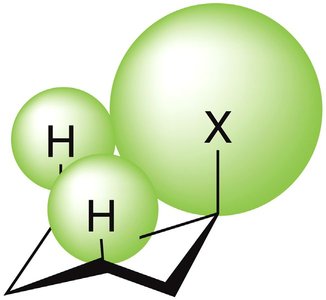
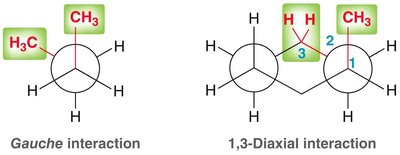
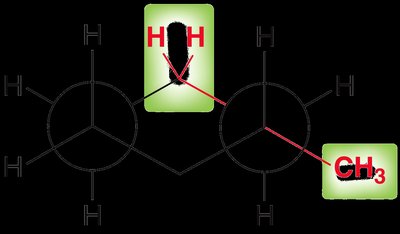
1,3-diaxial interactions in cyclohexane are analogous to gauche interactions in acyclic alkanes. Substituents in the axial position experience steric repulsion with axial hydrogens on the same side of the ring.
Disubstituted Cyclohexanes and Stereoisomerism
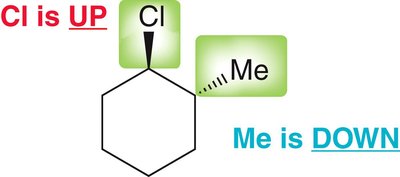
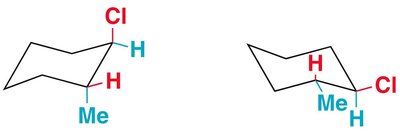
When two substituents are present, their relative positions (cis or trans) and their axial/equatorial orientation affect the molecule's stability and properties. Solid or dashed wedges indicate the orientation of substituents.
Cis-Trans Isomerism in Cycloalkanes
Cis-trans isomerism arises when two substituents are on the same (cis) or opposite (trans) sides of a cycloalkane ring. These are stereoisomers, not constitutional isomers, as they have the same connectivity but different spatial arrangements.

Additional info: This guide covers the nomenclature and conformational analysis of alkanes and cycloalkanes, including functional group naming, conformational energy profiles, and stereochemistry. For further practice, students should attempt drawing Newman projections, chair conformations, and identifying cis/trans isomers for various substituted cycloalkanes.
