 Indietro
Alkene Addition Reactions: Mechanisms, Products, and Stereochemistry
Guida di studio - Note intelligenti
 Appunti personalizzati basati sui tuoi materiali, ampliati con definizioni chiave, esempi e contesto.
Alkene Addition Reactions
Overview of Alkene Addition Reactions
Alkene addition reactions are fundamental transformations in organic chemistry, allowing the conversion of alkenes into a variety of functionalized products. These reactions often proceed via electrophilic addition mechanisms and are central to the synthesis of alkyl halides, halohydrins, epoxides, diols, and alkanes. The stereochemistry of these reactions is crucial, as it determines the nature and number of stereoisomers formed.
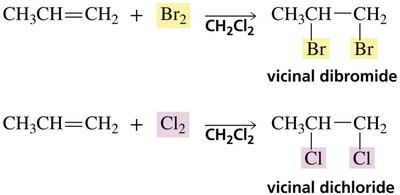
Alkyl halides can be formed from alkenes using halogens (Br2, Cl2) in inert solvents.
Halohydrins are produced when the solvent is not inert (e.g., water).
Epoxides are synthesized using peroxyacids.
Diols are formed via oxidation with OsO4 or KMnO4.
Alkanes are produced by catalytic hydrogenation.
Halogenation of Alkenes
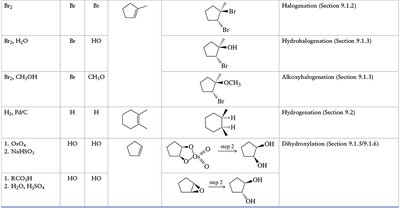
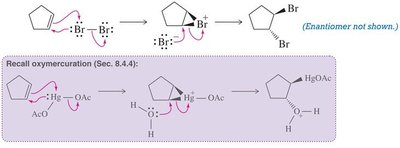
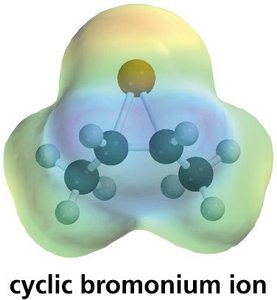
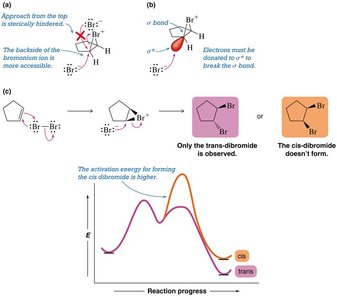
Halogenation involves the addition of halogens (Br2 or Cl2) to alkenes, resulting in vicinal dihalides. The reaction proceeds via a cyclic halonium ion intermediate, leading to anti addition and trans products.
Vicinal dihalides are formed when halogens add to adjacent carbons.
Mechanism: The alkene reacts with Br2 to form a cyclic bromonium ion, which is then attacked by Br- from the opposite side.
No carbocation rearrangements occur in this reaction.
Halohydrin Formation
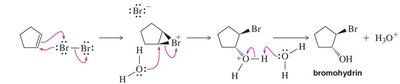
When halogenation is performed in water, halohydrins are formed. The water acts as a nucleophile, attacking the halonium ion to yield a product with both a halogen and an alcohol group.
Halohydrin: Contains both a halogen and a hydroxyl group on adjacent carbons.
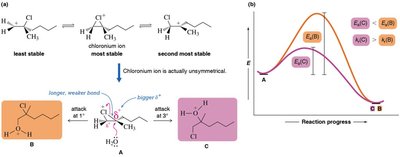
Major product: The hydroxyl group attaches to the more substituted carbon.
Mechanism: Water opens the halonium ion, leading to anti addition.

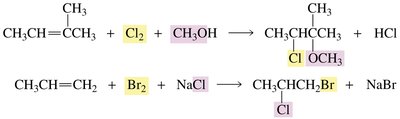
Competing Nucleophiles and Alkoxyhalogenation
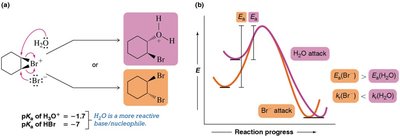
When other nucleophiles (e.g., alcohols or salts) are present, they can compete with water or halide ions, leading to the formation of alkoxyhalides or mixed products.
Alkoxyhalogenation: Alcohols react with halonium ions to form products with both halogen and alkoxy groups.
Mixed halides: Salts can lead to the exchange of halide ions.
Epoxidation of Alkenes
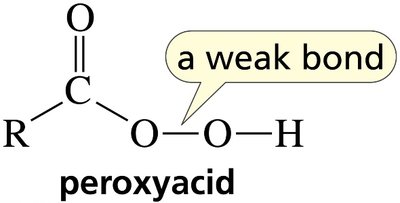
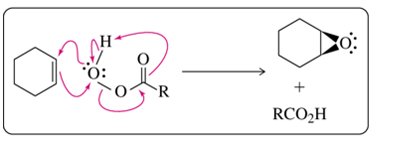
Epoxides are formed by the reaction of alkenes with peroxyacids (e.g., mCPBA). The reaction is stereospecific and proceeds via a concerted mechanism, resulting in syn addition.
Epoxide: A three-membered cyclic ether.
Peroxyacid: A carboxylic acid with an extra oxygen atom (e.g., mCPBA).
Mechanism: The alkene reacts with the peroxyacid, forming an epoxide and a carboxylic acid.

Dihydroxylation of Alkenes
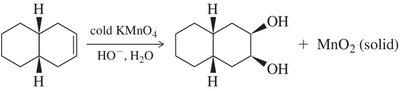
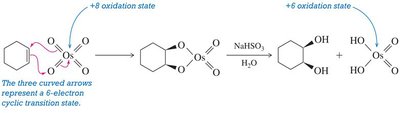
Dihydroxylation introduces two hydroxyl groups to the alkene, forming a diol. This can be achieved using osmium tetroxide (OsO4) or potassium permanganate (KMnO4), resulting in syn addition and cis diols.
Syn diol: Both hydroxyl groups are added to the same side of the double bond.
Mechanism: OsO4 or KMnO4 reacts with the alkene, followed by reduction (e.g., NaHSO3).

Trans Diol Formation via Epoxidation and Hydrolysis
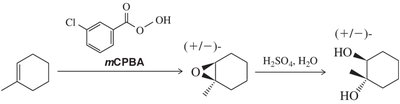
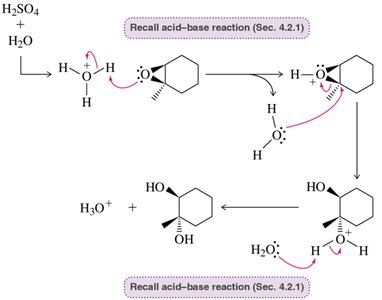
Trans diols can be synthesized by first forming an epoxide and then performing acid-catalyzed hydrolysis. This sequence results in anti addition across the double bond.
Trans diol: Hydroxyl groups are added to opposite sides of the double bond.
Mechanism: Epoxide formation followed by ring opening under acidic conditions.
Oxidative Cleavage of Alkenes
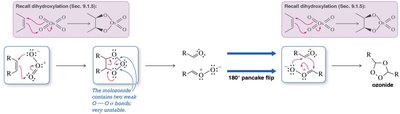
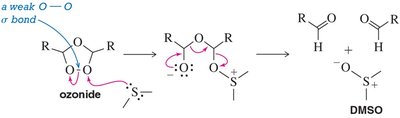
Alkenes can be cleaved to form carbonyl compounds (aldehydes and ketones) using reagents such as ozone (O3) followed by reductive workup (e.g., DMSO).
Ozonolysis: Cleavage of the double bond to yield carbonyl products.
Mechanism: Formation of ozonide intermediate, followed by reduction.
Catalytic Hydrogenation of Alkenes
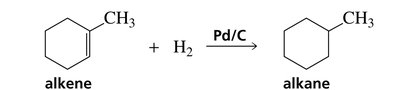
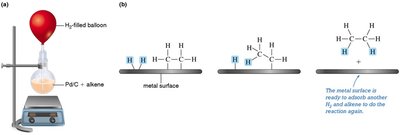
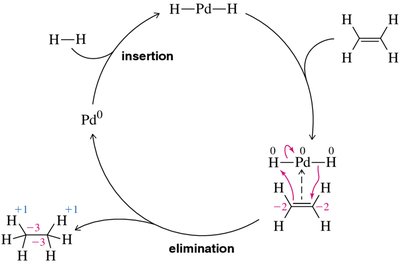
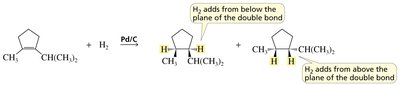
Catalytic hydrogenation reduces alkenes to alkanes by adding hydrogen across the double bond. The reaction requires a metal catalyst, typically palladium on carbon (Pd/C), and proceeds via syn addition.
Alkane formation: Complete reduction of the double bond.
Mechanism: Hydrogen atoms are added to the same face of the alkene.
Stereochemistry of Alkene Addition Reactions
Key Concepts in Stereochemistry
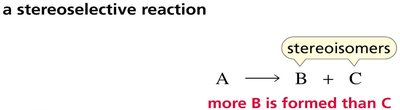
Stereochemistry is the study of the spatial arrangement of atoms in molecules. Addition reactions can be stereoselective or stereospecific, affecting the number and type of stereoisomers formed.
Stereoselective: One stereoisomer is formed preferentially over another.
Stereospecific: The stereochemistry of the reactant determines the stereochemistry of the product.
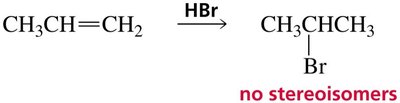
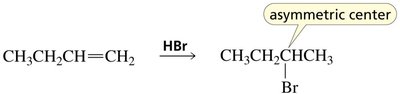
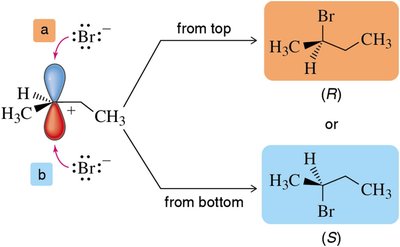
Chiral centers: Formation of new chiral centers can lead to enantiomers or diastereomers.

Anti and Syn Addition
Alkene addition reactions can proceed via anti or syn addition, depending on the mechanism and intermediate involved. Anti addition occurs when substituents are added to opposite faces, while syn addition places them on the same face.
Anti addition: Seen in halogenation and halohydrin formation due to cyclic intermediates.
Syn addition: Observed in hydrogenation, epoxidation, and dihydroxylation with OsO4.
Summary Table: Stereochemistry of Alkene Addition Reactions
The following table summarizes the stereochemical outcomes of common alkene addition reactions:
Reaction | Type of addition | Stereoisomers formed |
|---|---|---|
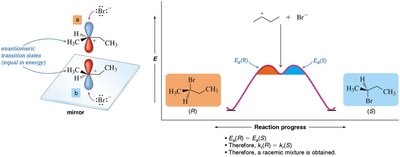
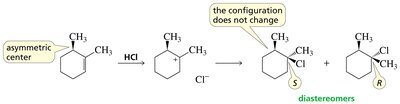
Addition reactions that create one asymmetric center in the product | — | If the reactant does not have an asymmetric center, a racemic mixture is formed. If the reactant has an asymmetric center, unequal amounts of a pair of diastereomers are formed. |
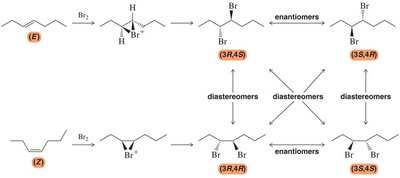
Addition reactions that create two asymmetric centers in the product | syn and anti | Four stereoisomers are formed: cis and trans isomers for each pair. |
Addition of reagents that form a carbocation intermediate | — | cis and trans isomers can form the same products. |
Addition of H2 | syn | cis — erythro or cis enantiomers* |
Addition of a peroxyacid | syn | cis — erythro or cis enantiomers* |
Addition of Br2, Br2 + H2O, Br2 + ROH (any reaction that forms a halonium ion intermediate) | anti | trans — threo or trans enantiomers* |
Mechanistic Pathways and Product Prediction
Mechanism Practice and Product Prediction
Understanding the mechanism of each alkene addition reaction is essential for predicting the products and their stereochemistry. Practice involves drawing the mechanism, identifying intermediates, and determining the stereochemical outcome.
Stepwise approach: Predict the product, then prove it via mechanism.
Mechanistic details: Include electron flow, intermediate formation, and stereochemical consequences.
Summary: Alkene Addition Reactions and Stereochemistry
Alkene addition reactions are diverse and yield a variety of products depending on the reagents and conditions used. The stereochemistry of these reactions is determined by the mechanism and the nature of the intermediates, leading to the formation of enantiomers, diastereomers, or racemic mixtures. Mastery of these concepts is essential for predicting reaction outcomes and understanding organic synthesis.
