 Indietro
Alkenes, Alkynes, and Radical Reactions: Study Guide
Guida di studio - Note intelligenti
 Appunti personalizzati basati sui tuoi materiali, ampliati con definizioni chiave, esempi e contesto.
Chapter 8: Alkenes
IUPAC Nomenclature of Alkenes
Alkenes are hydrocarbons containing at least one carbon-carbon double bond. The IUPAC naming system ensures systematic identification of these compounds.
Key Point 1: The longest chain containing the double bond is selected as the parent chain.
Key Point 2: Number the chain so that the double bond gets the lowest possible number.
Key Point 3: Use the suffix -ene to indicate the presence of a double bond.
Example: CH2=CH-CH3 is named propene.
Markovnikov’s Rule
Markovnikov’s Rule predicts the regioselectivity of electrophilic addition reactions to alkenes.
Key Point 1: In the addition of HX to an alkene, the hydrogen attaches to the carbon with more hydrogens, and the halide attaches to the carbon with fewer hydrogens.
Key Point 2: This rule helps determine the major product in reactions such as hydrohalogenation.
Example: Addition of HBr to propene yields 2-bromopropane as the major product.
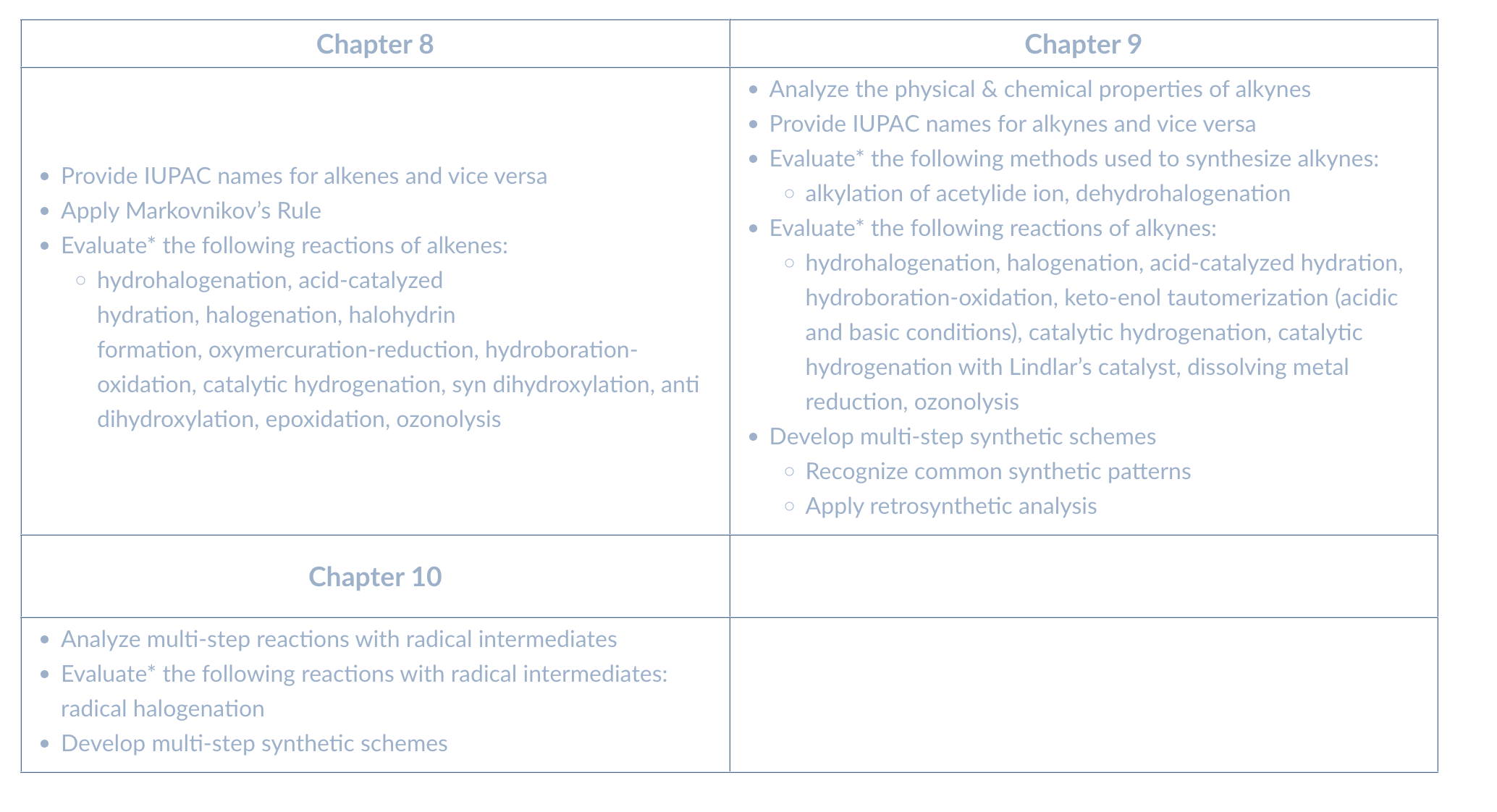
Reactions of Alkenes
Alkenes undergo a variety of addition reactions, each with distinct mechanisms and outcomes.
Hydrohalogenation: Addition of HX (e.g., HCl, HBr) to form alkyl halides.
Acid-catalyzed hydration: Addition of water in the presence of acid to form alcohols.
Halogenation: Addition of X2 (e.g., Br2, Cl2) to form dihalides.
Halohydrin formation: Addition of X2 and H2O to form halohydrins.
Oxymercuration-reduction: Addition of water via mercuric acetate, followed by reduction.
Hydroboration-oxidation: Anti-Markovnikov addition of water using BH3 and H2O2.
Catalytic hydrogenation: Addition of H2 across the double bond using a metal catalyst.
Syn dihydroxylation: Addition of two OH groups to the same side of the double bond.
Anti dihydroxylation: Addition of two OH groups to opposite sides of the double bond.
Epoxidation: Formation of an epoxide ring using peracids.
Ozonolysis: Cleavage of the double bond using ozone to form carbonyl compounds.
Example: Hydroboration-oxidation of propene yields 1-propanol.
Chapter 9: Alkynes
Physical and Chemical Properties of Alkynes
Alkynes are hydrocarbons with at least one carbon-carbon triple bond, exhibiting unique physical and chemical properties.
Key Point 1: Alkynes are generally less reactive than alkenes in addition reactions.
Key Point 2: Terminal alkynes are more acidic than alkenes and alkanes.
Example: Acetylene (ethyne) is a common alkyne used in welding.
IUPAC Nomenclature of Alkynes
The IUPAC system for alkynes is similar to that for alkenes, with the suffix -yne indicating a triple bond.
Key Point 1: The longest chain containing the triple bond is chosen as the parent chain.
Key Point 2: Number the chain so the triple bond gets the lowest possible number.
Example: CH≡C-CH3 is named propyne.
Synthesis of Alkynes
Alkynes can be synthesized using specific methods that introduce or extend the triple bond.
Alkylation of acetylide ion: Terminal alkynes can be deprotonated to form acetylide ions, which react with alkyl halides.
Dehydrohalogenation: Removal of two equivalents of HX from dihalides to form alkynes.
Example: Dehydrohalogenation of 1,2-dibromoethane yields acetylene.
Reactions of Alkynes
Alkynes undergo addition reactions, often resulting in the reduction of the triple bond to a double or single bond.
Hydrohalogenation: Addition of HX to form vinyl halides or geminal dihalides.
Halogenation: Addition of X2 to form tetrahalides.
Acid-catalyzed hydration: Addition of water in the presence of acid to form ketones or aldehydes.
Hydroboration-oxidation: Anti-Markovnikov addition of water to form aldehydes.
Keto-enol tautomerization: Interconversion between enol and keto forms under acidic or basic conditions.
Catalytic hydrogenation: Complete reduction to alkanes using metal catalysts.
Catalytic hydrogenation with Lindlar’s catalyst: Partial reduction to cis-alkenes.
Dissolving metal reduction: Partial reduction to trans-alkenes using sodium in liquid ammonia.
Ozonolysis: Cleavage of the triple bond to form carboxylic acids or ketones.
Example: Hydroboration-oxidation of terminal alkyne yields an aldehyde.
Multi-Step Synthetic Schemes and Retrosynthetic Analysis
Organic synthesis often involves multiple steps, requiring careful planning and retrosynthetic analysis.
Key Point 1: Recognize common synthetic patterns, such as functional group interconversions.
Key Point 2: Apply retrosynthetic analysis to break down complex molecules into simpler precursors.
Example: Synthesis of 2-butanone from acetylene via alkylation, hydration, and tautomerization.
Chapter 10: Radical Reactions
Radical Intermediates in Multi-Step Reactions
Radical intermediates play a crucial role in certain organic reactions, especially in halogenation and polymerization.
Key Point 1: Radicals are species with unpaired electrons, formed by homolytic bond cleavage.
Key Point 2: Multi-step reactions may involve radical propagation, termination, and initiation steps.
Example: Radical halogenation of alkanes proceeds via radical intermediates.
Radical Halogenation
Radical halogenation is a method for introducing halogen atoms into organic molecules.
Key Point 1: Initiation: Formation of radicals by homolytic cleavage of X2 (e.g., Cl2).
Key Point 2: Propagation: Radicals react with alkanes to form alkyl radicals and HX.
Key Point 3: Termination: Two radicals combine to form a stable molecule.
Example: Chlorination of methane yields chloromethane and hydrochloric acid.
Multi-Step Synthetic Schemes Involving Radicals
Radical reactions can be integrated into multi-step synthetic schemes for complex molecule construction.
Key Point 1: Identify steps where radical intermediates are formed and utilized.
Key Point 2: Combine radical reactions with other functional group transformations for efficient synthesis.
Example: Synthesis of alkyl halides via radical halogenation followed by nucleophilic substitution.
