 Indietro
Alkenes: Structure, Nomenclature, Reactivity, Thermodynamics, and Kinetics
Guida di studio - Note intelligenti
 Appunti personalizzati basati sui tuoi materiali, ampliati con definizioni chiave, esempi e contesto.
Alkenes: Structure and Nomenclature
Molecular Formula and Degree of Unsaturation
The degree of unsaturation is a key concept in organic chemistry, indicating the number of π bonds and rings present in a molecule. Each π bond or ring reduces the number of hydrogens by two compared to a saturated hydrocarbon.
Degree of Unsaturation: The total number of π bonds and rings in a molecule.
Formula: For a hydrocarbon, degree of unsaturation = (2C + 2 - H)/2, where C is the number of carbons and H is the number of hydrogens.
Application: Used to determine possible structures from a molecular formula.


Saturated and Unsaturated Hydrocarbons
Hydrocarbons are classified based on the presence or absence of double bonds.
Saturated hydrocarbons (alkanes): Contain only single bonds.
Unsaturated hydrocarbons (alkenes, alkynes): Contain one or more double or triple bonds.

Naming Alkenes
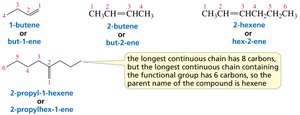
Alkenes are named by replacing the "-ane" suffix of alkanes with "-ene". The functional group (double bond) receives the lowest possible number in the chain.
Systematic and Common Names: Ethene (ethylene), propene (propylene), cyclopentene, cyclohexene.
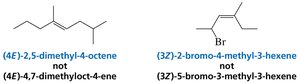
Numbering: The chain is numbered to give the double bond the lowest possible position.

Stereoisomers: cis/trans and E/Z Nomenclature
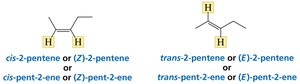
Alkenes can exhibit stereoisomerism due to restricted rotation around the double bond. The prefixes cis/trans or E/Z are used to distinguish these isomers.
cis (Z): Substituents on the same side of the double bond.
trans (E): Substituents on opposite sides of the double bond.
Naming Alkenes with Multiple Double Bonds
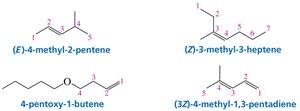
Alkenes with more than one double bond are named as dienes, trienes, etc., with appropriate locants for each double bond.
diene: Two double bonds.
triene: Three double bonds.

Substituent Placement and Alphabetical Order
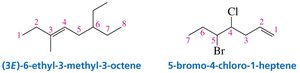
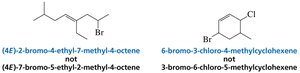
Substituents are listed before the parent name and in alphabetical order. The chain is numbered to give the functional group the lowest number, and if a tie occurs, the lowest substituent number is used.
Naming Cyclic Alkenes
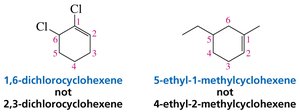
For cyclic alkenes, the double bond is always between C1 and C2, so numbering starts there. The ring is numbered to give substituents the lowest possible numbers.

Vinylic and Allylic Carbons
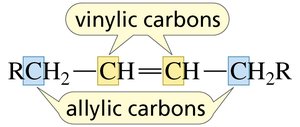
Understanding the location of vinylic and allylic carbons is important for predicting reactivity and naming groups.
Vinylic carbon: The sp2 carbon of an alkene.
Allylic carbon: A carbon adjacent to a vinylic carbon.
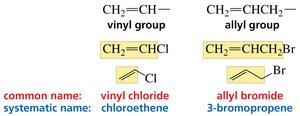
Vinyl and Allyl Groups
Vinyl and allyl groups are common substituents in organic chemistry, named based on their attachment to vinylic or allylic carbons.
Vinyl group: CH2=CH–
Allyl group: CH2=CHCH2–

Structure and Reactivity of Alkenes
Structure of an Alkene
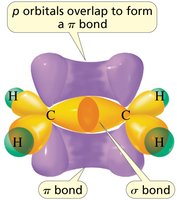
Alkenes are characterized by a double bond consisting of one σ bond and one π bond formed by the overlap of p orbitals.
Planarity of Alkenes
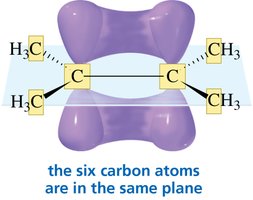
The six atoms involved in an alkene (the two carbons and four substituents) are in the same plane due to the geometry of the double bond.
Stereoisomers of Compounds with Multiple Double Bonds
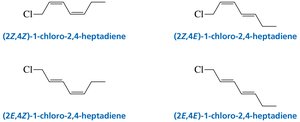
Compounds with two or more double bonds can have multiple stereoisomers, depending on the arrangement of substituents around each double bond.
Reactivity: Electrophiles and Nucleophiles
Families of Organic Compounds
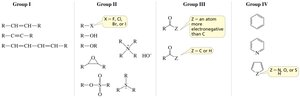
Organic compounds are grouped into families based on their functional groups, which determine their reactivity.
Functional group: The part of a molecule responsible for its chemical reactions.
Classification of Families
Each family can be placed in one of four groups, which react in similar ways.
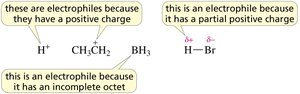
Electrophiles
Electrophiles are species that accept electrons. They may have a positive charge, partial positive charge, or an incomplete octet.
Examples: H+, CH3CH2+, BH3, H–Br (partial positive charge on H).
Nucleophiles
Nucleophiles are species that donate electrons. They may have a negative charge, lone pair, or π bond.
Examples: HO–, Cl–, CH3NH2, H2O, CH2=CH2.

Nucleophile-Electrophile Reactions
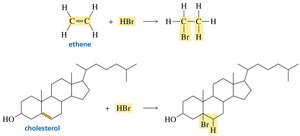
Organic reactions often proceed via nucleophile-electrophile interactions, typically in a stepwise mechanism.

Reaction Mechanisms and Curved Arrows
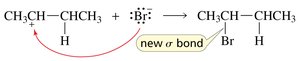
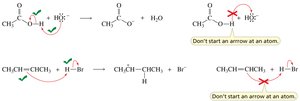
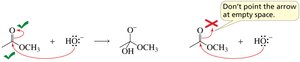
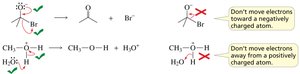
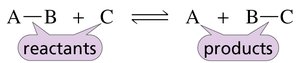
Mechanisms describe the step-by-step conversion of reactants to products. Curved arrows indicate the movement of electrons.
Arrow starts: Always at a pair of electrons.
Arrow points: To where electrons are going.
Arrow direction: Away from negative, toward positive.
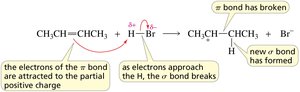
Thermodynamics and Kinetics
Reaction Coordinate Diagram
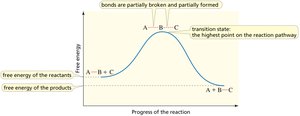
A reaction coordinate diagram illustrates the energy changes during a reaction, showing the transition state and energy barrier.
Thermodynamics vs. Kinetics
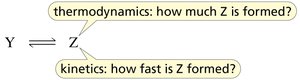
Thermodynamics determines how much product is formed, while kinetics determines how fast the product is formed.
Equilibrium Constant
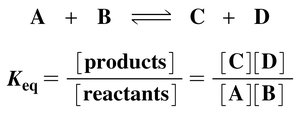
The equilibrium constant () gives the relative concentrations of reactants and products at equilibrium.
Formula:
Exergonic and Endergonic Reactions
Exergonic reactions release free energy ( negative), while endergonic reactions require free energy ($\Delta G$ positive).
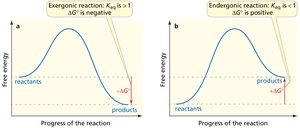
Gibbs Free-Energy Change
The change in Gibbs free energy () is calculated as:
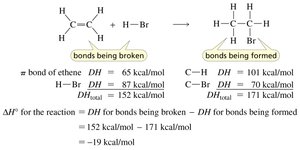
Calculating Enthalpy of Reaction
Enthalpy change () is determined by the difference between the energy required to break bonds and the energy released from forming bonds.
Catalytic Hydrogenation and Alkene Stability
Catalytic Hydrogenation
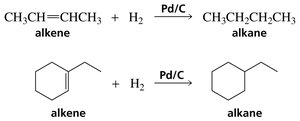
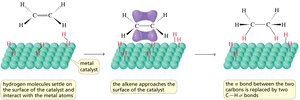
Catalytic hydrogenation is a reduction reaction where the number of C–H bonds increases, converting alkenes to alkanes using a metal catalyst.

Heat of Hydrogenation
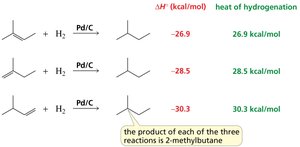
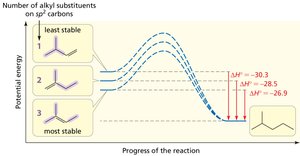
The heat of hydrogenation is the enthalpy change for the addition of hydrogen to an alkene. It is used to compare the relative stabilities of alkenes.
Using Heat of Hydrogenation to Determine Alkene Stability
The most stable alkene has the smallest heat of hydrogenation. Alkene stability increases with the number of alkyl groups attached to the sp2 carbons.

Trans vs. Cis Alkene Stability
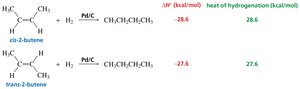
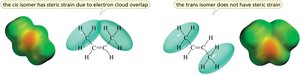
Trans alkenes are more stable than cis alkenes due to reduced steric strain.
Reaction Mechanisms and Catalysis
Reaction Coordinate Diagrams for Fast and Slow Reactions
Reaction coordinate diagrams can illustrate the energy profiles for fast and slow, exergonic and endergonic reactions.
Free Energy of Activation
The free energy of activation () is the energy barrier that must be overcome for a reaction to proceed.
Transition State Structure
Transition states have partially formed bonds and represent the highest energy point along the reaction pathway.
Reaction Coordinate Diagram for Addition of HBr to 2-Butene
The rate-limiting step is the step with the highest transition state on the reaction coordinate diagram.
Catalysts and Enzymes
A catalyst provides a pathway with a lower energy barrier, increasing the reaction rate without changing the energies of reactants or products. Most biological catalysts are enzymes, which bind substrates at their active sites and catalyze reactions using amino acid side chains.
Learning Objectives
5.1 Name an alkene given its structure and draw the condensed and/or skeletal structure of an alkene given its name.
5.2 Calculate the degree of unsaturation of a hydrocarbon from its molecular formula and determine the molecular formula of a hydrocarbon knowing the number of carbons and the degree of unsaturation.
5.3 Identify allylic and vinylic carbons and hydrogens.
5.4 Show how curved arrows can be used to describe the bond-breaking and bond-making steps that occur as reactants are converted into products and how curved arrows can be used to predict the product of a reaction.
5.5 Identify electrophiles and nucleophiles.
5.6 Describe how equilibrium is related to free energy and how free energy is related to the rate constant of a reaction.
5.7 Predict the relative stabilities of alkenes.
5.8 Identify the factors that determine the rate of a reaction.
