 Indietro
Alkyl Halides and Radical Reactions: Properties, Synthesis, and Mechanisms
Guida di studio - Note intelligenti
 Appunti personalizzati basati sui tuoi materiali, ampliati con definizioni chiave, esempi e contesto.
Alkyl Halides: Classification and Properties
Types of Alkyl Halides
Alkyl halides are organic compounds in which a halogen atom (F, Cl, Br, I) is bonded to an alkyl group. They are classified based on the nature of the carbon to which the halogen is attached:
Haloalkane (Alkyl Halide): Halogen attached to a saturated carbon atom.
Haloalkene (Alkenyl/Vinyl Halide): Halogen attached to a carbon in a double bond.
Haloarene (Aryl Halide): Halogen attached to an aromatic ring.
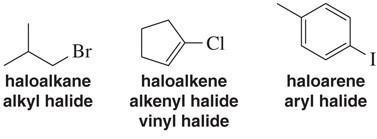
Example: 2-bromopropane (haloalkane), cyclopentenyl chloride (haloalkene), iodobenzene (haloarene).
Physical Properties of Alkyl Halides
Alkyl halides are generally polar due to the electronegativity of halogens. Their boiling and melting points depend on the size and polarizability of the halogen:
Boiling Point: Increases with the mass and polarizability of the halogen (I > Br > Cl > F).
Bond Length: Increases as the halogen atom size increases.
Dipole Moment: Varies with the halogen and the carbon-halogen bond.
Example: CH3I has a higher boiling point than CH3F due to iodine's larger size and greater polarizability.
Synthesis of Alkyl Halides
Common Methods of Synthesis
Alkyl halides can be synthesized by several methods, including direct halogenation and addition reactions:
Halogenation of Alkanes: Reaction with Cl2 or Br2 under heat or light.
Addition to Alkenes: Addition of HX (e.g., HBr) or halogens (Cl2, Br2).
Radical Addition: Addition of HBr in the presence of peroxides (anti-Markovnikov addition).
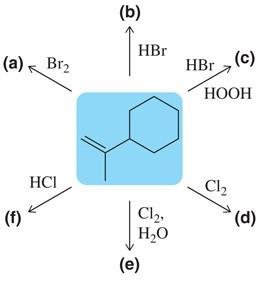
Example: Addition of HBr to 1-butene yields 2-bromobutane (Markovnikov) or 1-bromobutane (anti-Markovnikov with peroxide).
Radical Chemistry: Mechanisms and Stability
Bond Cleavage: Homolytic vs. Heterolytic
Bond breaking can occur in two ways:
Homolytic Cleavage: Each atom takes one electron, forming radicals. Represented by single-barbed arrows.
Heterolytic Cleavage: One atom takes both electrons, forming ions. Represented by double-barbed arrows.

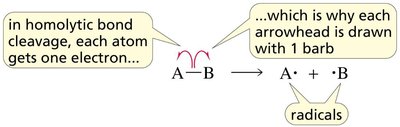
Example: Homolytic cleavage of Br2 forms two Br radicals.
Stability of Alkyl Radicals
Radical stability increases with the number of alkyl groups attached to the radical carbon due to hyperconjugation and inductive effects:
Tertiary Radical: Most stable
Secondary Radical: More stable than primary
Primary Radical: More stable than methyl
Methyl Radical: Least stable
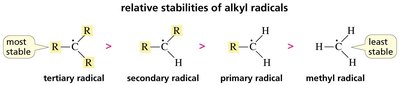
Example: Bromination favors formation of tertiary radicals due to their stability.
Halogenation of Alkanes: Mechanism and Selectivity
Reaction Conditions and Products
Halogenation of alkanes requires high temperatures or light (hν) to initiate radical formation. The reaction produces alkyl halides and hydrogen halide:
Chlorination: Less selective, produces a mixture of products.
Bromination: More selective, favors formation of more stable radicals.
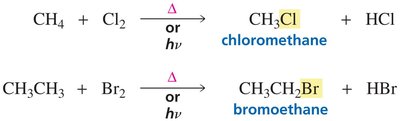
Example: CH4 + Cl2 → CH3Cl + HCl
Mechanism: Initiation, Propagation, Termination
The halogenation mechanism consists of three steps:
Initiation: Formation of radicals by homolytic cleavage.
Propagation: Radicals react with alkanes to form new radicals and products.
Termination: Radicals combine to form stable molecules, ending the chain reaction.
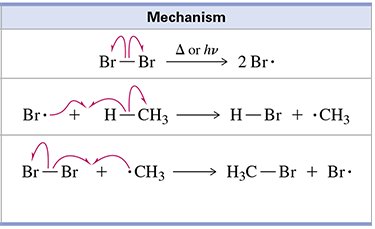
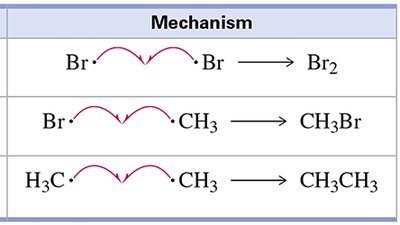
Example: Br2 + hν → 2 Br• (initiation); Br• + CH4 → HBr + CH3• (propagation).
Product Selectivity
Bromination is more selective than chlorination, producing a higher proportion of the most stable (tertiary) alkyl halide:
Reaction | Major Product (%) | Minor Product (%) |
|---|---|---|
Chlorination | 2-chloropropane (60%) | 1-chloropropane (40%) |
Bromination | 2-bromopropane (97%) | 1-bromopropane (3%) |

Example: Bromination of propane yields mostly 2-bromopropane.
Radical Reactions with Alkenes
Markovnikov vs. Anti-Markovnikov Addition
Alkenes react with HBr to form alkyl bromides. The product depends on the presence of peroxides:
Markovnikov Addition: HBr adds so that Br attaches to the more substituted carbon.
Anti-Markovnikov Addition: In the presence of peroxides, Br attaches to the less substituted carbon.


Example: 1-butene + HBr → 2-bromobutane (Markovnikov); 1-butene + HBr + peroxide → 1-bromobutane (anti-Markovnikov).
Mechanism of Radical Addition
The radical addition mechanism involves the formation of a bromine radical, which initiates the addition to the alkene. No carbocation intermediate is formed, preventing rearrangement. This reaction is specific to HBr due to thermodynamic factors.
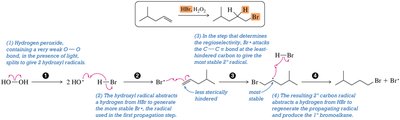
Example: Peroxide-initiated addition of HBr to 1-butene yields 1-bromobutane.
Allylic Bromination with NBS
Allylic Substitution
Bromination at the allylic position (carbon adjacent to a double bond) is achieved using N-bromosuccinimide (NBS). The reaction proceeds via a radical mechanism:
Initiation: Formation of bromine radicals.
Propagation: Bromine radical abstracts a hydrogen from the allylic carbon, forming an allylic radical.
Termination: Allylic radical reacts with Br2 to form the allylic bromide.
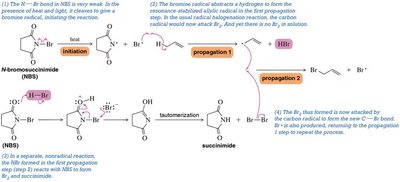
Example: NBS brominates the allylic position of cyclohexene.
Radical Substitution Products and Stereochemistry
Product Diversity and Stereochemistry
The number of alkyl halide products formed depends on the number of different hydrogens in the alkane. Substitution at chiral centers can produce racemic mixtures of stereoisomers.
Example: Bromination of propane yields both 1-bromopropane and 2-bromopropane, with the latter being the major product.
Additional info: Radical reactions are crucial for the functionalization of otherwise unreactive alkanes, and understanding their mechanisms is essential for predicting product distributions and stereochemistry in organic synthesis.
