 Indietro
Alkyl Halides and SN2 Reactions: Mechanisms, Molecular Orbitals, and Factors Affecting Rate
Guida di studio - Note intelligenti
 Appunti personalizzati basati sui tuoi materiali, ampliati con definizioni chiave, esempi e contesto.
Alkyl Halides: Structure and Properties
Definition and Bonding
Alkyl halides are organic compounds in which a halogen atom (X) is bonded to an sp3-hybridized carbon. The carbon-halogen (C–X) bond is polar due to the difference in electronegativity between carbon and the halogen.
Structure: General formula is R–X, where R is an alkyl group and X is a halogen (F, Cl, Br, I).
Bond Polarity: The halogen is more electronegative, resulting in a partial negative charge (δ–) on X and a partial positive charge (δ+) on the carbon.
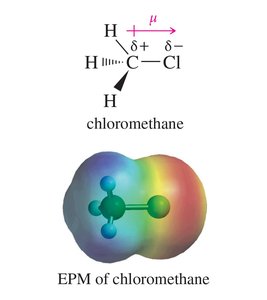
Example: Chloromethane (CH3Cl) shows a dipole moment due to the polar C–Cl bond.
Uses of Alkyl Halides
Used as aprotic solvents in organic synthesis.
Serve as electrophiles in substitution and elimination reactions.
SN2 Reaction: Mechanism and Molecular Orbitals
SN2 Mechanism Overview
The SN2 (bimolecular nucleophilic substitution) reaction is a fundamental mechanism in organic chemistry, where a nucleophile attacks an electrophilic carbon, displacing a leaving group in a single, concerted step.
Concerted Mechanism: Bond formation and bond breaking occur simultaneously.
Rate Law: The reaction rate depends on both the nucleophile and the substrate:
Frontier Molecular Orbital (FMO) Theory
FMO theory explains the electronic interactions during SN2 reactions. The HOMO (highest occupied molecular orbital) of the nucleophile interacts with the LUMO (lowest unoccupied molecular orbital) of the electrophile.
HOMO: Electron-rich orbital of the nucleophile.
LUMO: Electron-poor antibonding orbital (σ*) of the substrate.
Backside attack is favored, leading to inversion of configuration.
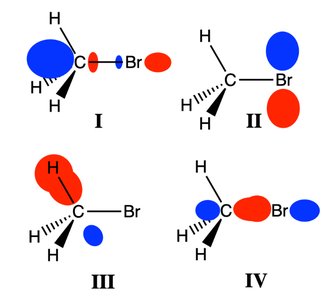
Example: The nucleophile attacks the carbon from the opposite side of the leaving group, filling the σ* orbital and breaking the C–X bond.
Transition State and Reaction Coordinate
The SN2 transition state is characterized by partial bonds to both the nucleophile and the leaving group. The geometry is trigonal bipyramidal, and the carbon is pentavalent in the transition state.
Transition State: Simultaneous bond formation and bond breaking.
Reaction Coordinate Diagram: Shows energy changes during the reaction, with a single transition state.
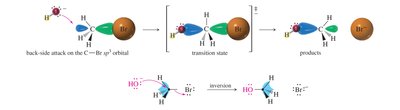
Example: The SN2 reaction leads to inversion of stereochemistry at the carbon center (Walden inversion).
Stereochemical Outcome of SN2 Reactions
Walden Inversion
When the carbon undergoing substitution is a stereocenter, the SN2 reaction results in inversion of configuration. This is known as Walden inversion.
Only the reacting stereocenter inverts; other centers remain unchanged.
Backside attack is responsible for the inversion.
Example: If the starting material is (R)-2-bromobutane, the product will be (S)-2-butanol after SN2 substitution.
Thermodynamics and Favorability of SN2 Reactions
Equilibrium Position
The favorability of an SN2 reaction depends on the relative thermodynamic stability of the nucleophile and the leaving group.
ΔG (Gibbs Free Energy): Favorable reactions have ΔG < 0 and Keq > 1.
Stable leaving groups and strong nucleophiles favor product formation.
Factors Affecting SN2 Rate: Nucleophile Strength
Trends in Nucleophilic Strength
The rate of SN2 reactions is influenced by the strength of the nucleophile. Several factors affect nucleophilic strength:
Electronegativity: Higher electronegativity decreases nucleophile strength.
Atomic Radius & Polarizability: Larger, more polarizable atoms are stronger nucleophiles.
Charge: Anionic nucleophiles are generally stronger than neutral ones.
Resonance: Delocalized electrons (resonance stabilization) decrease nucleophile reactivity.
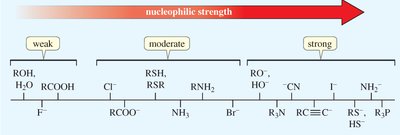
Example: I– is a stronger nucleophile than F– due to its larger radius and greater polarizability.
Common Nucleophiles and SN2 Products
Classification and Examples
SN2 reactions can be used to synthesize a wide variety of organic compounds, depending on the nucleophile used.
Alcohols: Formed by substitution with OH–.
Ethers: Formed by substitution with RO–.
Thiols: Formed by substitution with RS–.
Alkyl halides: Formed by substitution with halide ions.
Nitriles: Formed by substitution with CN–.
Nucleophile | Product | Class of Product |
|---|---|---|
I– | R–I | Alkyl halide |
OH– | R–OH | Alcohol |
RO– | R–OR | Ether |
SH– | R–SH | Thiol |
NH2– | R–NH2 | Amine salt |
CN– | R–CN | Nitrile |
RCO2– | R–CO2R | Ester |
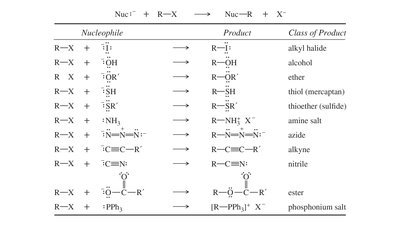
Example: Substitution of bromide with cyanide ion yields a nitrile product.
Summary of Key Concepts
Alkyl halides are important substrates for SN2 reactions due to their polar C–X bonds.
SN2 reactions proceed via a concerted mechanism, with backside attack and stereochemical inversion.
FMO theory explains the electronic basis for nucleophile approach and bond breaking.
Nucleophile strength, leaving group stability, and steric hindrance are critical factors affecting SN2 rate and favorability.
SN2 reactions are versatile for synthesizing a wide range of organic compounds.
