 Indietro
Alkynes: Electrophilic Addition and Redox Reactions – Study Notes
Guida di studio - Note intelligenti
 Appunti personalizzati basati sui tuoi materiali, ampliati con definizioni chiave, esempi e contesto.
Alkynes: Electrophilic Addition and Redox Reactions
Properties and Classification of Alkynes
Alkynes are unsaturated hydrocarbons characterized by a carbon–carbon triple bond. Their unique bonding leads to distinct physical and chemical properties compared to alkanes and alkenes.
Structure: Alkynes contain a linear C≡C triple bond, resulting in a bond angle of 180° at the triple-bonded carbons.
Polarity and Solubility: Alkynes are nonpolar and generally insoluble in water.
Boiling Points: Alkynes have slightly higher boiling points than corresponding alkenes and alkanes due to stronger intermolecular interactions.
Classification: Alkynes are classified as terminal (triple bond at the end of the chain), internal/symmetrical (triple bond between equivalent substituents), or internal/unsymmetrical (triple bond between different substituents).
Nomenclature of Alkynes
The IUPAC system provides systematic rules for naming alkynes and their isomers.
Parent Chain: The longest chain containing both carbons of the triple bond forms the root name. The infix -an- is replaced with -yn-.
Numbering: Number the chain to give the triple bond the lowest possible number.
Substituents: Name and number substituents as in alkanes and alkenes.
Alphabetization: List substituents alphabetically, using numbers to indicate their positions and the position of the triple bond.



Naming with Multiple Functional Groups
When molecules contain multiple functional groups, the IUPAC system prioritizes them for naming purposes. Alkenes and alkynes have equal priority; the chain is numbered to give the first functional group the lowest number. Compounds with both are named as -en-yne (e.g., hex-2-en-4-yne).
Functional Group Priority Table:
Functional Group | Priority |
|---|---|
Acids | 1 (highest) |
Esters | 2 |
Acid chlorides/Anhydrides | 3 |
Amides | 4 |
Nitriles | 5 |
Aldehydes | 6 |
Ketones | 7 |
Alcohols | 8 |
Amines | 9 |
Alkenes, Alkynes | 10 |
Alkanes, Ethers, Alkyl halides | Lowest |

Bond Strengths and Lengths in Alkynes
The triple bond in alkynes is stronger and shorter than the double bond in alkenes or the single bond in alkanes. This affects both their reactivity and physical properties.
Bond Strength: The C≡C triple bond is stronger due to the presence of one σ and two π bonds.
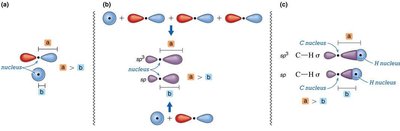
Bond Length: Triple bonds are shorter than double or single bonds. The C–H bond also shortens as the s-character of the carbon increases (sp > sp2 > sp3).
Acidity of Terminal Alkynes
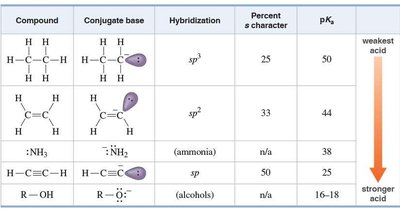
Terminal alkynes are more acidic than alkenes and alkanes due to the high s-character of the sp-hybridized carbon, which stabilizes the conjugate base.
Relative Acidity: Alkynes (pKa ≈ 25) are more acidic than ammonia (pKa ≈ 38) but less acidic than alcohols (pKa ≈ 16–18).
Deprotonation: Strong bases such as NaNH2 can deprotonate terminal alkynes to form acetylide anions.
Compound | Conjugate Base | Hybridization | Percent s Character | pKa |
|---|---|---|---|---|
Alkane (CH4) | CH3– | sp3 | 25 | 50 |
Alkene (H2C=CH2) | H2C=CH– | sp2 | 33 | 44 |
Ammonia (NH3) | NH2– | n/a | n/a | 38 |
Alkyne (HC≡CH) | HC≡C– | sp | 50 | 25 |
Alcohol (ROH) | RO– | n/a | n/a | 16–18 |
Formation of Carbon–Carbon Bonds: Acetylide Alkylation
Terminal alkynes can be converted into nucleophilic acetylide anions, which react with alkyl halides in substitution reactions to form new C–C bonds.
Step 1: Deprotonation of terminal alkyne with a strong base (e.g., NaNH2).
Step 2: Nucleophilic substitution with an alkyl halide to extend the carbon chain.




Hydrogenation of Alkynes
Alkynes can be reduced to alkanes or alkenes via catalytic hydrogenation. The choice of catalyst determines the extent and stereochemistry of reduction.
Complete Hydrogenation: Using Pd, Pt, or Ni catalysts, alkynes are fully reduced to alkanes.
Partial Hydrogenation: Lindlar's catalyst (Pd/CaCO3, Pb(OAc)2) yields cis-alkenes; dissolving metal reduction (Na/NH3) yields trans-alkenes.

Electrophilic Addition Reactions of Alkynes
Alkynes undergo electrophilic addition reactions similar to alkenes, but with some differences due to the triple bond's properties.
Hydrohalogenation (Addition of HX): Addition of HBr or HCl forms geminal dihalides via the most stable carbocation intermediate.
Hydration: Acid-catalyzed hydration (with HgSO4 catalyst) yields ketones via enol intermediates (keto-enol tautomerism). Hydroboration-oxidation yields aldehydes (anti-Markovnikov addition for terminal alkynes).
Bromination/Chlorination: Addition of halogens yields di- or tetrahalogenated products, depending on the amount of halogen used.
Keto-Enol Tautomerism
During hydration of alkynes, an enol intermediate is formed, which rapidly tautomerizes to a ketone (or aldehyde). This equilibrium is catalyzed by acid or base, with the ketone form generally favored.
Synthetic Strategies Involving Alkynes
Alkynes are versatile intermediates in organic synthesis. Their reactions can be used to construct complex molecules by forming new carbon–carbon bonds and introducing functional groups through addition reactions.
Retrosynthetic Analysis: When planning a synthesis, consider the minimum number of steps and the functional group transformations required.
Additional info: These notes cover the core learning objectives for alkynes in a college-level organic chemistry course, including structure, nomenclature, acidity, bond formation, and key reactions.
