 Indietro
Alkynes: Structure, Acidity, and Reactions (Chapter 9 Study Notes)
Guida di studio - Note intelligenti
 Appunti personalizzati basati sui tuoi materiali, ampliati con definizioni chiave, esempi e contesto.
Alkynes: Structure, Acidity, and Reactions
Acidity of Alkynes and Related Compounds
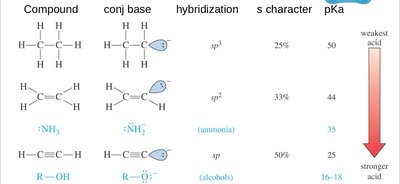
Alkynes are hydrocarbons containing a carbon-carbon triple bond. Their acidity is influenced by the hybridization of the carbon atom bonded to hydrogen. The table below compares the acidity (pKa) and hybridization of alkynes, alkenes, alkanes, ammonia, and alcohols.
Compound | Conjugate Base | Hybridization | s Character (%) | pKa |
|---|---|---|---|---|
Alkane (sp3) | Alkyl anion | sp3 | 25% | 50 |
Alkene (sp2) | Alkenyl anion | sp2 | 33% | 44 |
Alkyne (sp) | Alkynyl anion | sp | 50% | 25 |
Ammonia | Amide anion | sp3 | 25% | 35 |
Alcohol | Alkoxide anion | sp3 | 25% | 16-18 |
Key Point: The greater the s character, the more acidic the hydrogen. Alkynes (sp) are more acidic than alkenes (sp2) and alkanes (sp3).
Example: Terminal alkynes can be deprotonated by strong bases to form acetylide ions, which are useful nucleophiles in organic synthesis.
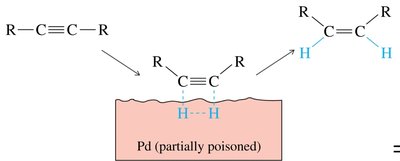
Hydrogenation of Alkynes
Alkynes can be reduced to alkenes or alkanes by catalytic hydrogenation. The use of a partially poisoned palladium catalyst (Lindlar's catalyst) allows selective reduction to cis-alkenes.
Key Point: Lindlar's catalyst stops hydrogenation at the alkene stage, producing a cis-alkene.
Equation:
Example: Internal alkynes are converted to cis-alkenes, not trans-alkenes.
Halogenation of Alkynes
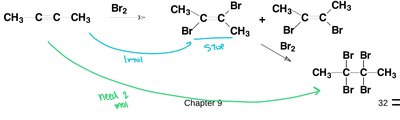
Alkynes react with halogens (e.g., Br2) to form dihaloalkenes and tetrahaloalkanes, depending on the amount of halogen used.
Key Point: Addition of 1 mol Br2 yields a dibromoalkene; 2 mol yields a tetrabromoalkane.
Equation: (1 mol) (2 mol)
Hydrohalogenation of Alkynes
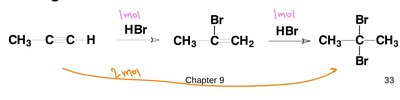
Alkynes react with hydrogen halides (e.g., HBr) to form haloalkenes and dihaloalkanes. The addition follows Markovnikov's rule unless peroxides are present.
Key Point: Markovnikov addition places the halide on the more substituted carbon.
Equation: (1 mol) (2 mol)
Anti-Markovnikov Hydrohalogenation (Peroxide Effect)
In the presence of peroxides (ROOR), hydrohalogenation of alkynes proceeds via an anti-Markovnikov mechanism, placing the halide on the less substituted carbon.
Key Point: Peroxides reverse the regioselectivity of HBr addition.
Equation:

Hydration of Alkynes: Formation of Enols and Ketones
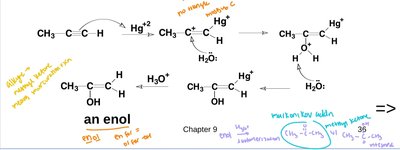
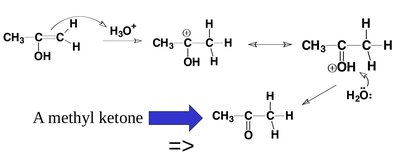
Alkynes undergo hydration in the presence of mercuric ion (Hg2+) and acid to form enols, which tautomerize to ketones.
Key Point: Enols are unstable and rapidly convert to ketones via tautomerization.
Equation:
Example: Hydration of a terminal alkyne yields a methyl ketone.
Hydroboration-Oxidation of Alkynes
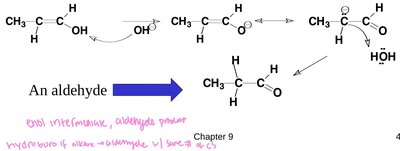
Hydroboration-oxidation of alkynes provides an anti-Markovnikov addition of water, yielding aldehydes from terminal alkynes.
Key Point: The boron adds to the less substituted carbon, and subsequent oxidation yields an aldehyde.
Equation:
Example: Terminal alkynes produce aldehydes, not ketones.

Oxidative Cleavage of Alkynes
Alkynes can be cleaved by ozone (O3) followed by water to yield carboxylic acids.
Key Point: Both sides of the triple bond are oxidized to carboxylic acids.
Equation:

Summary Table: Reactions of Alkynes
The following table summarizes the major reactions of alkynes covered above.
Reaction | Reagents | Product |
|---|---|---|
Hydrogenation | H2, Lindlar's catalyst | Cis-alkene |
Halogenation | Br2 (1 or 2 mol) | Dihaloalkene or tetrahaloalkane |
Hydrohalogenation | HBr (Markovnikov) | Haloalkene, dihaloalkane |
Anti-Markovnikov Hydrohalogenation | HBr, ROOR | Haloalkene (anti-Markovnikov) |
Hydration | Hg2+, H2O | Ketone (via enol) |
Hydroboration-Oxidation | R2BH, H2O2, NaOH | Aldehyde (via enol) |
Oxidative Cleavage | O3, H2O | Carboxylic acids |
Additional info: These reactions are fundamental for understanding the reactivity and synthetic utility of alkynes in organic chemistry. Mastery of these mechanisms and their outcomes is essential for college-level organic chemistry courses.
