 Indietro
Alpha-Halogenation and Reagent Identification in Organic Chemistry
Guida di studio - Note intelligenti
 Appunti personalizzati basati sui tuoi materiali, ampliati con definizioni chiave, esempi e contesto.
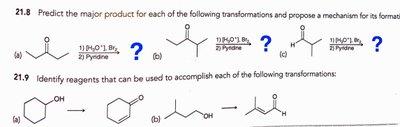
Q1. Predict the major product for each of the following transformations and propose a mechanism for its formation:
(a) (b) (c) (d) — Each shows a ketone or aldehyde treated with Br2 in acid, followed by pyridine.
Background
Topic: Alpha-Halogenation of Carbonyl Compounds
This question tests your understanding of the acid-catalyzed halogenation of the α-carbon in aldehydes and ketones, as well as the mechanism for this transformation. It also requires you to predict the major product and outline the stepwise mechanism.
Key Terms and Formulas
Alpha-carbon: The carbon adjacent to the carbonyl group.
Alpha-halogenation: Introduction of a halogen (Br) at the α-position.
Mechanism: Typically involves enol formation, electrophilic attack by Br2, and regeneration of the carbonyl.
Key Mechanistic Steps:
Enol formation under acidic conditions.
Electrophilic bromination at the α-carbon.
Regeneration of the carbonyl group.
Pyridine may act as a base to neutralize the acid or facilitate elimination.
Step-by-Step Guidance
Identify the α-carbon(s) adjacent to the carbonyl group in each substrate.
Draw the enol tautomer that forms under acidic conditions.
Show the electrophilic attack of Br2 on the enol, leading to α-bromination.
Regenerate the carbonyl group after bromination.
Consider the role of pyridine in the final step (may facilitate elimination or neutralization).
Try solving on your own before revealing the answer!
Final Answer:
The major product for each transformation is the α-brominated carbonyl compound. The mechanism involves enol formation, bromination at the α-carbon, and regeneration of the carbonyl. Pyridine may facilitate elimination if a second bromination occurs or simply neutralize the acid.
(a) 2-bromo-2-pentanone
(b) 2-bromo-3-pentanone
(c) 2-bromo-3-methyl-2-butanone
(d) 2-bromo-2-methyl-3-pentanone
The mechanism is consistent for each: enol formation, bromination, and carbonyl regeneration.
Q2. Identify reagents that can be used to accomplish each of the following transformations:
(a) Cyclohexanol to cyclohexanone (b) 1,3-propanediol to 3-oxopropanal
Background
Topic: Oxidation of Alcohols and Diols
This question tests your knowledge of reagents used to oxidize alcohols to carbonyl compounds, including ketones and aldehydes.
Key Terms and Formulas
Oxidation: Conversion of alcohols to carbonyl compounds (ketones or aldehydes).
Common oxidizing agents: PCC, Jones reagent, KMnO4, Swern oxidation.
Step-by-Step Guidance
For (a), identify that cyclohexanol is a secondary alcohol and will be oxidized to cyclohexanone.
Choose an appropriate oxidizing agent (e.g., PCC, Jones reagent, or KMnO4).
For (b), recognize that 1,3-propanediol can be selectively oxidized to a carbonyl compound.
Consider reagents that allow selective oxidation (e.g., periodate cleavage, Swern oxidation).
Try solving on your own before revealing the answer!
Final Answer:
(a) Suitable reagents: PCC, Jones reagent (CrO3/H2SO4), or KMnO4 can oxidize cyclohexanol to cyclohexanone.
(b) For selective oxidation of 1,3-propanediol to 3-oxopropanal, reagents like periodate (NaIO4) or Swern oxidation can be used.
These reagents are commonly used in organic synthesis for oxidation of alcohols to carbonyl compounds.
