 Indietro
Amines and Amides: Structure, Properties, and Reactions
Guida di studio - Note intelligenti
 Appunti personalizzati basati sui tuoi materiali, ampliati con definizioni chiave, esempi e contesto.
Amines
Definition and Structure
Amines are organic compounds derived from ammonia (NH3), in which one or more hydrogen atoms are replaced by alkyl or aromatic groups. The nitrogen atom in amines is bonded to one or more carbon-containing groups, giving rise to a variety of structures and properties.
Key Point 1: Amines contain a nitrogen atom attached to alkyl or aromatic rings.
Key Point 2: Amines are important in biological systems and industrial applications.
Classification of Amines
Amines are classified based on the number of carbon groups attached to the nitrogen atom:
Primary (1°) amine: One carbon group bonded to the nitrogen atom.
Secondary (2°) amine: Two carbon groups bonded to the nitrogen atom.
Tertiary (3°) amine: Three carbon groups bonded to the nitrogen atom.
Example: Methylamine (1°), Dimethylamine (2°), Trimethylamine (3°). 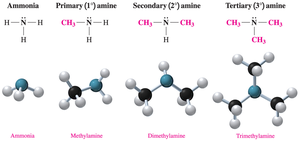
Naming Amines
Simple amines are named as alkylamines. The names of the alkyl groups bonded to the nitrogen atom are listed in alphabetical order, and prefixes are used to identify duplicate alkyl substituents.
Example: Ethylamine, Dimethylamine, Ethyldimethylamine.
Aromatic Amines
Aromatic amines are based on the benzene ring. The simplest aromatic amine is aniline. Alkyl groups on the nitrogen are named using the prefix "N-" with the alkyl name. Aniline is widely used in the manufacture of dyes. 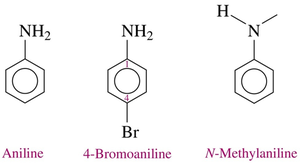
Line-Angle Formulas of Amines
Line-angle formulas are used to represent the shapes of amine molecules, showing the arrangement of alkyl groups bonded to the nitrogen atom. 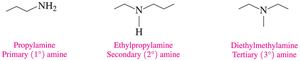
Solubility of Amines: Hydrogen Bonds
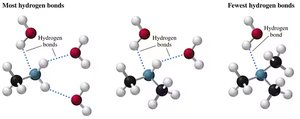
Amines can form hydrogen bonds with water, affecting their solubility. Primary and secondary amines form more hydrogen bonds than tertiary amines, leading to greater solubility in water.
Key Point: The ability to form hydrogen bonds decreases from primary to tertiary amines.
Amines as Bases in Water
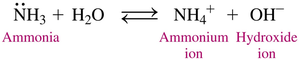
Amines act as Brønsted-Lowry bases in water. The lone pair of electrons on the nitrogen atom accepts a proton (H+) from water, forming an ammonium ion and a hydroxide ion.
Equation:
Equation:

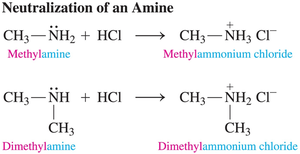
Neutralization of Amines
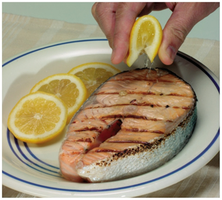
Amines react with acids in a neutralization reaction to form amine salts. This process is used to neutralize odors (such as fishy smells) and is important in pharmaceutical applications.
Example: Amines in fish are neutralized by the acid in lemon juice.
Formation and Properties of Amine Salts
Amine salts are named by using the alkylammonium ion name followed by the name of the negative ion.
Properties: Amine salts are solids at room temperature, odorless, soluble in water and body fluids.
Application: Many drugs are administered as amine salts (e.g., ephedrine, diphenhydramine).
Alkaloids: Amines in Plants
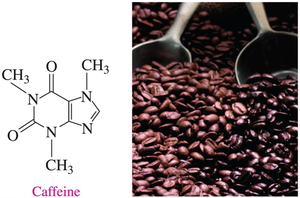
Alkaloids are naturally occurring amines produced by plants. They are used as anesthetics and stimulants. Examples include morphine (painkiller from poppy plant), nicotine (stimulant), and caffeine (stimulant found in coffee).
Key Point: Alkaloids have significant physiological effects and are often addictive.
Amides
Definition and Structure
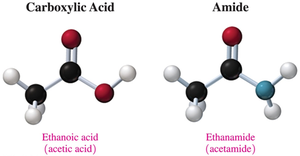
Amides are derivatives of carboxylic acids in which the hydroxyl group (-OH) is replaced by a nitrogen group (-NH2). Amides are important in biological systems and pharmaceuticals (e.g., acetaminophen in Tylenol).
Example: Urea is an amide produced in protein metabolism.
Preparation of Amides: Amidation
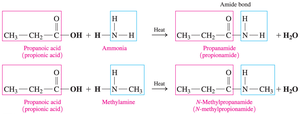
Amides are synthesized by reacting a carboxylic acid with ammonia, a primary amine, or a secondary amine, in the presence of heat.
Equation:
Naming Amides
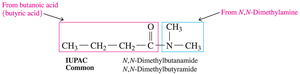
The IUPAC name for an amide is formed by dropping the "oic acid" or "ic acid" suffix from the carboxylic acid and adding "amide." Alkyl groups attached to the nitrogen are named with the prefix "N-" followed by the alkyl name.
Example: Butanamide, N-methylbutanamide.
Hydrolysis of Amides
Amides can be hydrolyzed by acid or base:
Acid hydrolysis: Produces a carboxylic acid and an ammonium salt.
Base hydrolysis: Produces the salt of a carboxylic acid and an amine or ammonia.
Equation (acid hydrolysis): 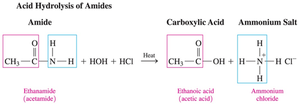 Equation (base hydrolysis): Additional info: Base hydrolysis image not included due to lack of clear direct relevance.
Summary Table: Classification of Amines
Type | Structure | Example |
|---|---|---|
Primary (1°) | R-NH2 | Methylamine |
Secondary (2°) | R2-NH | Dimethylamine |
Tertiary (3°) | R3-N | Trimethylamine |
Additional info: Table inferred for clarity and completeness.
