 Indietro
Anti-Markovnikov Electrophilic Addition to Alkenes: Mechanisms, Stereochemistry, and Synthetic Applications
Guida di studio - Note intelligenti
 Appunti personalizzati basati sui tuoi materiali, ampliati con definizioni chiave, esempi e contesto.
Electrophilic Addition to Alkenes
Markovnikov and Anti-Markovnikov Addition
Electrophilic addition reactions are fundamental transformations in organic chemistry, particularly involving alkenes. The regiochemical outcome of these reactions is governed by the stability of carbocation intermediates and the nature of the reagents used. Markovnikov addition results in the electrophile adding to the more substituted carbon, while anti-Markovnikov addition places the electrophile on the less substituted carbon.
Markovnikov Addition: The electrophile (e.g., H+ from HCl) adds to the carbon with more alkyl substituents, stabilizing the carbocation intermediate.
Anti-Markovnikov Addition: Achieved via specific reagents (e.g., BH3 in hydroboration), the electrophile adds to the less substituted carbon, avoiding carbocation rearrangements.
Carbocation Rearrangement: In Markovnikov addition, carbocation intermediates may rearrange to form more stable carbocations, affecting product distribution.
Example: HCl Addition to an Alkene
When HCl is added to an alkene, the reaction may proceed via carbocation intermediates, which can undergo rearrangement if a more stable carbocation is accessible.
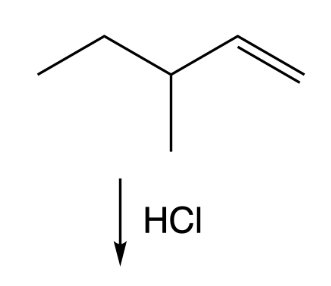
Rearrangement Possibility: Rearrangements can occur in this general type of reaction, depending on the substrate's structure.
Substrate Analysis: The provided substrate could potentially rearrange if a more stable carbocation is formed during the reaction.
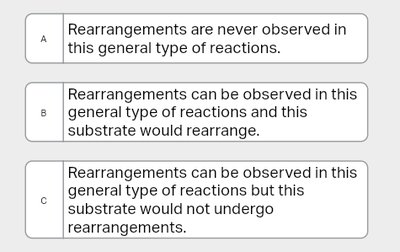
Option | Explanation |
|---|---|
A | Rearrangements are never observed in this general type of reactions. |
B | Rearrangements can be observed in this general type of reactions and this substrate would rearrange. |
C | Rearrangements can be observed in this general type of reactions but this substrate would not undergo rearrangements. |
Stereochemical Outcome of Electrophilic Addition
Formation of Stereocenters
Electrophilic addition to alkenes can create new stereocenters. If the addition results in a stereocenter, both possible configurations (R and S) may form, leading to a racemic mixture.
Flat sp2 Carbon: The alkene's sp2 carbon is planar, allowing attack from either face.
Tetrahedral sp3 Carbon: After addition, the carbon becomes tetrahedral, and both enantiomers are possible.
Borane (BH3) and Hydroboration-Oxidation
Properties and Reactivity of Borane
Borane (BH3) is a highly electrophilic molecule due to its empty p orbital and incomplete octet. In solution, it often exists as a dimer or as a complex with tetrahydrofuran (THF).
Electrophilicity: Borane's empty p orbital makes it reactive toward nucleophilic alkenes.
Octet Rule Exception: Borane does not satisfy the octet rule, increasing its reactivity.
Forms in Solution: BH3 can exist as a dimer (B2H6) or as BH3-THF.
Hydroboration-Oxidation Mechanism
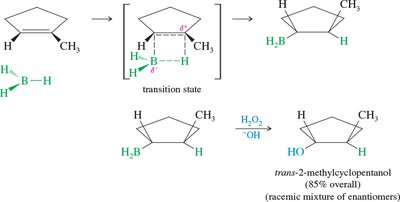
Hydroboration-oxidation is a two-step process for converting alkenes to alcohols via anti-Markovnikov addition. The first step is hydroboration (concerted addition of BH3), followed by oxidation (conversion of the boron group to a hydroxyl group).
Step 1: Hydroboration (concerted addition of BH3 to the alkene)
Step 2: Oxidation (H2O2, NaOH converts BH2 to OH)
Regiochemistry: Boron adds to the less substituted carbon (anti-Markovnikov), and hydrogen adds to the more substituted carbon.
Stereochemistry: Both H and BH2 add to the same face (syn addition), resulting in a racemic mixture of enantiomers.
Regiochemistry and Stereochemistry in Hydroboration
Regiochemical Outcome
The regiochemistry of hydroboration is determined during the addition step, where boron acts as the electrophile. The addition follows anti-Markovnikov rules, with boron attaching to the less substituted carbon.
Hammond's Postulate: The transition state resembles the most stable carbocation, guiding the regioselectivity.
Syn Addition: Both H and BH2 are added simultaneously to the same face of the alkene.
Stereochemical Outcome
Hydroboration is a stereospecific reaction, always resulting in syn addition. The oxidation step preserves the stereochemistry, yielding a racemic mixture of enantiomers.
Racemic Mixture: Two stereoisomers are formed, each with the hydroxyl group on the same face as the original boron group.
Organic Synthesis Applications
Using Markovnikov and Anti-Markovnikov Addition in Synthesis
Organic synthesis involves designing sequences of reactions to convert starting materials into desired products. Both Markovnikov and anti-Markovnikov additions are crucial for functional group transformations.
Reagent Prediction: Choose reagents based on desired regio- and stereochemical outcomes.
Product Prediction: Anticipate possible rearrangements and stereoisomers.
Sequential Steps: Indicate multiple steps on a single reaction arrow if necessary.
Example Synthesis Route
To convert an alkene to an alcohol via anti-Markovnikov addition, use hydroboration-oxidation. For Markovnikov addition, use acid-catalyzed hydration.
Hydroboration-Oxidation: Step 1: BH3, THF Step 2: H2O2, NaOH
Markovnikov Hydration: H3O+ (acid-catalyzed)
Summary Table: Markovnikov vs. Anti-Markovnikov Addition
Type of Addition | Reagent | Regiochemistry | Stereochemistry |
|---|---|---|---|
Markovnikov | HX, H3O+ | Electrophile adds to more substituted carbon | Both faces possible, racemic mixture |
Anti-Markovnikov | BH3, H2O2, NaOH | Electrophile adds to less substituted carbon | Syn addition, racemic mixture |
Additional info: Academic context was added to clarify the mechanism, stereochemistry, and synthetic applications of Markovnikov and anti-Markovnikov additions, as well as the role of carbocation rearrangements and hydroboration-oxidation.
