 Indietro
Aromatic Compounds: Structure, Nomenclature, and Properties
Guida di studio - Note intelligenti
 Appunti personalizzati basati sui tuoi materiali, ampliati con definizioni chiave, esempi e contesto.
Chapter 17: Aromatic Compounds
Introduction to Aromatic Compounds
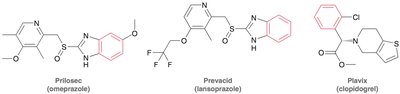
Aromatic compounds, also known as arenes, are a class of organic molecules characterized by the presence of one or more planar rings with delocalized π-electrons. Benzene is the simplest and most well-known aromatic compound, and its derivatives are widespread in nature and industry. Many drugs and natural products contain aromatic rings, which contribute to their chemical properties and biological activities.
Aromaticity refers to the special stability associated with conjugated cyclic π-systems that obey specific rules.
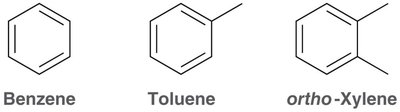
Benzene and its derivatives are common examples of aromatic compounds.
Historically, aromatic compounds were named for their pleasant aromas, but most are odorless.
Nomenclature of Aromatic Compounds
The nomenclature of aromatic compounds follows IUPAC rules, but many common names are still widely used. Substituents on the benzene ring are named and numbered to indicate their positions.
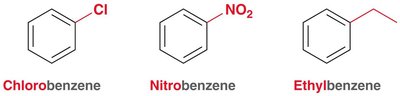
Monosubstituted benzenes are named as derivatives of benzene (e.g., chlorobenzene, nitrobenzene, ethylbenzene).
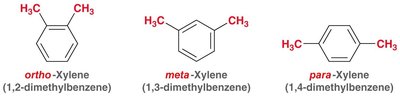
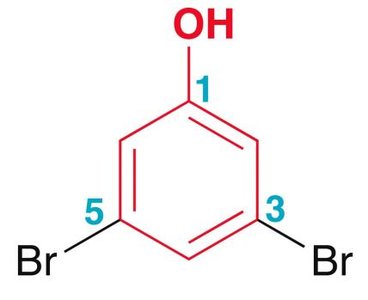
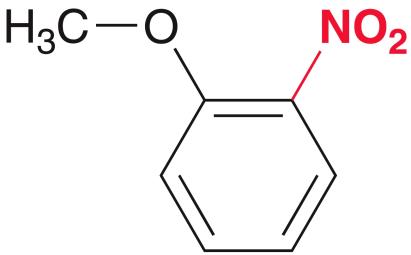
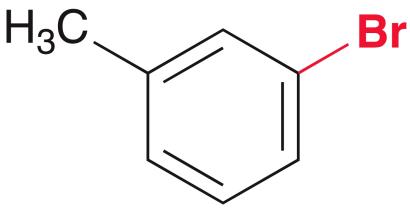
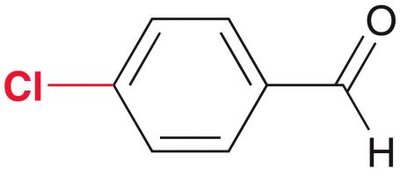
Disubstituted benzenes use the prefixes ortho- (1,2-), meta- (1,3-), and para- (1,4-) to indicate relative positions of substituents.
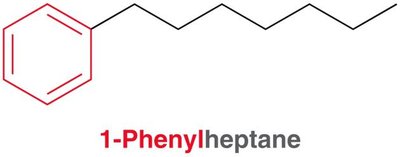
When the substituent is larger than the ring, the aromatic ring is named as a substituent (phenyl group).
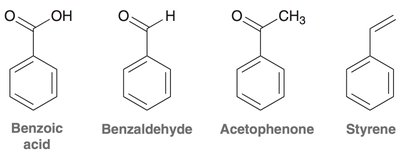
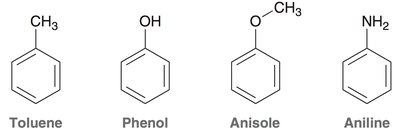
Common parent names include toluene, phenol, aniline, anisole, benzoic acid, benzaldehyde, and acetophenone.
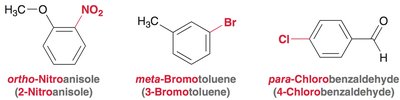
Number the ring to give the lowest possible numbers to substituents.
List substituents alphabetically, ignoring prefixes except "iso-".
If a substituent is part of the parent name, it is assigned position 1.
Structure and Stability of Benzene
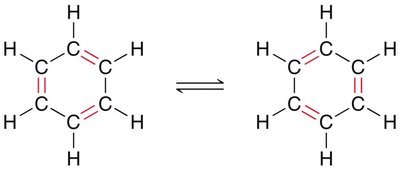
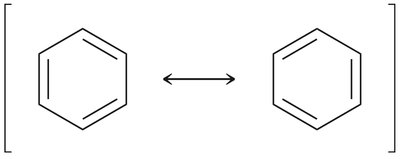
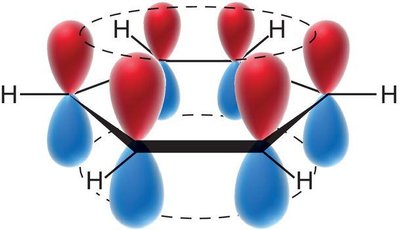
Benzene is a planar, cyclic molecule with six carbon atoms and six π-electrons. Its structure is best described by resonance, with the electrons delocalized over the ring. This delocalization leads to exceptional stability, known as aromatic stabilization.
Kekulé proposed alternating single and double bonds, but modern theory describes benzene as a resonance hybrid.
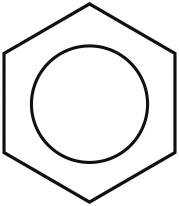
Benzene is often depicted as a hexagon with a circle inside to represent delocalized electrons.
Criteria for Aromaticity (Hückel's Rule)
For a molecule to be aromatic, it must satisfy four criteria:
Cyclic: The molecule must be a ring.
Planar: All atoms in the ring must be in the same plane to allow for continuous overlap of p orbitals.
Completely conjugated: Every atom in the ring must have a p orbital (no sp3 interruptions).
Hückel's Rule: The ring must contain π-electrons, where n is a non-negative integer (0, 1, 2, ...).
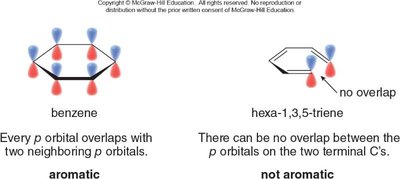
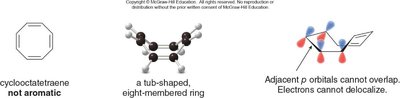
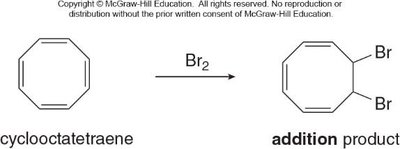
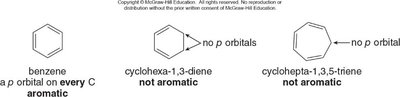
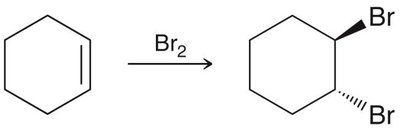
Compounds that do not meet all four criteria are either nonaromatic or antiaromatic.
Stability of Benzene and Aromatic Compounds
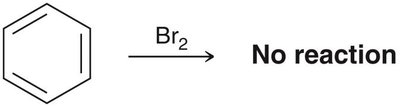
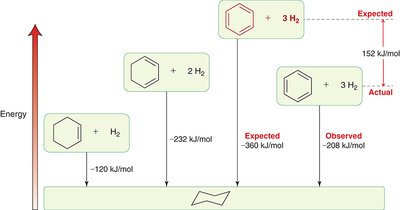
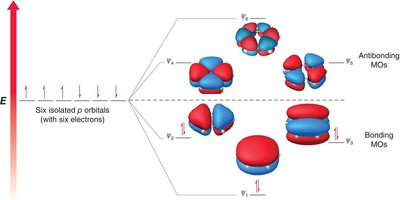
Benzene is much more stable than expected for a molecule with three double bonds. This stability is due to the delocalization of π-electrons, as explained by molecular orbital (MO) theory.
The heat of hydrogenation of benzene is much less exothermic than expected, indicating extra stabilization energy (aromatic stabilization energy).
MO theory shows that benzene's six p orbitals combine to form six molecular orbitals, with the six π-electrons filling the three lowest (bonding) orbitals.
Antiaromatic and Nonaromatic Compounds
Not all conjugated rings are aromatic. Compounds that are planar, fully conjugated, and have 4n π-electrons (where n is an integer) are antiaromatic and are destabilized. Compounds that are not planar or not fully conjugated are nonaromatic.
Antiaromatic: Planar, fully conjugated, 4n π-electrons (e.g., cyclobutadiene, cyclooctatetraene if planar).
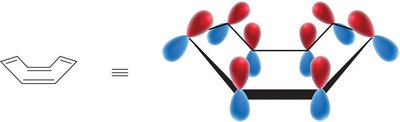
Nonaromatic: Lacks planarity or full conjugation (e.g., tub-shaped cyclooctatetraene).


Annulenes and Frost Circles
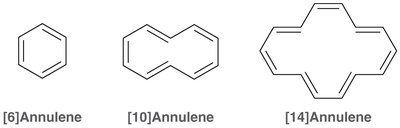
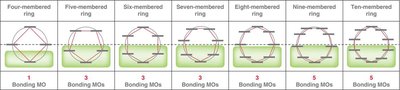
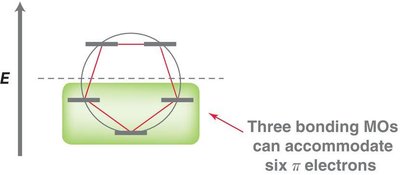
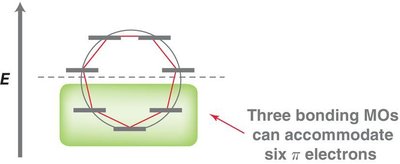
Annulenes are monocyclic compounds with alternating single and double bonds. Their aromaticity can be predicted using Frost circles, which help visualize the relative energies of molecular orbitals in cyclic π-systems.
Examples: [6]Annulene (benzene), [10]Annulene, [14]Annulene.
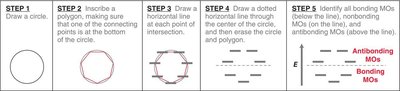
Frost circles are constructed by inscribing a polygon in a circle, with one vertex at the bottom, and drawing horizontal lines for MO energy levels.
Other Aromatic Compounds: Carbanions, Carbocations, and Heterocycles
Aromaticity is not limited to neutral hydrocarbons. Some anions, cations, and heterocycles are also aromatic if they meet the criteria.
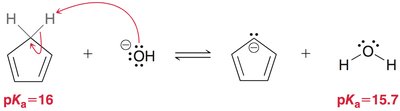
Cyclopentadienyl anion: Aromatic anion with 6 π-electrons, stabilized by delocalization.
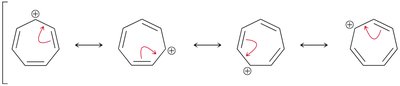
Tropylium cation: Aromatic cation with 6 π-electrons in a seven-membered ring.
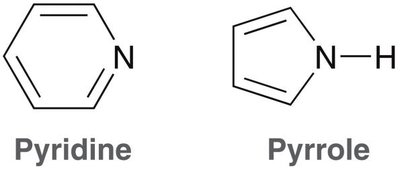
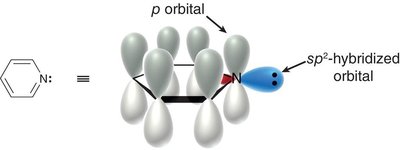
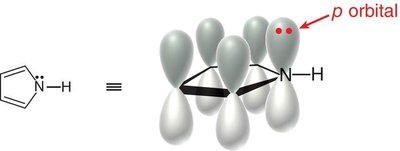
Heterocycles: Rings containing atoms other than carbon (e.g., nitrogen, oxygen, sulfur) can be aromatic if the lone pairs contribute to the π-system.

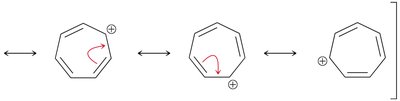
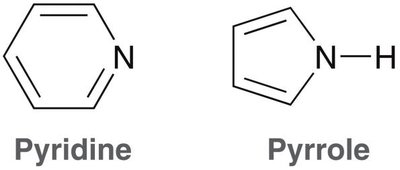
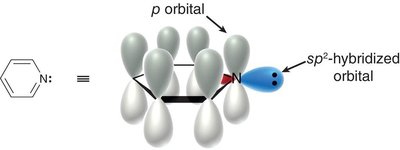
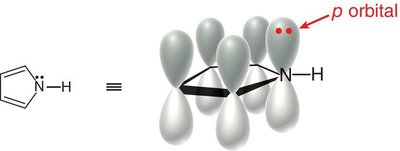
If a heteroatom's lone pair is needed for aromaticity, it is included in the π-electron count and is less basic.


Polycyclic Aromatic Compounds
Polycyclic aromatic compounds contain multiple fused benzene rings. Examples include naphthalene, anthracene, and phenanthrene. These compounds are also aromatic and exhibit unique chemical properties.
Reactions at the Benzylic Position
The benzylic position is the carbon atom directly attached to a benzene ring. This position is especially reactive in oxidation and substitution reactions due to the resonance stabilization of intermediates.
Benzylic positions are readily oxidized by chromic acid or permanganate if at least one hydrogen is present.
Benzylic bromides undergo SN1 and SN2 substitution, as well as E1 and E2 elimination reactions.
Reduction of Benzene and Its Derivatives
Benzene can be reduced to cyclohexane under forceful conditions, but selective reduction is possible using the Birch reduction. The regioselectivity of the Birch reduction depends on the presence of electron-donating or electron-withdrawing groups.
Birch reduction produces a 1,4-cyclohexadiene, not a fully saturated ring.
Electron-donating groups direct reduction away from their position, while electron-withdrawing groups direct reduction toward their position.
Spectroscopy of Aromatic Compounds
Spectroscopic techniques are essential for identifying aromatic compounds:
IR Spectroscopy: Aromatic C-H stretches appear around 3030 cm-1.
1H NMR: Aromatic protons typically appear between 6.5 and 8 ppm.
13C NMR: Aromatic carbons appear between 100 and 150 ppm; the number of signals helps determine substitution patterns.
Special Forms of Aromatic Carbon: Graphite, Buckyballs, and Nanotubes
Graphite consists of layers of fused aromatic rings. Fullerenes (buckyballs) and carbon nanotubes are composed of interlocking aromatic rings and have unique physical and chemical properties with applications in materials science and nanotechnology.
Summary Table: Classification of Cyclic Compounds by Aromaticity
Type | Criteria | Example | Stability |
|---|---|---|---|
Aromatic | Planar, cyclic, fully conjugated, (4n+2) π-electrons | Benzene | Highly stabilized |
Antiaromatic | Planar, cyclic, fully conjugated, 4n π-electrons | Cyclobutadiene | Highly destabilized |
Nonaromatic | Not planar or not fully conjugated | Cyclooctatetraene (tub-shaped) | No special stability |
