 Indietro
Bonding Preferences and the Octet Rule in Organic Chemistry
Guida di studio - Note intelligenti
 Appunti personalizzati basati sui tuoi materiali, ampliati con definizioni chiave, esempi e contesto.
Bonding Preferences and the Octet Rule
Concept of Octet Electrons and Valence Electrons
The stability of organic molecules is largely determined by how atoms satisfy the octet rule, which states that atoms tend to "own" eight electrons in their valence shell. The way electrons are distributed among atoms in a molecule affects both the stability and reactivity of the compound.
Octet electrons are the electrons that an atom actually "owns" in a molecule. The number of octet electrons determines which possible electron arrangements are most stable.
An atom owns every lone electron it has.
An atom owns one electron for every bond that it has.
Valence electrons are the electrons in the outermost shell of an atom, which participate in bonding. The total number of valence electrons is determined by the atom's group number in the periodic table.
Example: Hydrocarbons and the Octet Rule
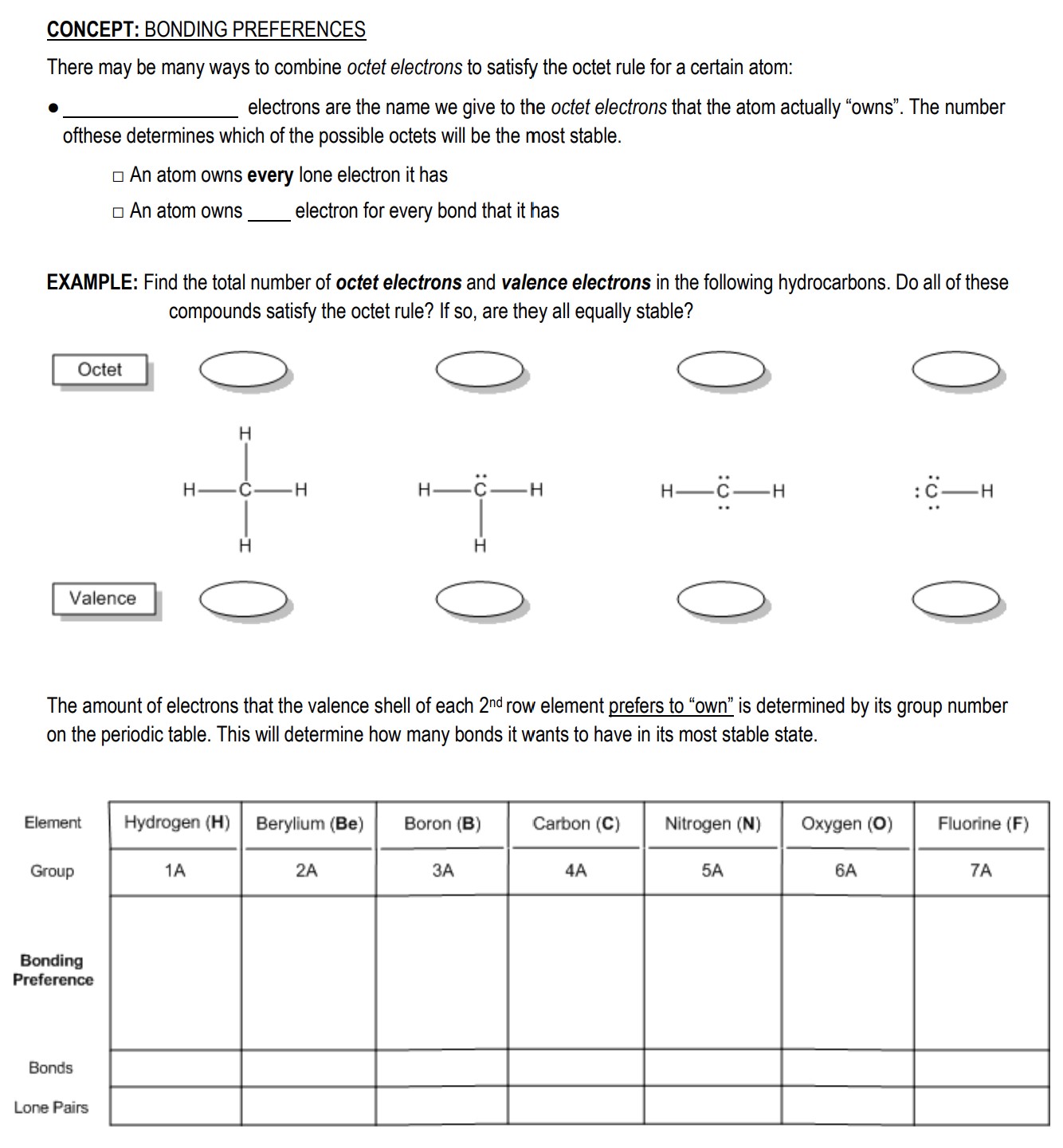
Consider the following hydrocarbons. For each, determine the total number of octet electrons and valence electrons. Assess whether each compound satisfies the octet rule and if they are equally stable.
Methane (CH4): Carbon forms four single bonds with hydrogen, owning four bond electrons and no lone pairs. Each hydrogen owns one bond electron.
Ethene (C2H4): Each carbon forms three bonds (two with hydrogen, one with another carbon) and shares a double bond between carbons.
Ethyne (C2H2): Each carbon forms two bonds (one with hydrogen, one triple bond with another carbon).
Carbene (CH2): Carbon forms two bonds with hydrogen and has two lone electrons.
All these compounds can satisfy the octet rule, but their stability varies based on how completely the octet is satisfied and the distribution of electrons.
Bonding Preferences of Second Row Elements
The number of electrons that an atom prefers to "own" in its valence shell is determined by its group number in the periodic table. This preference dictates the typical number of bonds and lone pairs for each element in its most stable state.
Element | Group | Bonding Preference | Bonds | Lone Pairs |
|---|---|---|---|---|
Hydrogen (H) | 1A | 2 electrons | 1 | 0 |
Beryllium (Be) | 2A | 4 electrons | 2 | 0 |
Boron (B) | 3A | 6 electrons | 3 | 0 |
Carbon (C) | 4A | 8 electrons | 4 | 0 |
Nitrogen (N) | 5A | 8 electrons | 3 | 1 |
Oxygen (O) | 6A | 8 electrons | 2 | 2 |
Fluorine (F) | 7A | 8 electrons | 1 | 3 |
Example: Carbon, with a group number of 4A, prefers to form four bonds and have no lone pairs, as seen in methane (CH4).
Key Definitions and Equations
Octet Rule: Atoms tend to "own" eight electrons in their valence shell for maximum stability.
Valence Electrons: Electrons in the outermost shell available for bonding.
Bonding Preference: The typical number of bonds and lone pairs an atom forms, based on its group number.
Equation for Octet Electron Ownership:
Equation for Valence Electrons:
Additional info: The concepts presented here are foundational for understanding molecular structure, stability, and reactivity in organic chemistry, and are directly relevant to Chapter 1: A Review of General Chemistry.
