 Indietro
Carbohydrates and Chirality: Structure, Classification, and Stereochemistry
Guida di studio - Note intelligenti
 Appunti personalizzati basati sui tuoi materiali, ampliati con definizioni chiave, esempi e contesto.
Carbohydrates: Structure and Classification
Introduction to Carbohydrates
Carbohydrates are a major class of biomolecules that serve as a primary energy source in living organisms. They are composed of carbon (C), hydrogen (H), and oxygen (O), and are commonly referred to as saccharides or sugars. Carbohydrates are produced by plants during photosynthesis and are oxidized in living cells to produce energy, carbon dioxide, and water.
General Formula: Most simple carbohydrates have the empirical formula Cn(H2O)n.
Examples: Glucose, fructose, galactose, ribose, deoxyribose.
Types of Carbohydrates
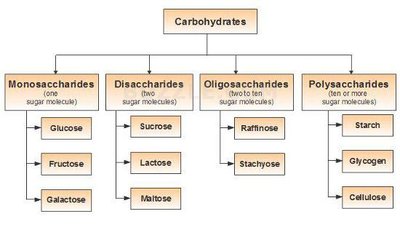
Carbohydrates are classified based on the number of sugar units they contain:
Monosaccharides: Single sugar units (e.g., glucose, fructose, galactose).
Disaccharides: Two monosaccharide units (e.g., sucrose, lactose, maltose).
Oligosaccharides: 2–10 monosaccharide units (e.g., raffinose, stachyose).
Polysaccharides: More than ten monosaccharide units (e.g., starch, glycogen, cellulose).
Hydrolysis of Carbohydrates
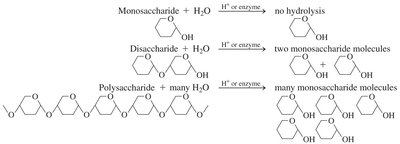
Carbohydrates can be hydrolyzed to yield smaller sugar units. Monosaccharides cannot be hydrolyzed further, while disaccharides and polysaccharides can be broken down into monosaccharides by acid or enzymatic hydrolysis.
Monosaccharide + H2O: No hydrolysis occurs.
Disaccharide + H2O: Yields two monosaccharide molecules.
Polysaccharide + many H2O: Yields many monosaccharide molecules.
Monosaccharides: Structure and Classification
Structural Features of Monosaccharides
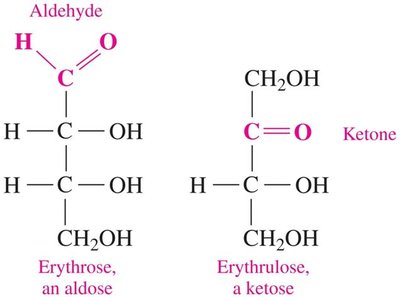
Monosaccharides are the simplest carbohydrates, consisting of 3–7 carbon atoms. They contain either an aldehyde group (aldose) or a ketone group (ketose), and hydroxyl groups on all other carbons except the carbonyl carbon.
Aldose: Contains an aldehyde group (–CHO).
Ketose: Contains a ketone group (C=O).
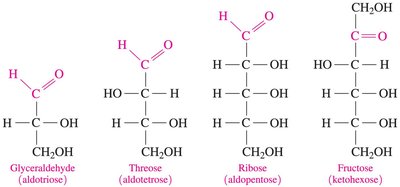
Classification by Carbon Number:
Triose: 3 carbons
Tetrose: 4 carbons
Pentose: 5 carbons
Hexose: 6 carbons
Isomerism in Carbohydrates
Structural Isomers
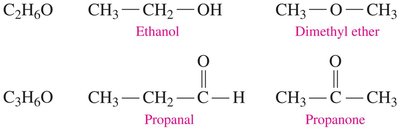
Structural isomers have the same molecular formula but different bonding arrangements of atoms. For example, ethanol and dimethyl ether both have the formula C2H6O but differ in structure and properties.
Example: Ethanol (CH3CH2OH) vs. Dimethyl ether (CH3OCH3).
Stereoisomers and Chirality
Stereoisomers have the same molecular formula and sequence of bonded atoms but differ in the three-dimensional arrangement of atoms in space. Chirality is a key concept in stereochemistry:
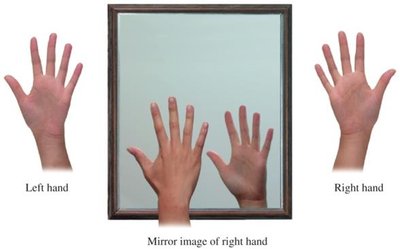
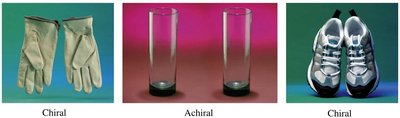
Chiral Molecule: A molecule that is not superimposable on its mirror image (like left and right hands).
Achiral Molecule: A molecule that is superimposable on its mirror image.
Chiral Carbon: A carbon atom bonded to four different groups.
Enantiomers: Stereoisomers that are nonsuperimposable mirror images of each other.
Chiral and Achiral Carbon Atoms
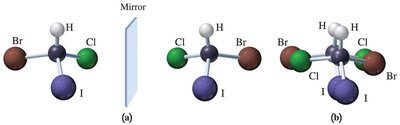
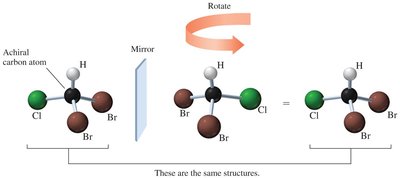
Chirality in organic molecules arises when a carbon atom is attached to four different groups, resulting in nonsuperimposable mirror images. If a molecule's mirror image can be superimposed, it is achiral.
Visualizing Chirality: Molecular Models
Three-dimensional models help visualize chirality. A chiral carbon with four different substituents will have two nonsuperimposable mirror images (enantiomers), while an achiral carbon will have superimposable images.
Fischer Projections and Stereochemistry
Fischer Projections
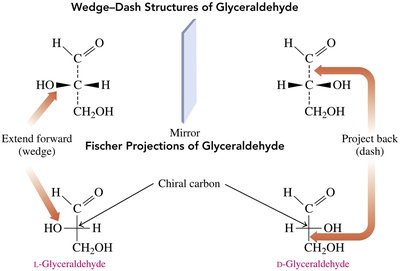
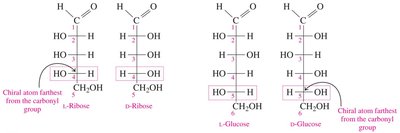
Fischer projections are two-dimensional representations of three-dimensional molecules, commonly used for carbohydrates. The most oxidized carbon is placed at the top, and chiral centers are shown at the intersection of lines. Horizontal lines represent bonds projecting out of the plane, while vertical lines represent bonds going behind the plane.
D and L Notation
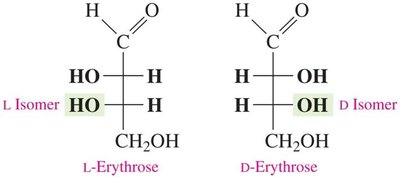
The D and L system is used to distinguish between enantiomers of sugars. The configuration is determined by the position of the –OH group on the chiral carbon farthest from the carbonyl group:
D-isomer: –OH group on the right
L-isomer: –OH group on the left
Biological Importance of Enantiomers
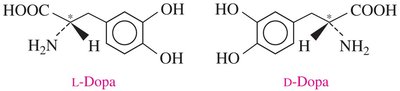
Enantiomers can have dramatically different biological effects. For example, only L-dopa is effective in treating Parkinson's disease, while D-dopa is not.
Monosaccharides: Common Examples and Properties
Common Monosaccharides
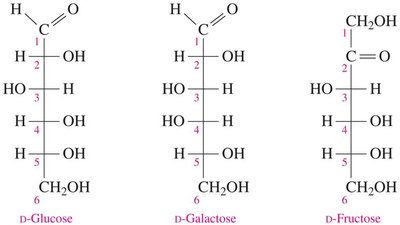
D-Glucose: An aldohexose (C6H12O6), found in fruits, syrups, and honey; also known as dextrose or blood sugar.
D-Fructose: A ketohexose (C6H12O6), the sweetest carbohydrate, found in fruit and honey.
D-Galactose: An aldohexose, obtained from lactose; differs from glucose at carbon 4.
Clinical Relevance: Blood Glucose Regulation
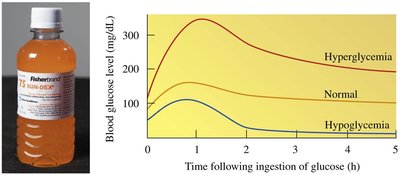
Blood glucose levels are tightly regulated. Hypoglycemia (low blood sugar) and hyperglycemia (high blood sugar) are associated with various symptoms and are important in the context of diabetes.
Cyclic Structures of Monosaccharides: Haworth Projections
Formation of Cyclic Structures
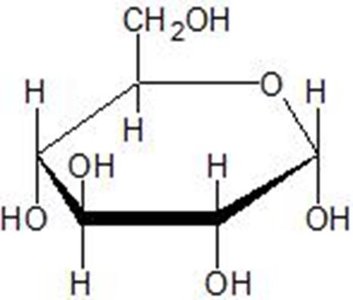
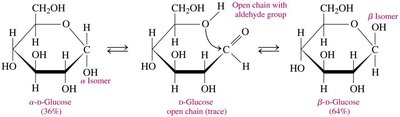
Pentoses and hexoses commonly exist as five- or six-membered rings (Haworth structures) in solution. These rings form by the reaction of a carbonyl group with a hydroxyl group within the same molecule, creating a hemiacetal or hemiketal.
Drawing Haworth Projections
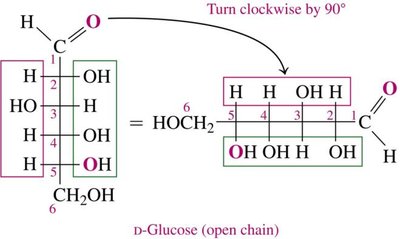
To draw a Haworth projection from a Fischer projection:
Rotate the Fischer projection 90° clockwise.
Fold the chain to form a ring, bringing the –OH group on carbon 5 close to the carbonyl carbon (carbon 1).
Form a bond between the oxygen of the –OH on carbon 5 and carbon 1.
The new –OH on carbon 1 can be drawn below the ring (α isomer) or above the ring (β isomer).

Summary Table: Types and Examples of Carbohydrates
Type | Number of Sugar Units | Examples |
|---|---|---|
Monosaccharide | 1 | Glucose, Fructose, Galactose |
Disaccharide | 2 | Sucrose, Lactose, Maltose |
Oligosaccharide | 2–10 | Raffinose, Stachyose |
Polysaccharide | 10 or more | Starch, Glycogen, Cellulose |
Key Equations
General formula for monosaccharides:
Hydrolysis of disaccharide:
Hydrolysis of polysaccharide:
Additional info: The D/L system is based on the configuration of glyceraldehyde, the simplest chiral carbohydrate. The biological activity of enantiomers is highly specific, as seen in the case of L-dopa and D-dopa.
