 Indietro
Carboxylic Acid Derivatives and Alpha Substitutions: Study Guide for Organic Chemistry II
Guida di studio - Note intelligenti
 Appunti personalizzati basati sui tuoi materiali, ampliati con definizioni chiave, esempi e contesto.
Carboxylic Acid Derivatives
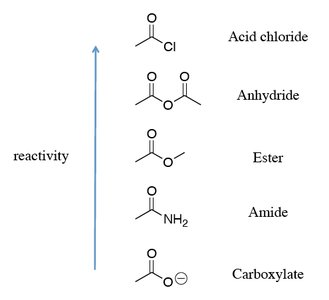
Reactivity of Carboxylic Acid Derivatives
Carboxylic acid derivatives are compounds derived from carboxylic acids by replacing the hydroxyl group with other substituents. Their reactivity varies depending on the nature of the substituent attached to the carbonyl carbon.
Acid Chlorides: Most reactive due to the good leaving group (Cl).
Anhydrides: Less reactive than acid chlorides but more reactive than esters.
Esters: Moderate reactivity; leaving group is an alkoxide.
Amides: Less reactive; leaving group is an amine.
Carboxylates: Least reactive; leaving group is a carboxylate ion.
Example: The order of reactivity is crucial for predicting the outcome of hydrolysis and interconversion reactions.
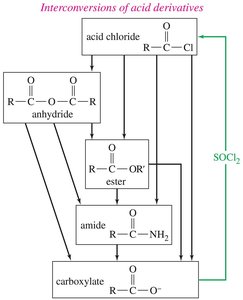
Interconversion of Acid Derivatives
More reactive acid derivatives can be converted to less reactive ones, but not vice versa. This principle guides synthetic strategies in organic chemistry.
Acid chlorides can be converted to anhydrides, esters, amides, and carboxylates.
Anhydrides can be converted to esters, amides, and carboxylates.
Esters can be converted to amides and carboxylates.
Amides can be converted to carboxylates.
Example: Synthesis of an amide from an acid chloride involves nucleophilic substitution.
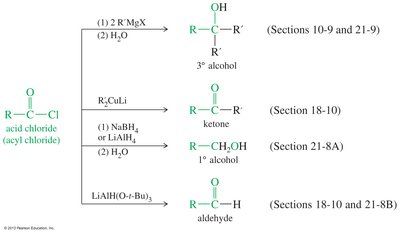
Acid Chloride Reactions
Acid chlorides undergo nucleophilic acyl substitution with a variety of nucleophiles, leading to different products:
Alcohols produce esters.
Amines produce amides.
Water produces carboxylic acids.
Organometallic reagents (e.g., Grignard, organolithium) produce alcohols or ketones.
Equation:
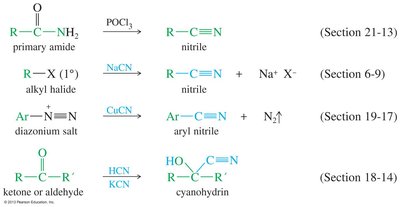
Synthesis and Reactions of Nitriles
Nitriles are important intermediates in organic synthesis. They can be synthesized from various precursors:
Primary amides react with POCl3 to form nitriles.
Alkyl halides react with NaCN to form nitriles via SN2 substitution.
Diazonium salts react with CuCN to form aryl nitriles.
Ketones or aldehydes react with HCN/KCN to form cyanohydrins.
Equation:
Alpha Substitutions and Condensations of Carbonyl Compounds
Alpha Substitution
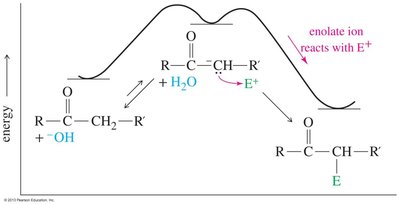
Alpha substitution involves replacing a hydrogen atom on the alpha carbon (adjacent to the carbonyl group) with an electrophile. This reaction proceeds via enolate ion intermediates.
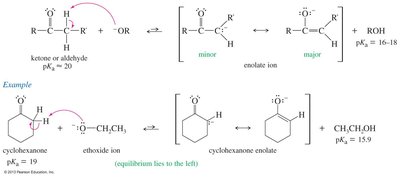
Enolate formation occurs when a base abstracts an alpha hydrogen.
Enolate ions are resonance stabilized and can react with electrophiles.
Equation:

Keto–Enol Tautomerism
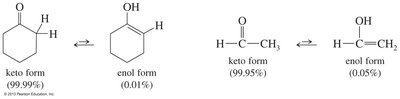
Keto–enol tautomerism is the equilibrium between a ketone (or aldehyde) and its enol form. Tautomers are structural isomers that differ by the position of a proton and a double bond.
Keto form is usually favored at equilibrium.
Enol form is important in certain reactions, such as alpha halogenation.
Base and Acid Catalyzed Tautomerism
Tautomerization can be catalyzed by acids or bases:
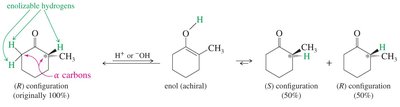
Base-catalyzed: Base abstracts an alpha proton, forming an enolate ion, which is then protonated to form the enol.
Acid-catalyzed: Acid protonates the carbonyl oxygen, followed by removal of an alpha proton to form the enol.


Racemization via Tautomerism
If a chiral alpha carbon has an enolizable hydrogen, tautomerization can lead to racemization, as the enol intermediate allows for inversion of configuration.
Acidity of Alpha Hydrogens
Alpha hydrogens of carbonyl compounds are more acidic than those of alkanes or alkenes, but less acidic than water or alcohols. This acidity enables enolate formation.
pKa of alpha hydrogen (aldehyde/ketone): ~20
pKa of alkane/alkene: >40
pKa of alkyne: 25
pKa of water: 15.7
pKa of alcohol: 16–19
Enolate Formation and Alkylation
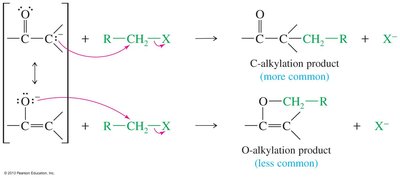
Strong bases such as LDA (lithium diisopropylamide) or NaNH2 can convert carbonyl compounds completely to their enolate forms, which can then be alkylated at the alpha carbon.
LDA synthesis: Formed by deprotonating diisopropylamine with n-butyllithium.
Alkylation: Enolate attacks alkyl halide, forming a new C–C bond.
Thermodynamic vs. Kinetic Enolate Formation
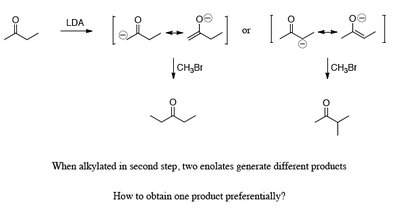
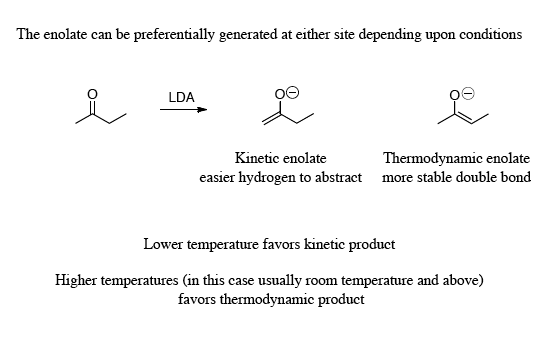
Enolates can be generated at different positions depending on reaction conditions:
Kinetic enolate: Formed at the less substituted alpha carbon; favored by low temperature and strong, bulky base.
Thermodynamic enolate: Formed at the more substituted alpha carbon; favored by higher temperature and less bulky base.
Enamines and Their Reactivity
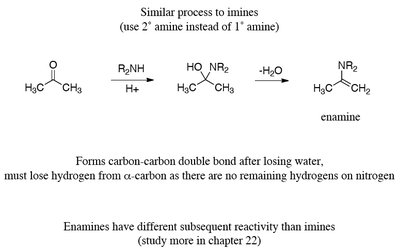
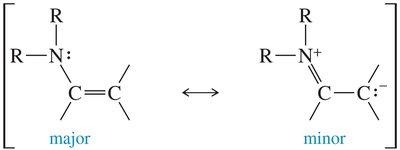
Enamines are formed by the reaction of ketones or aldehydes with secondary amines. The alpha carbon of the enamine is nucleophilic and can be used for alkylation or acylation.
Formation: Ketone/aldehyde + secondary amine → enamine + water
Reactivity: Enamines can attack alkyl halides or acyl halides, forming iminium salts that are hydrolyzed to carbonyl compounds.
Alpha Halogenation of Ketones
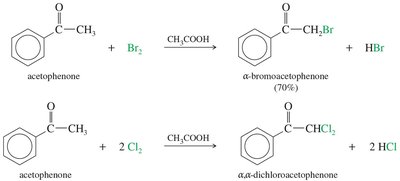
Ketones can undergo alpha halogenation under basic or acidic conditions:
Base-promoted: Enolate ion attacks halogen, leading to halogenated ketone.
Acid-catalyzed: Enol form attacks halogen, leading to halogenated ketone.

Haloform Reaction
The haloform reaction occurs when a methyl ketone reacts with excess halogen under basic conditions, producing a carboxylate ion and a haloform (e.g., CHI3).
Used for identification of methyl ketones and certain alcohols.
Equation:

Hell–Volhard–Zelinsky (HVZ) Reaction
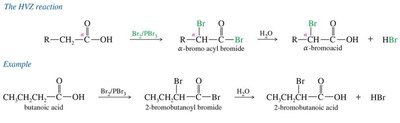
The HVZ reaction is used to brominate the alpha carbon of carboxylic acids. The acid is treated with bromine and phosphorus tribromide, followed by hydrolysis.
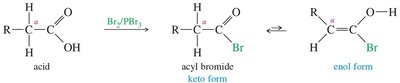
Step 1: Formation of acyl bromide.
Step 2: Enolization and bromination.
Step 3: Hydrolysis to regenerate the carboxylic acid.
Condensation Reactions of Carbonyl Compounds
Aldol Condensation
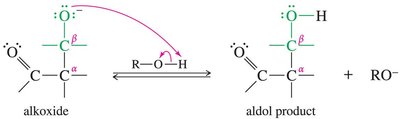
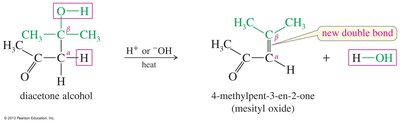
Aldol condensation is the nucleophilic addition of an enolate ion to another carbonyl group, forming a β-hydroxy carbonyl compound. Heating leads to dehydration and formation of an α,β-unsaturated carbonyl compound.
Occurs under basic or acidic conditions.
Product: β-hydroxy carbonyl (aldol product), which can dehydrate to α,β-unsaturated carbonyl.

Crossed Aldol Condensation
When the enolate of one aldehyde or ketone adds to the carbonyl group of a different aldehyde or ketone, the reaction is called crossed aldol condensation. It is effective when only one reactant can form an enolate.
Claisen Condensation
The Claisen condensation involves the nucleophilic acyl substitution of an ester by an enolate, forming a β-keto ester. The Dieckmann condensation is an intramolecular version forming cyclic β-keto esters.
Crossed Claisen: Uses two different esters, one without alpha hydrogens.
Dieckmann: Intramolecular Claisen cyclization.
Example: Malonic ester synthesis and acetoacetic ester synthesis are applications of Claisen condensation.
Conjugate Addition (Michael Reaction)
Michael addition is the 1,4-addition of a nucleophile to an α,β-unsaturated carbonyl compound. The β carbon is electrophilic due to resonance.
Strong nucleophiles favor 1,2 addition.
Stabilized nucleophiles (e.g., enolates, enamines, cuprates) favor 1,4 addition (Michael addition).
Equation:
Robinson Annulation
Robinson annulation combines Michael addition and aldol condensation to form a six-membered ring, typically a conjugated cyclohexenone.
Mechanism: Michael addition followed by intramolecular aldol condensation and dehydration.
Summary Table: Reactivity of Carboxylic Acid Derivatives
Derivative | Structure | Reactivity |
|---|---|---|
Acid chloride | RCOCl | Most reactive |
Anhydride | RCOOCOR | High |
Ester | RCOOR' | Moderate |
Amide | RCONH2 | Low |
Carboxylate | RCOO- | Least reactive |
Additional info: These notes expand on the original content by providing definitions, mechanisms, equations, and examples for each major topic, ensuring completeness and academic quality for exam preparation.
