Indietro
Carboxylic Acids: Structure, Properties, and Biological Significance
Guida di studio - Note intelligenti
 Appunti personalizzati basati sui tuoi materiali, ampliati con definizioni chiave, esempi e contesto.
Carboxylic Acids
Structure and Nomenclature
Carboxylic acids are organic compounds characterized by the presence of a carboxyl group (-COOH), which consists of a carbonyl group (C=O) bonded to a hydroxyl group (-OH). The systematic naming of carboxylic acids follows IUPAC rules, where the suffix “-oic acid” replaces the “-e” ending of the parent alkane. The carboxyl carbon is always numbered as carbon 1, and substituents are numbered accordingly.
Key Point 1: The carboxyl group is highly polar due to the presence of both the carbonyl and hydroxyl groups.
Key Point 2: IUPAC names are derived from the longest carbon chain containing the carboxyl group, with substituents numbered from the carboxyl carbon.
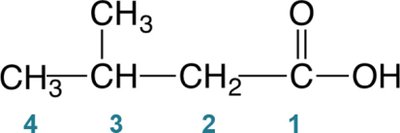
Example: The compound below is named 3-methylbutanoic acid because the methyl group is on carbon 3 of a four-carbon chain ending with a carboxyl group.
Additional info: Common names are often used for simple carboxylic acids, such as formic acid (methanoic acid) and acetic acid (ethanoic acid).
Common Carboxylic Acids
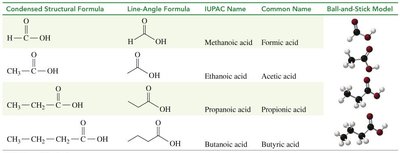
Several carboxylic acids are encountered in everyday life and biological systems. Their common and IUPAC names, structural formulas, and molecular models are summarized below.
Condensed Structural Formula | Line-Angle Formula | IUPAC Name | Common Name | Ball-and-Stick Model |
|---|---|---|---|---|
HCOOH | — | Methanoic acid | Formic acid | Ball-and-stick model |
CH3COOH | — | Ethanoic acid | Acetic acid | Ball-and-stick model |
CH3CH2COOH | — | Propanoic acid | Propionic acid | Ball-and-stick model |
CH3CH2CH2COOH | — | Butanoic acid | Butyric acid | Ball-and-stick model |
Examples and Applications
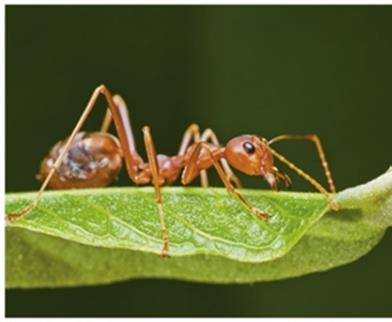
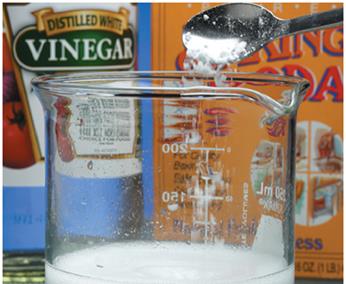
Carboxylic acids are found in nature and everyday products. For example, formic acid is responsible for the sting of red ants, and acetic acid gives vinegar its sour taste.
Example: Formic acid is secreted by ants as a defense mechanism.
Example: Acetic acid is the main component of vinegar.
Properties of Carboxylic Acids
Polarity and Solubility
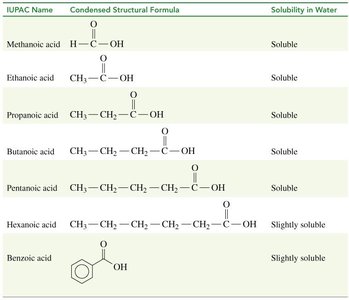
Carboxylic acids are strongly polar due to the presence of two polar groups. They can form extensive hydrogen bonds with water, making them highly soluble when the carbon chain is short (1–5 carbons). As the chain length increases, solubility decreases.
Key Point 1: Hydrogen bonding increases solubility in water.
Key Point 2: Longer carbon chains reduce solubility due to increased hydrophobic character.
Example: Acetic acid forms multiple hydrogen bonds with water molecules.
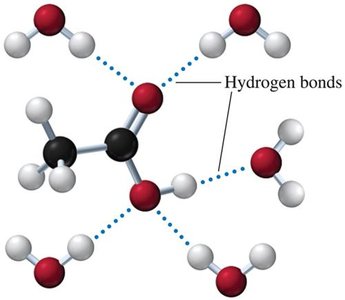
Additional info: The solubility of carboxylic acids in water is summarized in the table below.
IUPAC Name | Condensed Structural Formula | Solubility in Water |
|---|---|---|
Methanoic acid | HCOOH | Soluble |
Ethanoic acid | CH3COOH | Soluble |
Propanoic acid | CH3CH2COOH | Soluble |
Butanoic acid | CH3CH2CH2COOH | Soluble |
Pentanoic acid | CH3CH2CH2CH2COOH | Soluble |
Hexanoic acid | CH3CH2CH2CH2CH2COOH | Slightly soluble |
Benzoic acid | C6H5COOH | Slightly soluble |
Acidity and Dissociation
Carboxylic acids are weak acids that ionize in water to produce carboxylate ions and hydronium ions. The negative charge on the carboxylate ion is stabilized by resonance between the two oxygen atoms.
Key Point 1: Carboxylic acids lose a proton in water, forming carboxylate ions.
Key Point 2: The dissociation equilibrium is represented as:
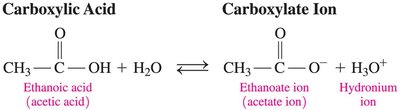
Additional info: The carboxylate ion is named by replacing “ic acid” with “ate” (e.g., acetate ion).
Neutralization and Carboxylic Acid Salts
Formation and Properties of Salts
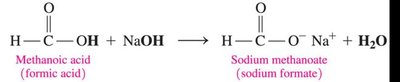
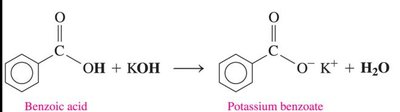
Carboxylic acid salts are formed by the neutralization of carboxylic acids with strong bases such as NaOH or KOH. These salts are ionic compounds, solid at room temperature, with high melting points and good solubility in water. They are widely used as preservatives and flavor enhancers.
Key Point 1: The neutralization reaction produces a carboxylate salt and water.
Key Point 2: Carboxylic acid salts are named by replacing “ic acid” with “ate” (e.g., sodium acetate).
Example: Sodium propionate is used in cheeses and breads; sodium benzoate is used in fruit juices and jams.
Carboxylic Acids in Metabolism
Role in Cellular Processes
Carboxylic acids are integral to metabolic pathways such as glycolysis and the citric acid cycle (Krebs cycle). During glycolysis, glucose is converted to pyruvate, a carboxylate salt. Under anaerobic conditions, pyruvate is reduced to lactic acid.
Key Point 1: Pyruvic acid is a key intermediate in glycolysis.
Key Point 2: Lactic acid is produced during anaerobic metabolism.
Example: The reduction of pyruvic acid to lactic acid:

The Citric Acid Cycle
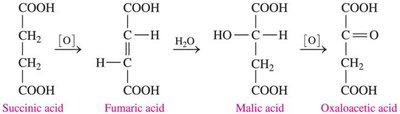
The citric acid cycle involves the oxidation and decarboxylation of di- and tricarboxylic acids to produce energy. Citric acid is oxidized to α-ketoglutaric acid, which loses CO2 to form succinic acid. Succinic acid is further converted to oxaloacetic acid through a series of reactions.
Key Point 1: The citric acid cycle is essential for cellular energy production.
Key Point 2: Several carboxylic acids are intermediates in this cycle.
Example: The conversion of succinic acid to oxaloacetic acid:
Additional info: The presence of carboxylic acids in fruits and juices is a source of dietary acids, as shown below.