Indietro
Carboxylic Acids: Structure, Properties, Reactions, and Synthesis
Guida di studio - Note intelligenti
 Appunti personalizzati basati sui tuoi materiali, ampliati con definizioni chiave, esempi e contesto.
Carboxylic Acids: Structure and Classification
Structure of Carboxylic Acids
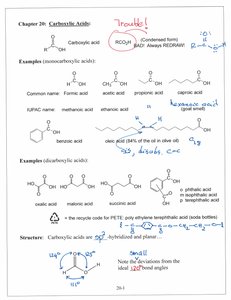
Carboxylic acids are organic compounds containing the carboxyl functional group (-COOH). Their condensed formula is RCOOH, where R represents an alkyl or aryl group. The carboxyl group consists of a carbonyl (C=O) and a hydroxyl (OH) group bonded to the same carbon.
General formula: RCOOH
Condensed form: Always written as RCOOH
Example: Acetic acid (CH3COOH)
Classification and Examples
Carboxylic acids can be classified as monocarboxylic (one carboxyl group) or dicarboxylic (two carboxyl groups).
Monocarboxylic acids: Formic acid, acetic acid, propanoic acid, butanoic acid, caproic acid
Dicarboxylic acids: Oxalic acid, malonic acid, succinic acid, glutaric acid, adipic acid
Applications: Used in food, plastics (e.g., PTFE), and as intermediates in organic synthesis
Physical Properties of Carboxylic Acids
Solubility and Acidity
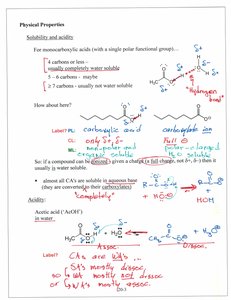
Carboxylic acids exhibit distinct solubility and acidity characteristics due to their polar carboxyl group.
Solubility:
1-4 carbons: completely water soluble
5-6 carbons: mostly water soluble
>7 carbons: usually not water soluble
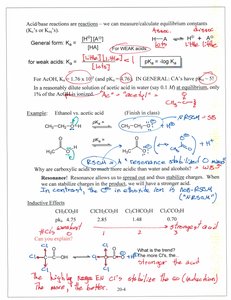
Acidity: Carboxylic acids are weak acids, but stronger than alcohols and phenols. Their acidity is due to resonance stabilization of the carboxylate ion.
Example: Acetic acid dissociates in water to form acetate and hydronium ion.
Acid-Base Equilibria and Inductive Effects
Acid-Base Equilibrium Constants
The acidity of carboxylic acids is quantified by their equilibrium constant (Ka) and pKa values.
General form:
pKa:
Acetic acid: ,
Inductive Effects
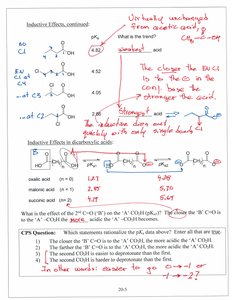
Electron-withdrawing groups (EWG) increase acidity by stabilizing the carboxylate ion, while electron-donating groups (EDG) decrease acidity.
Trend: The closer the EWG (e.g., Cl) is to the carboxyl group, the stronger the acid.
Example: Chloroacetic acid is more acidic than acetic acid.
Salts of Carboxylic Acids
Formation and Properties
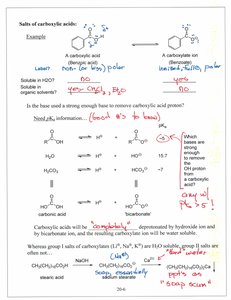
Carboxylic acids react with strong bases to form carboxylate salts, which are often water soluble and used in soaps.
Example: Sodium acetate (CH3COONa)
Solubility: Carboxylate salts are polar and water soluble
pKa: Carboxylic acids typically have pKa ≈ 5
Separation and Consequences of Carboxylate Salts
Separation Techniques
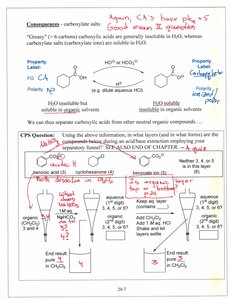
Carboxylic acids can be separated from other organic compounds by converting them to their salts, which are water soluble.
Technique: Extraction using aqueous base to form carboxylate salt
Application: Used in organic synthesis and purification
Spectroscopy of Carboxylic Acids
IR and NMR Spectroscopy
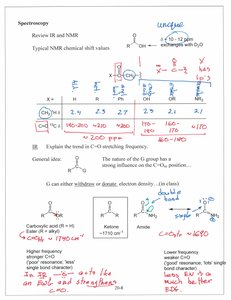
Carboxylic acids exhibit characteristic IR and NMR signals due to their functional groups.
IR: C=O stretch at 1700 cm-1, O-H stretch at 2500-3300 cm-1
NMR: Typical chemical shifts for carboxylic acid protons are 10-12 ppm
Synthesis of Carboxylic Acids
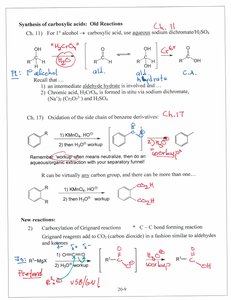
Oxidation Reactions
Carboxylic acids can be synthesized by oxidation of primary alcohols and aldehydes.
Primary alcohol oxidation:
Side-chain oxidation of aromatic compounds:
Hydrolysis of Nitriles
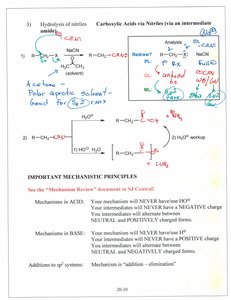
Nitriles can be hydrolyzed to carboxylic acids via acid or base catalysis.
Acid hydrolysis:
Base hydrolysis:
Mechanisms of Carboxylic Acid Formation
Acid and Base Promoted Mechanisms
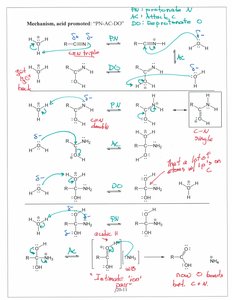
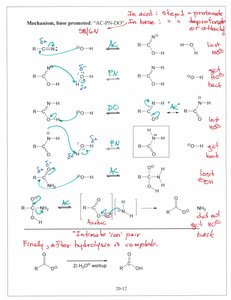
The hydrolysis of nitriles to carboxylic acids involves multi-step mechanisms, differing in acid and base conditions.
Acid-promoted: Protonation, nucleophilic attack, deprotonation
Base-promoted: Nucleophilic attack, deprotonation, protonation
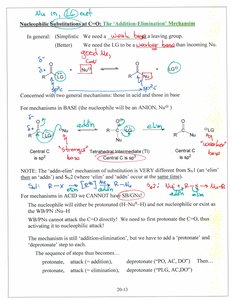
Nucleophilic Substitution at C=O: Addition-Elimination Mechanism
Mechanistic Principles
Nucleophilic substitution at the carbonyl carbon of carboxylic acids and derivatives proceeds via an addition-elimination mechanism.
Key steps: Nucleophilic attack, addition, elimination of leaving group
Requirement: Leaving group must be weaker base than incoming nucleophile
Esters via Carboxylic Acids and Alcohols: Fischer Esterification
Reaction and Mechanism
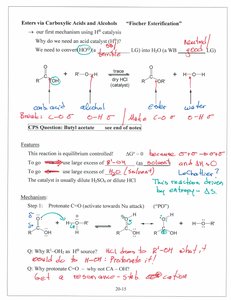
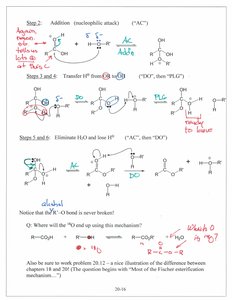
Esters are formed by the acid-catalyzed reaction of carboxylic acids with alcohols, known as Fischer esterification.
General reaction:
Mechanism: Protonation, nucleophilic attack, transfer, elimination
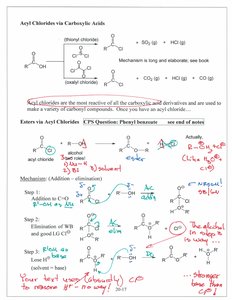
Acyl Chlorides via Carboxylic Acids
Preparation and Reactivity
Acyl chlorides are highly reactive derivatives of carboxylic acids, prepared by reaction with thionyl chloride (SOCl2).
General reaction:
Application: Used to synthesize esters and amides
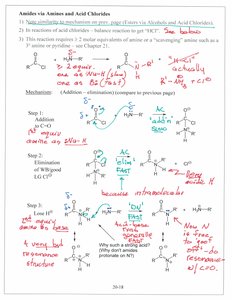
Amides via Amines and Acid Chlorides
Formation and Mechanism
Amides are formed by the reaction of acid chlorides with amines, proceeding via nucleophilic addition-elimination.
General reaction:
Mechanism: Nucleophilic attack, elimination of chloride
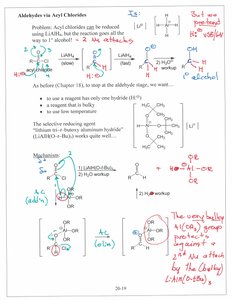
Aldehydes via Acyl Chlorides
Reduction to Aldehydes
Acyl chlorides can be selectively reduced to aldehydes using reagents such as lithium tri-tert-butoxyaluminum hydride (LiAlH(OtBu)3).
General reaction:
Application: Useful for synthesizing aldehydes without over-reduction to alcohols
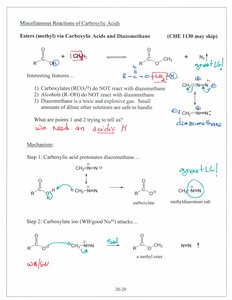
Miscellaneous Reactions of Carboxylic Acids
Esters via Carboxylic Acids and Diazomethane
Carboxylic acids react with diazomethane to form methyl esters, a reaction used for methylation.
General reaction:
Mechanism: Nucleophilic attack by diazomethane, elimination of nitrogen gas
Reduction of Carboxylic Acids
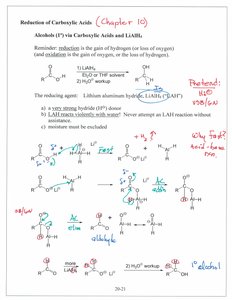
Alcohols via Carboxylic Acids and LiAlH4
Carboxylic acids can be reduced to primary alcohols using lithium aluminum hydride (LiAlH4).
General reaction:
Mechanism: Hydride transfer, protonation
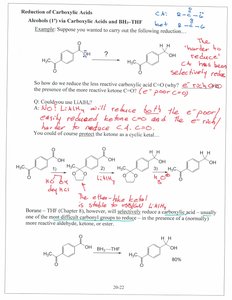
Selective Reduction with BH3-THF
Borane (BH3-THF) can selectively reduce carboxylic acids in the presence of other functional groups.
Application: Useful for reducing carboxylic acids without affecting ketones or esters
Practice Questions and Functional Group Identification
Functional Group Analysis and Density
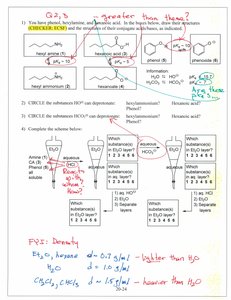
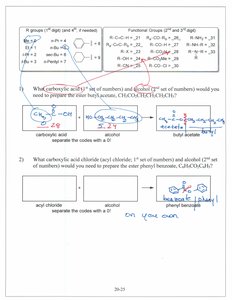
Practice questions involve identifying carboxylic acids, their salts, and related functional groups, as well as comparing densities of organic solvents.
Key concepts: Functional group recognition, acid-base properties, density comparisons