 Indietro
Chapter 1: Molecular Shapes, Resonance, Bond Rotation, and Isomerism
Guida di studio - Note intelligenti
 Appunti personalizzati basati sui tuoi materiali, ampliati con definizioni chiave, esempi e contesto.
Resonance & Resonance Forms
Understanding Resonance in Organic Molecules
Some organic molecules cannot be accurately represented by a single Lewis structure. Resonance forms are alternative Lewis structures for the same molecule, differing only in the arrangement of electrons, not the positions of atoms. The actual structure is a resonance hybrid, which is a weighted average of all valid resonance forms.
Resonance Criteria:
Maximize the number of octets
Maximize the number of bonds
Place negative charge on the most electronegative atom
Minimize charge separation
Resonance forms are interconverted by moving only electrons (usually π or lone pairs).
The resonance hybrid is more stable than any individual resonance form.
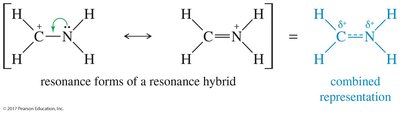
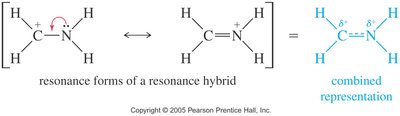
Example: The formiminium ion (CH2=NH2+) is best represented as a resonance hybrid of two structures, with delocalized electrons between carbon and nitrogen.
Line-Angle Notation
Efficient Representation of Organic Structures
Line-angle drawings (skeletal structures) are a simplified way to represent organic molecules. Each vertex or line end represents a carbon atom, and hydrogens attached to carbons are omitted for clarity. Heteroatoms (N, O, halides) and their hydrogens are always shown explicitly.
Each line represents a bond.
Carbons are implied at line ends and vertices.
Hydrogens on carbons are not shown; all other atoms are shown.

The Hydrogen Molecule: Bond Strength and Length
Basic Covalent Bonding Example
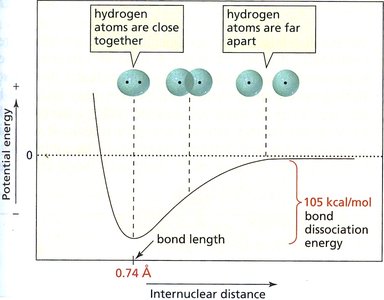
The hydrogen molecule (H2) is the simplest example of covalent bonding. The bond strength and bond length are fundamental properties that illustrate the nature of covalent bonds.
Bond strength: 436 kJ/mol (105 kcal/mol)
Bond length: 74 pm (0.74 Å)
Molecular Properties and VSEPR
Predicting Molecular Shapes
The Valence Shell Electron Pair Repulsion (VSEPR) model is used to predict the geometry of molecules based on electron pair repulsion. It provides approximate bond angles and shapes, which are essential for understanding molecular properties such as polarity and reactivity.
VSEPR is a qualitative model; more advanced theories are needed for detailed predictions.
Common Bond Angles
Bond Angles in Organic Molecules
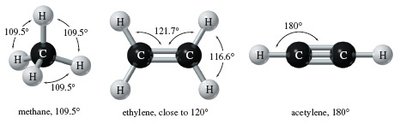
Bond angles in organic molecules are determined by the hybridization of the central atom:
sp3 (tetrahedral): 109.5° (e.g., methane)
sp2 (trigonal planar): 120° (e.g., ethylene)
sp (linear): 180° (e.g., acetylene)
Orbital Hybridization
Mixing Atomic Orbitals to Form Hybrid Orbitals
Hybridization is the process of mixing atomic orbitals within an atom to form new, equivalent hybrid orbitals. This concept explains observed molecular geometries and bond angles.
sp3 hybridization: One s and three p orbitals mix to form four equivalent sp3 orbitals (tetrahedral, 109.5°).
sp2 hybridization: One s and two p orbitals mix to form three sp2 orbitals (trigonal planar, 120°), with one unhybridized p orbital.
sp hybridization: One s and one p orbital mix to form two sp orbitals (linear, 180°), with two unhybridized p orbitals.



Bonding in Alkanes, Alkenes, and Alkynes
Types of Bonds and Their Rotational Properties
Single bonds (σ): Formed by direct overlap of orbitals; allow free rotation (e.g., in alkanes).
Double bonds (σ + π): One sigma and one pi bond; no free rotation due to the pi bond (e.g., in alkenes).
Triple bonds (σ + 2π): One sigma and two pi bonds; linear geometry (e.g., in alkynes).


Bond Rotation and Isomerism
Conformational and Geometric Isomerism
Bond rotation: Single bonds can rotate freely, leading to different conformations.
Double bonds: Cannot rotate, leading to geometric (cis/trans) isomerism.
Isomers: Compounds with the same molecular formula but different arrangements of atoms.
Constitutional (structural) isomers: Differ in bonding sequence.
Stereoisomers: Same bonding sequence, different spatial arrangement (e.g., cis/trans).
Example: C4H10 has two constitutional isomers: n-butane and isobutane.
Functional Groups
Classification and Reactivity in Organic Chemistry
A functional group is an atom or group of atoms within a molecule that imparts characteristic chemical and physical properties. Functional groups are the basis for classifying organic compounds, predicting reactivity, and systematic naming.
Common functional groups: alkane, alkene, alkyne, aromatic, alkyl halide, amine, alcohol, thiol, phenol, ether, epoxide, nitrile, aldehyde, ketone, carboxylic acid, ester, amide, anhydride, sulfonic acid, sulfonyl chloride, sulfonic ester, sulfonamide.
Functional groups determine the sites of chemical reactions.
Classes of Hydrocarbons
Types of Hydrocarbon Structures
Alkane: Only single bonds, sp3 carbons
Cycloalkane: Ring structure with single bonds
Alkene: Contains a double bond, sp2 carbons
Cycloalkene: Ring structure with a double bond
Alkyne: Contains a triple bond, sp carbons
Aromatic: Contains a benzene ring or similar structure
Summary Table: Hybridization and Geometry
Hybridization | Geometry | Bond Angle | Example |
|---|---|---|---|
sp3 | Tetrahedral | 109.5° | Methane (CH4) |
sp2 | Trigonal planar | 120° | Ethylene (C2H4) |
sp | Linear | 180° | Acetylene (C2H2) |
