 Indietro
Chapter 1: Remembering General Chemistry – Electronic Structure and Bonding
Guida di studio - Note intelligenti
 Appunti personalizzati basati sui tuoi materiali, ampliati con definizioni chiave, esempi e contesto.
Introduction to Organic Chemistry
Definition and Scope
Organic chemistry is the study of compounds containing carbon. Historically, organic compounds were thought to originate only from living organisms, while inorganic compounds came from minerals. Today, organic chemistry encompasses all carbon-containing compounds, regardless of their source.
Organic compounds: Contain carbon atoms, often bonded to hydrogen, oxygen, nitrogen, and other elements.
Inorganic compounds: Typically do not contain carbon-hydrogen bonds.
Atomic Structure and Electron Configuration
Structure of an Atom
Atoms consist of a nucleus containing protons (positively charged) and neutrons (neutral), surrounded by electrons (negatively charged). The number of protons defines the atomic number and the element.
Carbon atom: 6 protons, 6 electrons (neutral atom).
Isotopes
Isotopes are atoms of the same element with different numbers of neutrons, resulting in different mass numbers but identical chemical properties.
Electron Distribution and Atomic Orbitals
Electrons occupy atomic orbitals arranged in shells around the nucleus. The energy of an orbital increases with distance from the nucleus. Within a shell, s orbitals are lower in energy than p orbitals.
Aufbau principle: Electrons fill the lowest energy orbitals first.
Pauli exclusion principle: Each orbital holds a maximum of two electrons with opposite spins.
Hund’s rule: Electrons occupy degenerate orbitals singly before pairing up.
Periodic Trends and Bonding
Electron Loss and Gain
Atoms achieve stability by filling their outermost shell (octet rule). Elements on the left of the periodic table (e.g., Li, Na) lose electrons, while those on the right (e.g., F, Cl) gain electrons. Hydrogen can either lose or gain an electron to achieve a stable configuration.
Covalent Bonding
Atoms can achieve filled outer shells by sharing electrons, forming covalent bonds. The number of bonds an atom forms is determined by the number of electrons needed to complete its octet.
Bond Polarity and Electronegativity
Nonpolar and Polar Covalent Bonds
The type of bond formed depends on the difference in electronegativity between the bonded atoms:
Nonpolar covalent bond: Electronegativity difference < 0.5
Polar covalent bond: Electronegativity difference 0.5–1.9
Ionic bond: Electronegativity difference > 1.9
The greater the difference in electronegativity, the more polar the bond and the larger the dipole moment.
Lewis Structures and Formal Charges
Drawing Lewis Structures
Lewis structures represent the arrangement of valence electrons in molecules. Steps to draw a Lewis structure:
Determine the total number of valence electrons.
Arrange atoms and connect them with single bonds.
Distribute remaining electrons to satisfy the octet rule.
Check for formal charges and minimize them.
Bonding Preferences of Common Elements
Carbon: Forms four bonds. If not, it carries a charge or is a radical.
Nitrogen: Forms three bonds and has one lone pair. Deviations result in a charge.
Oxygen: Forms two bonds and has two lone pairs. Deviations result in a charge.
Hydrogen and Halogens: Form one bond. Halogens have three lone pairs.
Structural Representations in Organic Chemistry
Kekulé, Condensed, and Skeletal Structures
Organic molecules can be represented in several ways:
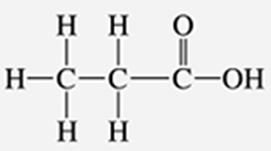
Kekulé structures: Show all atoms and bonds explicitly.
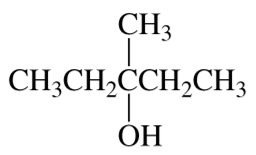
Condensed structures: Group atoms together, omitting some bonds for simplicity.
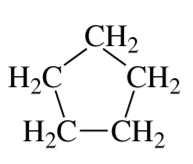
Skeletal structures: Show only the carbon skeleton and heteroatoms; hydrogens bonded to carbons are implied.
Examples of Kekulé and condensed structures:
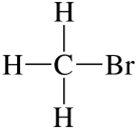
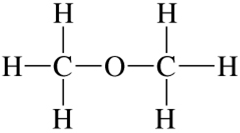
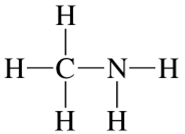
Condensed and line-bond representations:
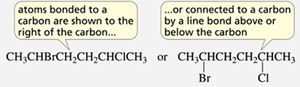
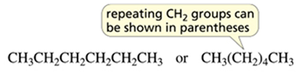
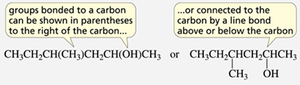
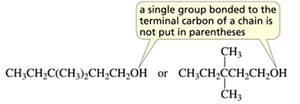
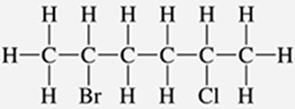
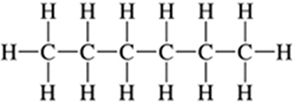
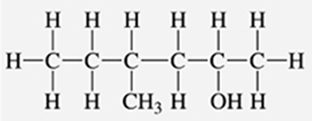
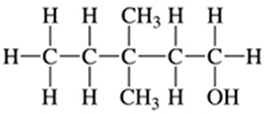
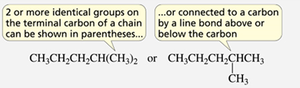
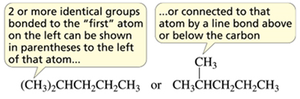
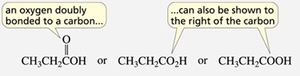
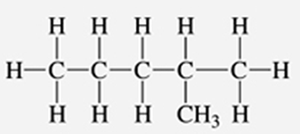
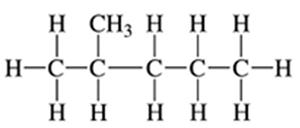
Skeletal Structures
Skeletal structures are simplified representations where carbon atoms are implied at the ends and intersections of lines, and hydrogens attached to carbons are not shown. Heteroatoms and hydrogens attached to them are explicitly drawn.
Atomic and Molecular Orbitals
s and p Atomic Orbitals
An atomic orbital is a region in space where an electron is likely to be found. The s orbital is spherical, while p orbitals are dumbbell-shaped and oriented along the x, y, and z axes. The lobes of a p orbital have opposite phases.
Hybridization and Molecular Geometry
Hybridization is the mixing of atomic orbitals to form new hybrid orbitals suitable for bonding. The type of hybridization determines the geometry of the molecule:
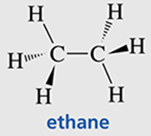
sp3 hybridization: Tetrahedral geometry, bond angle ≈ 109.5°
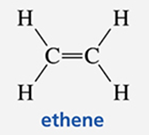
sp2 hybridization: Trigonal planar geometry, bond angle ≈ 120°
sp hybridization: Linear geometry, bond angle ≈ 180°
Examples:
Bond Strength, Bond Length, and Bond Angles
Single, Double, and Triple Bonds
The number of bonds between two atoms affects bond strength and length:
Single bond (σ): Longest and weakest
Double bond (σ + π): Shorter and stronger
Triple bond (σ + 2π): Shortest and strongest
The more s character in the hybrid orbital, the shorter and stronger the bond, and the larger the bond angle.
Summary Table: Hybridization, Bond Angle, Bond Length, Bond Strength
Hybridization | Bond Angle | Bond Length | Bond Strength |
|---|---|---|---|
sp3 | 109.5° | Longest | Weakest |
sp2 | 120° | Intermediate | Intermediate |
sp | 180° | Shortest | Strongest |
Bonding in Hydrogen Halides
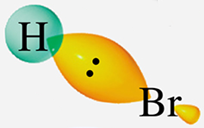
Hydrogen halides (e.g., HF, HCl, HBr, HI) form by the overlap of an s orbital from hydrogen and an sp3 hybrid orbital from the halogen. The bond length increases and bond strength decreases as the halogen becomes larger down the group.



Key Takeaways
The shorter the bond, the stronger it is.
The greater the electron density in the region of orbital overlap, the stronger the bond.
The more s character, the shorter and stronger the bond, and the larger the bond angle.
π bonds are weaker than σ bonds.
