Indietro
Chapter 1: Structure and Bonding – Foundations of Organic Chemistry
Guida di studio - Note intelligenti
 Appunti personalizzati basati sui tuoi materiali, ampliati con definizioni chiave, esempi e contesto.
Chapter 1: Structure and Bonding
Introduction to Organic Chemistry
Organic chemistry is the study of carbon-containing compounds and their properties, structures, and reactions. Carbon's unique ability to form stable covalent bonds with itself and other elements leads to a vast array of molecular diversity, making organic chemistry central to the study of life and materials.
Electronic Structure of the Atom
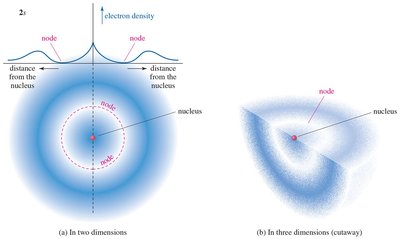
Atoms consist of a dense, positively charged nucleus surrounded by a cloud of electrons. The electron density is highest at the nucleus and decreases exponentially with distance. The arrangement of electrons in atomic orbitals determines the chemical properties of elements.
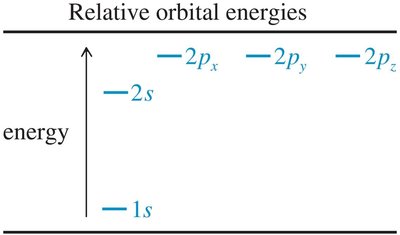
The 2p Orbitals
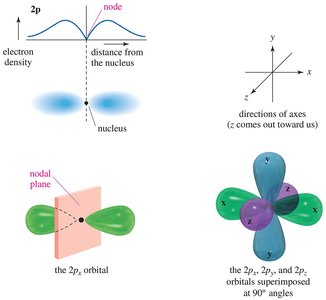
There are three 2p orbitals (2px, 2py, 2pz), each oriented at right angles to each other.
Each p orbital consists of two lobes separated by a nodal plane at the nucleus.
These orbitals are important for bonding and molecular geometry.
Isotopes
Isotopes are atoms of the same element with the same number of protons but different numbers of neutrons. The mass number is the sum of protons and neutrons in an atom. For example, 12C and 14C are isotopes of carbon.
Electronic Configurations of Atoms
Valence electrons are the electrons in the outermost shell of an atom and are primarily responsible for chemical bonding. The electronic configuration of an atom describes the distribution of electrons among atomic orbitals.
The aufbau principle states that electrons fill the lowest energy orbitals first.
Hund’s rule states that electrons occupy degenerate orbitals singly before pairing up.
Ionic and Covalent Bonding
Ionic Bonding
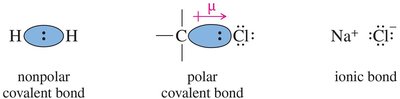
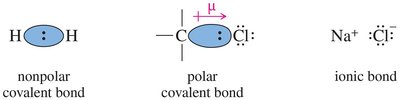
Atoms may transfer electrons to achieve a noble gas configuration, resulting in oppositely charged ions that attract each other to form ionic bonds.

Covalent Bonding
In covalent bonds, electrons are shared between atoms to complete their octets. If electrons are shared equally, the bond is nonpolar covalent; if unequally, it is polar covalent.
Lewis Structures and Nonbonding Electrons
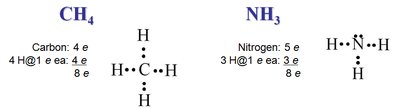
Lewis structures represent the arrangement of valence electrons in molecules. Nonbonding electrons, or lone pairs, are valence electrons not involved in bonding.

Multiple Bonding
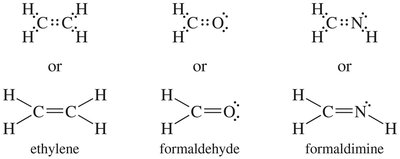
Atoms can share more than one pair of electrons:
Double bond: sharing two pairs of electrons
Triple bond: sharing three pairs of electrons
Bonding Patterns
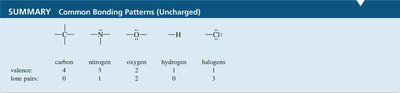
Common bonding patterns for main group elements in organic compounds are summarized below:
Element | Valence | Lone Pairs |
|---|---|---|
Carbon | 4 | 0 |
Nitrogen | 3 | 1 |
Oxygen | 2 | 2 |
Hydrogen | 1 | 0 |
Halogens | 1 | 3 |
Electronegativity, Bond Polarity, and Dipole Moment
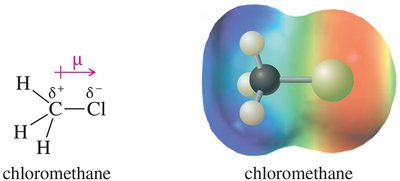
Electronegativity is the ability of an atom to attract electrons in a bond. The difference in electronegativity between two atoms determines bond polarity and the presence of a dipole moment.
Nonpolar covalent bond: electrons shared equally
Polar covalent bond: electrons shared unequally
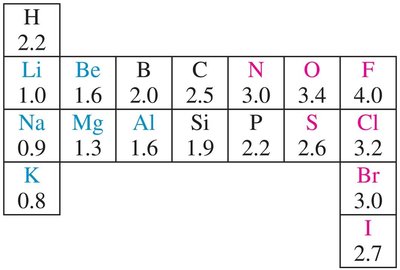
Pauling Electronegativities
Electronegativity values can be used to predict bond polarity and dipole direction. For example, C–H bonds are considered nonpolar due to similar electronegativities.
Formal Charges
Formal charge is a bookkeeping tool to keep track of electron distribution in molecules. It is calculated as:
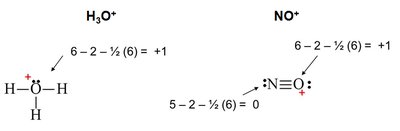
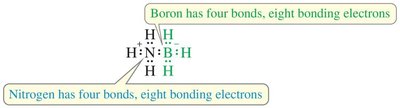
Resonance Forms
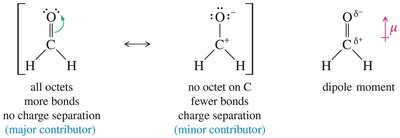
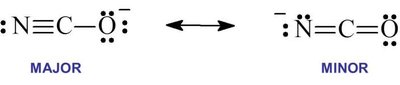
Some molecules cannot be adequately represented by a single Lewis structure. Resonance forms are alternative Lewis structures that differ only in the arrangement of electrons. The true structure is a resonance hybrid of all valid forms.
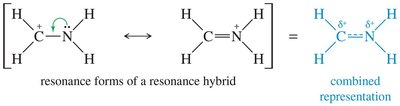
Resonance in the Acetate Ion
When acetic acid loses a proton, the resulting acetate ion has a negative charge delocalized over both oxygen atoms, stabilizing the ion. Each C–O bond has a bond order of 1.5.

Evaluating Resonance Forms
Most important resonance forms have as many octets as possible.
Major contributors have the negative charge on the most electronegative atom and minimal charge separation.
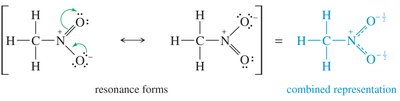
Condensed Structural Formulas
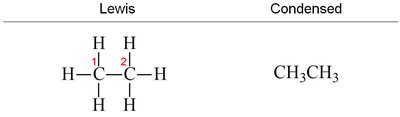
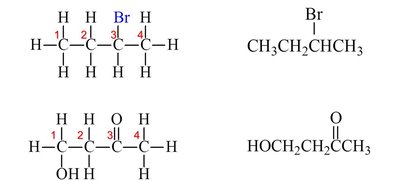
Condensed formulas represent molecules in a compact form, often using parentheses and subscripts for repeating groups.

Line-Angle Drawings
Line-angle (skeletal) drawings are simplified representations where lines represent bonds and vertices represent carbon atoms. Heteroatoms (N, O, halides) are shown explicitly.


Molecular and Empirical Formulas
The molecular formula gives the number of atoms of each element in a molecule. The empirical formula is the simplest whole-number ratio of elements. To determine empirical formulas from percent composition:
Assume 100 g sample.
Convert grams to moles for each element.
Divide by the smallest number of moles to get the ratio.
The molecular formula may be a multiple of the empirical formula.
Hybridization and Molecular Shapes
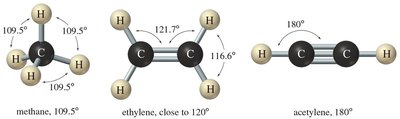
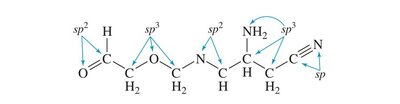
Atomic orbitals combine to form hybrid orbitals, which explain molecular shapes and bond angles. VSEPR theory is used to predict molecular geometry based on electron pair repulsion.
sp Hybrid Orbitals
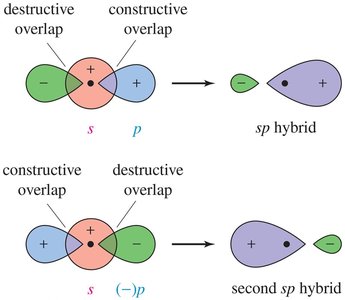
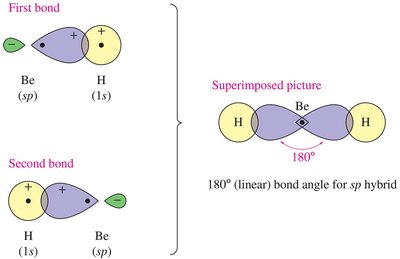
Formed by mixing one s and one p orbital, resulting in two sp orbitals with linear geometry (180° bond angle).
sp2 Hybrid Orbitals
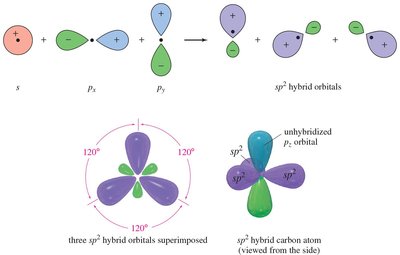
Formed by mixing one s and two p orbitals, resulting in three sp2 orbitals with trigonal planar geometry (120° bond angle).
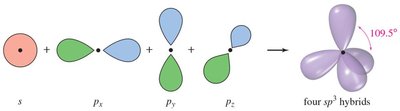
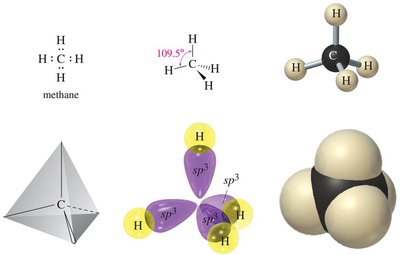
sp3 Hybrid Orbitals
Formed by mixing one s and three p orbitals, resulting in four sp3 orbitals with tetrahedral geometry (109.5° bond angle).
Hybridization | Geometry | Bond Angles |
|---|---|---|
sp | Linear | 180° |
sp2 | Trigonal planar | 120° |
sp3 | Tetrahedral | 109.5° |
Bonding in Ethylene and Acetylene
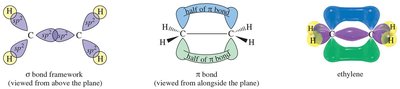
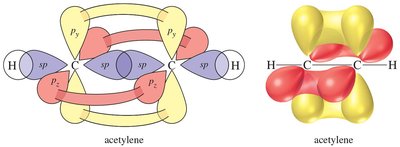
In ethylene (C2H4), each carbon is sp2 hybridized, forming sigma bonds in a trigonal planar geometry. The unhybridized p orbitals overlap to form a pi bond above and below the plane of the molecule (double bond). In acetylene (C2H2), each carbon is sp hybridized, forming a triple bond (one sigma and two pi bonds).
Rotation Around Bonds and Isomerism
Rotation in Single Bonds
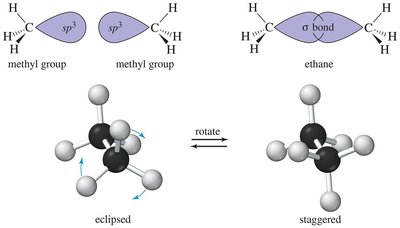
Single (sigma) bonds allow free rotation, resulting in different conformations of molecules.
Rotation Around Double Bonds
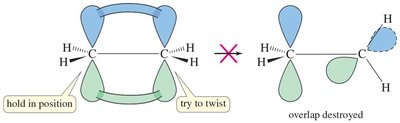
Double bonds (containing a pi bond) restrict rotation, leading to the possibility of geometric (cis/trans) isomerism.
Isomerism
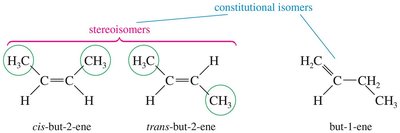
Isomers are molecules with the same molecular formula but different arrangements of atoms.
Constitutional (structural) isomers: Differ in bonding sequence.
Stereoisomers: Same bonding sequence, different spatial arrangement.
Constitutional Isomers
Constitutional isomers have different connectivity and often different physical and chemical properties.


Geometric Isomers: Cis and Trans
Geometric (cis/trans) isomers are a type of stereoisomerism that arises due to restricted rotation around double bonds. Cis isomers have substituents on the same side, while trans isomers have them on opposite sides.