 Indietro
Chapter 1: Structure and Bonding in Organic Chemistry
Guida di studio - Note intelligenti
 Appunti personalizzati basati sui tuoi materiali, ampliati con definizioni chiave, esempi e contesto.
Chapter 1: Structure and Bonding
Atoms, Ions, and Bonds
This section introduces the fundamental building blocks of organic chemistry: atoms, ions, and the types of bonds that connect them. Understanding these concepts is essential for grasping molecular structure and reactivity.
Atoms: Consist of a nucleus (protons and neutrons) surrounded by electrons.
Ions: Formed when atoms gain or lose electrons. Cations are positively charged (e.g., Na+), anions are negatively charged (e.g., Cl-).
Ionic Bonds: Electrostatic attraction between oppositely charged ions.
Covalent Bonds: Sharing of electrons between atoms.
Polar Covalent Bonds: Unequal sharing of electrons due to differences in electronegativity.
Dipole Moment: Occurs in polar bonds, resulting in partial positive and negative charges.
Electronegativity: The ability of an atom to attract electrons in a bond. Fluorine is the most electronegative element.
Example: In H–F, fluorine attracts electrons more strongly, creating a polar bond.
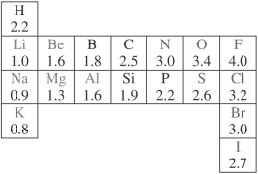
Electronic Configuration
Electronic configuration describes the arrangement of electrons in atomic orbitals. It determines the chemical properties and bonding behavior of elements.
Valence Electrons: Electrons in the outermost shell, involved in bonding.
Example: Carbon (C): ; Nitrogen (N): .
Orbital Energies: 1s < 2s < 2p (energy increases with principal quantum number).
Lewis Structures and Formal Charges
Lewis structures represent molecules by showing all valence electrons and bonds. Formal charge helps identify the distribution of charge within a molecule.
Lewis Structure: Shows atoms, bonds, and lone pairs.
Octet Rule: Atoms (except H) strive for eight electrons in their valence shell.
Formal Charge Formula:
Example: In H2O, O has a formal charge of 0; in NH4+, N has a formal charge of +1.
Resonance Structures
Resonance structures are different electronic representations of a molecule, used to describe delocalization of electrons. They stabilize molecules and affect reactivity.
Resonance: Electrons are delocalized across multiple atoms.
Drawing Rules: Move only electrons, not atoms; all resonance forms must have the same net charge.
Resonance Hybrid: The actual molecule is a blend of all resonance forms.
Importance Guidelines:
Structures with more octets and bonds are more important.
Minimize charge separation.
Place charges on atoms with compatible electronegativity.

Structural Formulas
Chemical structures can be represented in several ways, each with varying levels of detail and abstraction.
Lewis Structure: Shows all atoms, bonds, and lone pairs.
Condensed Structure: Groups atoms together (e.g., CH3CH2OH).
Line-Angle Structure: Each vertex and line end represents a carbon atom; hydrogens attached to carbons are usually omitted.
Example: CH3CH2CH2OH can be drawn as a line-angle structure.
Molecular Orbitals and Bonding
Molecular orbitals are formed by the combination of atomic orbitals. The type of orbital overlap determines the nature of the bond.
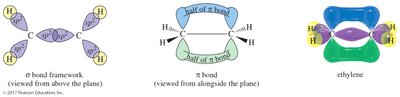
Sigma (σ) Bond: Electron density is centered along the line joining the nuclei; cylindrically symmetric.
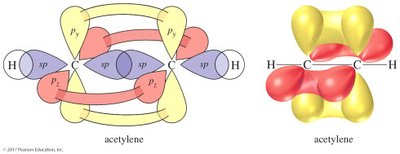
Pi (π) Bond: Formed by the side-to-side overlap of p orbitals; electron density is above and below the bond axis.
Single Bonds: Usually sigma bonds.
Double Bonds: One sigma and one pi bond.
Triple Bonds: One sigma and two pi bonds.
Hybridization and Molecular Shapes
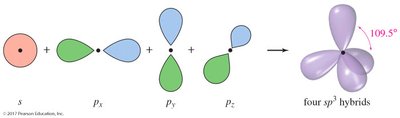
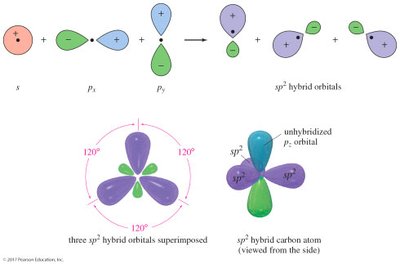
Hybridization explains the shapes of molecules by combining atomic orbitals into new hybrid orbitals. The geometry depends on the number of electron domains.
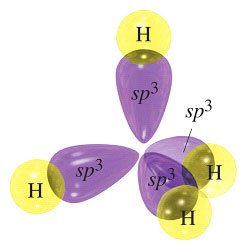
sp3 Hybridization: Four electron domains; tetrahedral shape; bond angle ≈ 109.5°.
sp2 Hybridization: Three electron domains; trigonal planar shape; bond angle ≈ 120°.
sp Hybridization: Two electron domains; linear shape; bond angle ≈ 180°.
Example: Methane (CH4) is sp3 hybridized; ethene (C2H4) is sp2 hybridized; acetylene (C2H2) is sp hybridized.










Isomerism
Isomers are compounds with the same molecular formula but different structures or spatial arrangements. Isomerism is a key concept in organic chemistry.
Constitutional Isomers (Structural Isomers): Same molecular formula, different connectivity of atoms.
Stereoisomers: Same connectivity, different spatial arrangement.
Geometric Isomers (cis-trans Isomers): Stereoisomers due to restricted rotation around double bonds.
Example: cis-but-2-ene and trans-but-2-ene are geometric isomers.
Requirement for cis-trans Isomerism: Each carbon of the double bond must have two different groups attached.
Physical Properties: Geometric isomers have different physical properties.
Summary Table: Types of Isomers
Type | Description | Example |
|---|---|---|
Constitutional Isomers | Same formula, different connectivity | C7H16 (multiple isomers) |
Stereoisomers | Same connectivity, different spatial arrangement | cis/trans-but-2-ene |
Geometric Isomers | cis/trans arrangement around double bond | cis-but-2-ene, trans-but-2-ene |
Additional info: The E/Z system is used for geometric isomers when hydrogens are not present on both carbons of the double bond (see Chapter 7).
