 Indietro
Chapter 13: NMR Spectroscopy – Principles and Applications
Guida di studio - Note intelligenti
 Appunti personalizzati basati sui tuoi materiali, ampliati con definizioni chiave, esempi e contesto.
Chapter 13: NMR Spectroscopy
General Features of 1H NMR Spectroscopy
1H NMR (Proton Nuclear Magnetic Resonance) is a key analytical technique in organic chemistry for identifying hydrogen atoms in different electronic environments. It works by detecting the magnetic fields induced in electrons surrounding the nucleus, which affect the resonance of protons.
Tetramethylsilane (TMS) is the standard reference point for NMR spectra (0 ppm).
Shielding: Electrons shield protons from the external magnetic field, affecting their resonance frequency.
Downfield (higher ppm): Indicates more deshielded protons (closer to electronegative groups or π systems).
Four main types of information from 1H NMR spectra:
Total Number of Signals: Number of unique proton environments.
Chemical Shift: Indicates the electronic environment of each proton.
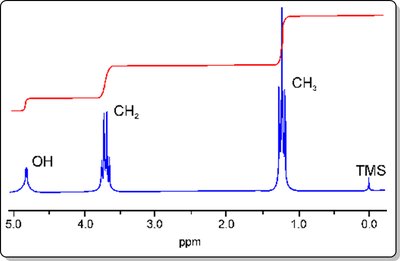
Integration: Relative number of protons for each signal.
Spin-Splitting (Multiplicity): Information about neighboring protons.
Total Number of Signals
The number of signals in a 1H NMR spectrum equals the number of unique, non-equivalent protons in a molecule. Symmetry reduces the number of signals, as equivalent protons (those in identical environments) give the same signal.
Hydrogens bound to the same carbon are often equivalent unless chirality or other factors differentiate them.
Symmetry elements (planes, centers) reduce the number of unique signals.
Proton Relationships: Homotopic, Enantiotopic, Diastereotopic
Protons on the same or different carbons can have different relationships, affecting their NMR signals. The Q-Test (replacing a proton with a different group, Q) helps determine these relationships:
Homotopic Protons: Replacement does not create a new chiral center; protons are always equivalent and share a signal (e.g., all three hydrogens in a methyl group).
Enantiotopic Protons: Replacement creates a new chiral center, but the molecule has no original chiral centers; protons are still equivalent in achiral environments.
Diastereotopic Protons: Replacement creates a new chiral center in a molecule that already has one or more chiral centers; protons are not equivalent and give separate signals.
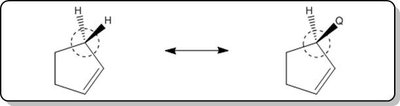
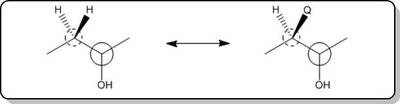
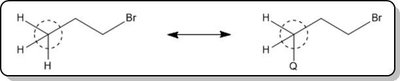
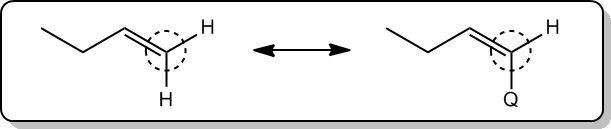
E/Z Diastereoisomerism
In alkenes, protons on the same carbon can be diastereotopic due to E/Z (cis/trans) isomerism, leading to distinct NMR signals for each proton.
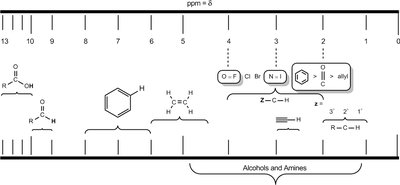
Chemical Shifts
The chemical shift (measured in ppm) reflects the electronic environment of each proton. Electronegative atoms and π systems deshield protons, moving their signals downfield (higher ppm).
Common chemical shift ranges:
Type | δ (ppm) |
|---|---|
C–H (alkane) | 1–2 |
C=C–H (alkene) | 4.5–6 |
Ar–H (aromatic) | 6–8 |
CHO (aldehyde) | 9–10 |
COOH (carboxylic acid) | 10–13 |
OH, NH | 1–5 |

Spin-Splitting (Multiplicity)
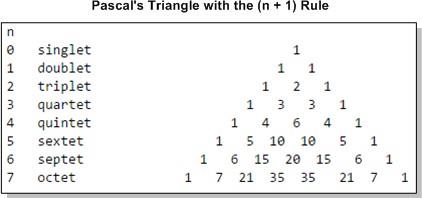
Spin-spin coupling (J-coupling) causes splitting of NMR signals, revealing the number of neighboring protons. The n + 1 rule states that a proton with n equivalent neighbors will be split into (n + 1) peaks.
Pascal’s Triangle predicts the relative intensities of multiplet peaks.
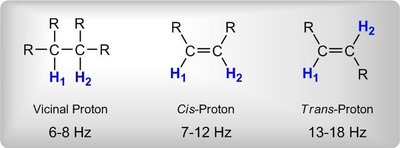
Common Coupling Constants (J-values)
Vicinal (3-bond) protons: 6–8 Hz
Cis-alkene protons: 7–12 Hz
Trans-alkene protons: 13–18 Hz
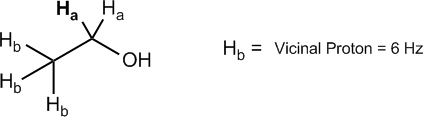
Tree Diagrams
When multiple coupling constants are present, tree diagrams help predict the splitting pattern by sequentially applying each J-value.
Integration
Integration measures the area under each NMR signal, corresponding to the relative number of protons contributing to that signal. This helps determine the ratio of different types of hydrogens in the molecule.
Structure Determination Using NMR
Structure elucidation involves combining molecular formula, NMR, and IR data to deduce the structure of an unknown compound. The process includes:
Determining the Index of Hydrogen Deficiency (IHD).
Analyzing NMR chemical shifts, splitting patterns, and integration.
Comparing the number of 1H NMR signals to the number of carbons (from 13C NMR).
Proposing possible structures and confirming with all available data.
13C NMR Spectroscopy
13C NMR identifies unique carbon environments in a molecule. Due to the low natural abundance of 13C, coupling between carbons is not observed, and each unique carbon gives a single peak.
Key chemical shift ranges for 13C NMR:
Type | δ (ppm) |
|---|---|
C–H (alkane) | 5–45 |
C≡C (alkyne) | 65–100 |
C=C (alkene) | 100–140 |
Benzene | 120–150 |
Carbonyl (C=O) | 160–210 |

Summary Table: Key 1H and 13C NMR Chemical Shifts
Group | 1H NMR (ppm) | 13C NMR (ppm) |
|---|---|---|
Alkane (C–H) | 1–2 | 5–45 |
Alkene (C=C–H) | 4.5–6 | 100–140 |
Aromatic (Ar–H) | 6–8 | 120–150 |
Aldehyde (CHO) | 9–10 | 160–210 |
Carboxylic Acid (COOH) | 10–13 | 160–210 |
Alcohol/Amine (OH/NH) | 1–5 | 30–80 |
Additional info: The Q-Test is a conceptual tool for distinguishing between homotopic, enantiotopic, and diastereotopic protons by replacing a hydrogen with a different group and observing the effect on chirality. Tree diagrams are essential for complex splitting patterns where multiple coupling constants are present. Integration is crucial for determining the ratio of different types of protons, which, combined with chemical shift and splitting, allows for complete structure elucidation.
