 Indietro
Chapter 19: Amines – Structure, Chirality, Basicity, Reactions, and Synthesis
Guida di studio - Note intelligenti
 Appunti personalizzati basati sui tuoi materiali, ampliati con definizioni chiave, esempi e contesto.
Chapter 19: Amines
Overview of Amines
Amines are organic compounds derived from ammonia (NH3) by replacing one or more hydrogen atoms with alkyl or aryl groups. They play a crucial role in biological systems and synthetic organic chemistry, serving as building blocks for pharmaceuticals and other functional molecules.
Key Examples: Nicotine, cocaine, morphine, fentanyl, amphetamine, methamphetamine, oxycodone.
Functional Groups: Amines are classified as primary (1°), secondary (2°), or tertiary (3°) based on the number of alkyl/aryl groups attached to the nitrogen atom.
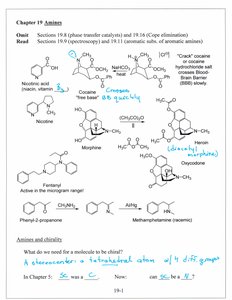
Chirality in Amines
Chirality arises when a molecule cannot be superimposed on its mirror image. For amines, chirality is possible if the nitrogen atom is attached to three different groups and the lone pair acts as the fourth group. However, rapid inversion (tunneling of the lone pair) often prevents isolation of enantiomers.
Requirements for Chirality: Four different groups attached to a stereocenter.
Chiral Amines: Some cyclic amines (e.g., in 5-membered and 3-membered rings) can be chiral due to restricted inversion.
Achiral Amines: If inversion is fast, the molecule is achiral.
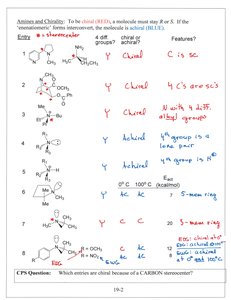
Recombination and Inversion in Amines
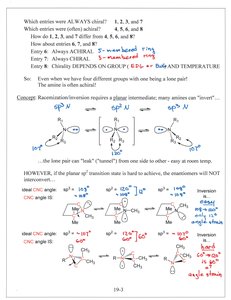
Recombination/inversion involves the nitrogen atom's lone pair tunneling through a planar intermediate, allowing the molecule to interconvert between enantiomers. The rate of inversion depends on ring size, substituents, and temperature.
Planar Transition State: The lone pair can "leak" from one side to another, causing inversion.
Restricted Inversion: In small rings (e.g., 3-membered), inversion is hindered, preserving chirality.
Energetics of Inversion
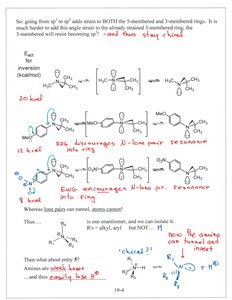
The energy barrier for inversion varies with ring size and resonance effects. Five-membered and three-membered rings have higher barriers, making inversion less likely and chirality more stable.
Energy Barriers: 20 kcal/mol for 5-membered rings, 12 kcal/mol for 3-membered rings.
Resonance Effects: Resonance with adjacent groups can stabilize the planar intermediate, lowering the barrier.
Basicity of Amines
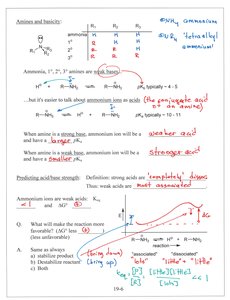
Amines are basic due to the lone pair on nitrogen, which can accept protons. The basicity depends on the structure and environment of the amine.
Ammonia (NH3): pKa ≈ 9.3
Primary, Secondary, Tertiary Amines: pKa values vary based on substituents.
Ammonium Ions: Conjugate acids of amines, easier to compare acidity than basicity.
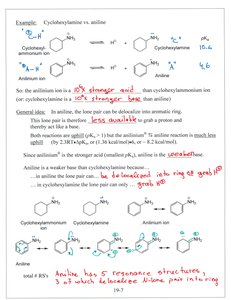
Cyclohexylamine vs. Aniline
The basicity and acidity of cyclohexylamine and aniline differ due to resonance effects. Aniline's lone pair can delocalize into the aromatic ring, making it a weaker base and stronger acid compared to cyclohexylamine.
Cyclohexylamine: Stronger base, weaker acid.
Aniline: Weaker base, stronger acid due to resonance stabilization.
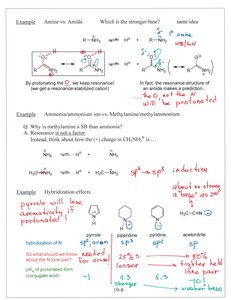
Amine vs. Amide Basicity
Amides are less basic than amines because the nitrogen lone pair is delocalized into the carbonyl group, reducing its availability for protonation.
Resonance: Amide nitrogen participates in resonance with the carbonyl, making it less basic.
Hybridization: sp2 hybridization in amides vs. sp3 in amines.
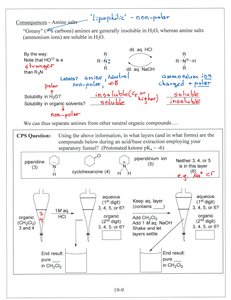
Solubility of Amines
"Green" (non-polar) amines are generally insoluble in water, while amine salts (ammonium ions) are soluble. Solubility depends on polarity and the presence of charged groups.
Amine Salts: Soluble in water due to ionic nature.
Neutral Amines: Insoluble or less soluble in water.
Reactions of Amines
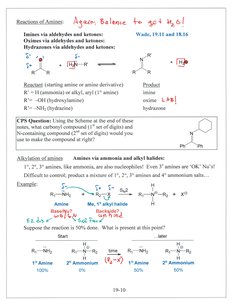
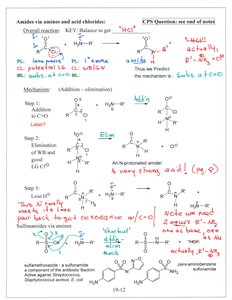
Amines undergo various reactions, including condensation with aldehydes/ketones to form imines, alkylation with alkyl halides, and reactions with acid chlorides to form amides.
Imines Formation: Amines react with aldehydes/ketones to form imines (Schiff bases).
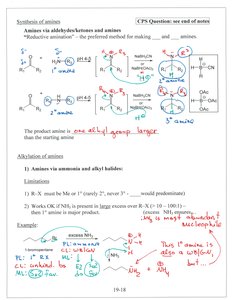
Alkylation: Amines can be alkylated using alkyl halides, but over-alkylation can occur.
Amide Formation: Amines react with acid chlorides to form amides via nucleophilic substitution.
Hofmann Elimination
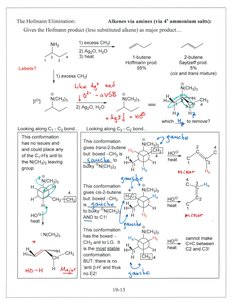
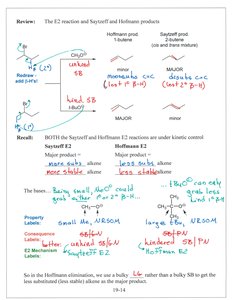
The Hofmann elimination involves the conversion of quaternary ammonium salts to alkenes, favoring the formation of the less substituted (Hofmann) product.
Major Product: Less substituted alkene due to steric effects.
Mechanism: E2 elimination under basic conditions.
Diazonium Ion Formation and Reactions
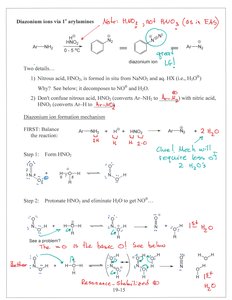
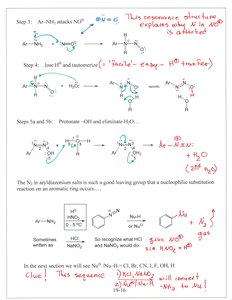
Primary aryl amines react with nitrous acid to form diazonium ions, which are versatile intermediates for aromatic substitution reactions.
Diazonium Ion: Formed from aryl amines and nitrous acid (NaNO2 + HCl).
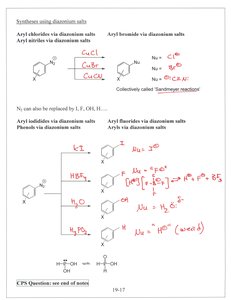
Substitution Reactions: Diazonium ions can be replaced by Cl, Br, CN, OH, and other nucleophiles.
Synthesis of Amines
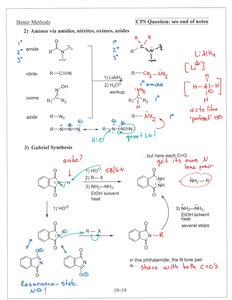
Amines can be synthesized via reductive amination, alkylation, reduction of nitro compounds, and the Gabriel synthesis. Each method has specific advantages and limitations.
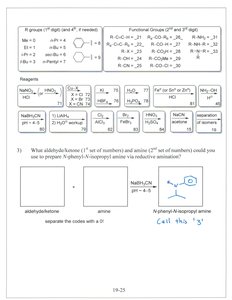
Reductive Amination: Preferred method for making amines from aldehydes/ketones and amines.
Gabriel Synthesis: Used for preparing primary amines via phthalimide intermediates.
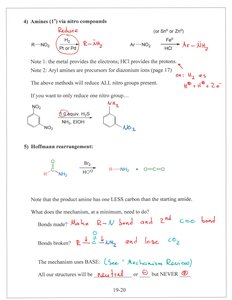
Reduction of Nitro Compounds: Metals and acids reduce nitro groups to amines.
Hofmann Rearrangement: Converts amides to amines with one less carbon atom.
Electrophilic Aromatic Substitution of Aniline
Aniline undergoes electrophilic aromatic substitution, but strong acids can protonate the amino group, reducing its activating effect. Protecting groups or milder conditions are used to direct substitution.
Protection: Convert the amino group to an amide to reduce activation.
Directing Effects: Amino groups are ortho/para directors; amides are less activating.
Summary Tables and Practice Questions
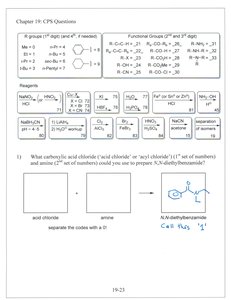
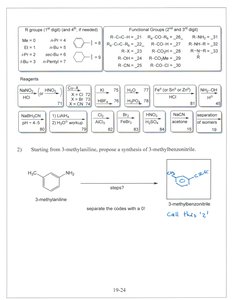
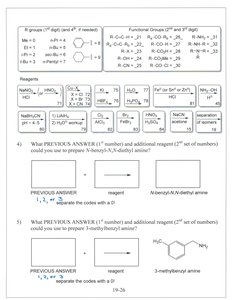
Tables summarizing functional groups, reagents, and synthetic routes are provided for exam practice. These help in planning multi-step syntheses and understanding reagent selection.
Functional Groups: Codes for various groups and reagents.
Practice Questions: Synthesis planning using provided codes and reagents.
Additional info: These notes cover the structure, chirality, basicity, reactions, and synthesis of amines, including advanced topics such as diazonium chemistry and aromatic substitution. The content is suitable for college-level organic chemistry students preparing for exams.
