Indietro
Chapter 19: The Chemistry of Carbonyl Compounds – Aldehydes and Ketones
Guida di studio - Note intelligenti
 Appunti personalizzati basati sui tuoi materiali, ampliati con definizioni chiave, esempi e contesto.
Chapter 19: The Chemistry of Carbonyl Compounds
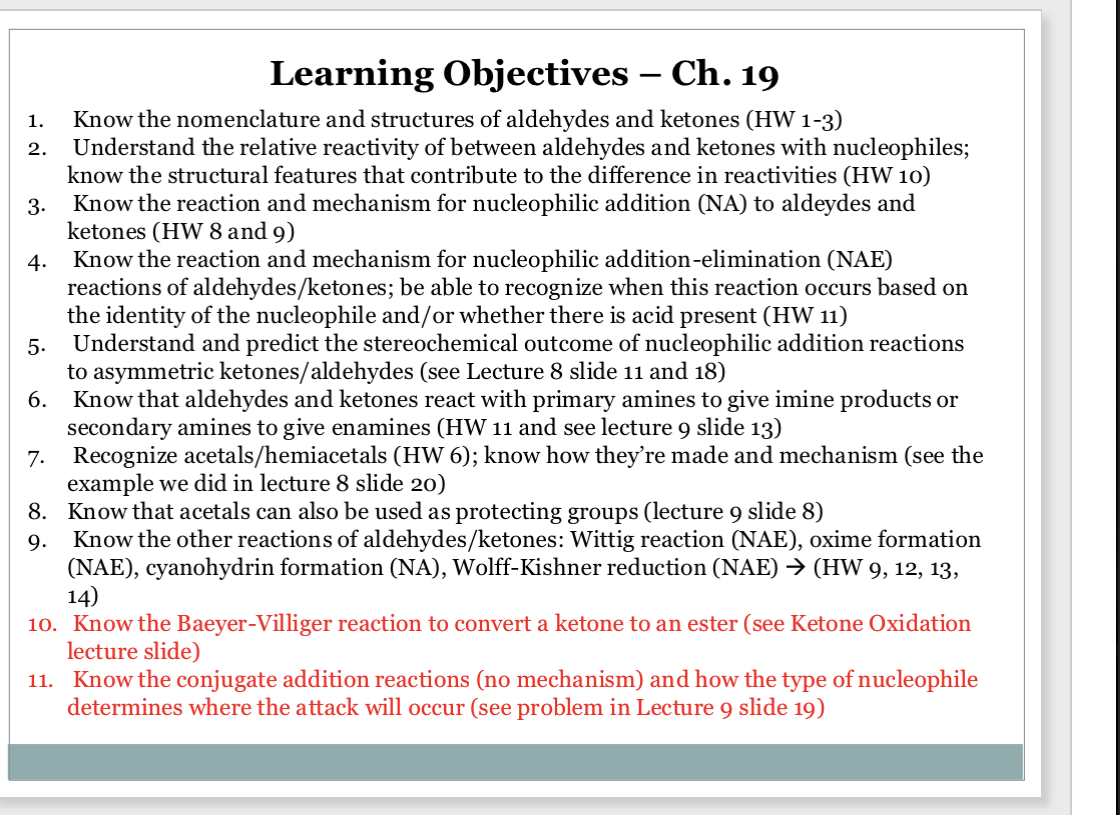
Aldehydes and Ketones: Nomenclature and Structure
Aldehydes and ketones are fundamental carbonyl-containing compounds in organic chemistry. Their nomenclature follows IUPAC rules, and their structures are defined by the presence of a carbonyl group (C=O).
Aldehydes: Contain a carbonyl group bonded to at least one hydrogen atom. Named by replacing the -e ending of the parent alkane with -al (e.g., ethanal).
Ketones: Contain a carbonyl group bonded to two carbon atoms. Named by replacing the -e ending of the parent alkane with -one (e.g., propanone).
Structure: The carbonyl carbon is sp2 hybridized, resulting in a planar geometry.
Example: Formaldehyde (HCHO), Acetone (CH3COCH3).
Relative Reactivity of Aldehydes and Ketones with Nucleophiles
The reactivity of aldehydes and ketones toward nucleophilic attack is influenced by their structure.
Aldehydes are generally more reactive than ketones due to less steric hindrance and a less electron-donating environment around the carbonyl carbon.
Ketones have two alkyl groups, which decrease the partial positive charge on the carbonyl carbon and increase steric hindrance.
Key structural features: Electron-withdrawing groups increase reactivity; electron-donating groups decrease reactivity.
Example: Acetaldehyde reacts faster with nucleophiles than acetone.
Nucleophilic Addition (NA) to Aldehydes and Ketones
Nucleophilic addition is a central reaction for carbonyl compounds, where a nucleophile attacks the electrophilic carbonyl carbon.
Mechanism: The nucleophile adds to the carbonyl carbon, breaking the C=O pi bond and forming a tetrahedral intermediate.
General equation:
Example: Addition of hydride (H-) from NaBH4 or LiAlH4 reduces aldehydes/ketones to alcohols.
Nucleophilic Addition-Elimination (NAE) Reactions
NAE reactions occur when the nucleophile can eliminate a leaving group after addition, often in the presence of acid.
Mechanism: Nucleophile adds to carbonyl, followed by elimination of a leaving group (e.g., water).
Occurs with: Nucleophiles like amines, hydrazine, or hydroxylamine.
Recognition: Acid catalysis often facilitates elimination.
Example: Formation of imines from aldehydes/ketones and primary amines.
Stereochemical Outcome of Nucleophilic Addition
Nucleophilic addition to asymmetric carbonyl compounds can create new stereocenters, leading to stereoisomer formation.
Outcome: Attack can occur from either face of the planar carbonyl, producing enantiomers.
Example: Addition to a chiral ketone yields a racemic mixture if no chiral influence is present.
Reactions with Amines: Imine and Enamine Formation
Aldehydes and ketones react with amines to form imines or enamines, depending on the amine type.
Primary amines: Form imines via NAE mechanism.
Secondary amines: Form enamines.
General equation for imine formation:
Example: Acetone + methylamine forms an imine.
Acetals and Hemiacetals: Recognition and Mechanism
Acetals and hemiacetals are formed by the reaction of aldehydes/ketones with alcohols.
Hemiacetal: Formed by addition of one alcohol molecule to the carbonyl.
Acetal: Formed by addition of a second alcohol molecule, usually under acidic conditions.
Mechanism: Involves nucleophilic addition followed by elimination.
Example: Formation of dimethoxyethane from acetaldehyde and methanol.
Acetals as Protecting Groups
Acetals are used in organic synthesis to protect carbonyl groups from unwanted reactions.
Protection: Acetals are stable under basic conditions and can be removed by acid hydrolysis.
Application: Protecting an aldehyde during multi-step synthesis.
Other Reactions of Aldehydes and Ketones
Aldehydes and ketones undergo several specialized reactions:
Wittig Reaction (NAE): Converts carbonyls to alkenes using phosphonium ylides.
Oxime Formation (NAE): Reaction with hydroxylamine to form oximes.
Cyanohydrin Formation (NA): Addition of cyanide to carbonyls.
Wolff-Kishner Reduction (NAE): Reduces carbonyls to alkanes using hydrazine and base.
General equation for Wittig:
Baeyer-Villiger Reaction: Ketone to Ester Conversion
The Baeyer-Villiger reaction oxidizes ketones to esters using peroxy acids.
Mechanism: Involves migration of an alkyl group to an oxygen atom.
General equation:
Example: Cyclohexanone + mCPBA yields caprolactone.
Conjugate Addition Reactions
Conjugate addition involves nucleophilic attack at the beta position of α,β-unsaturated carbonyl compounds.
Type of nucleophile: Determines whether attack occurs at the carbonyl (1,2-addition) or at the beta carbon (1,4-addition).
Example: Gilman reagents (R2CuLi) favor 1,4-addition; Grignard reagents favor 1,2-addition.