 Indietro
Chapter 4: The Study of Chemical Reactions – Free Energy, Equilibrium, and Activation Energy
Guida di studio - Note intelligenti
 Appunti personalizzati basati sui tuoi materiali, ampliati con definizioni chiave, esempi e contesto.
Free Energy, Equilibrium, and Activation Energy in Organic Reactions
Introduction to Organic Reaction Analysis
Organic reactions are evaluated by examining both the transformation of reactants to products and the detailed mechanism describing electron flow. Two fundamental aspects are considered:
Thermodynamics: The study of energy changes during chemical and physical transformations.
Kinetics: The study of reaction rates and the factors affecting them.
Chlorination of Methane: A Model Reaction
The chlorination of methane is a classic example of a free-radical chain reaction in organic chemistry.
Initiation: Requires heat or light, especially blue light absorbed by chlorine gas.
Chain Reaction: Many product molecules are formed from the absorption of a single photon.
Example: The overall reaction is: 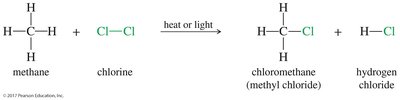
Mechanism of Free Radical Chlorination
Initiation Step
The chlorine molecule undergoes homolytic cleavage upon absorbing a photon, producing two chlorine atoms (free radicals). 
Lewis Structures of Free Radicals
Free radicals are species with an unpaired electron. Halogens, such as chlorine, have seven valence electrons, making their atomic form a radical. 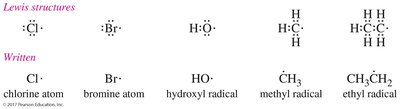
Propagation Steps
Step 1: Chlorine radical abstracts a hydrogen atom from methane, forming a methyl radical and hydrogen chloride.
Step 2: Methyl radical reacts with another chlorine molecule, producing chloromethane and regenerating a chlorine radical.
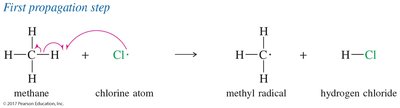
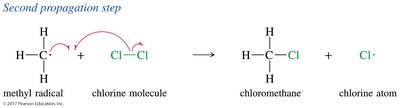
Termination Steps
Termination occurs when two radicals combine to form a stable, non-radical product or when radicals are removed by side reactions (e.g., collision with reactor walls). 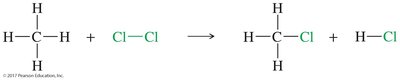
Free Energy Change and Chemical Equilibrium
Equilibrium Constant ()
The equilibrium constant quantifies the ratio of products to reactants at equilibrium.
Definition:
Interpretation: Large favors products; small $K_{eq}$ favors reactants.
Example: For methane chlorination: 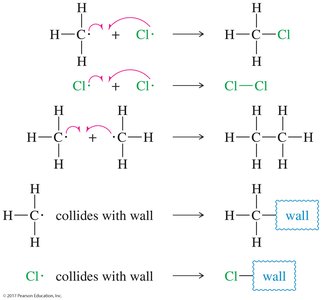
Free Energy Change ()
Negative indicates a spontaneous, energetically favorable reaction.
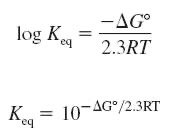
Relationship to equilibrium:
Factors Determining
Enthalpy (): Heat released or absorbed. Negative favors product formation.
Entropy (): Change in disorder or randomness. Positive favors spontaneity.
Combined:
Example: Spontaneous reactions maximize disorder and/or minimize enthalpy.
Product Composition as a Function of
Table: Product composition changes dramatically with small changes in .
(kJ/mol) | (kcal/mol) | Conversion to Products (%) | |
|---|---|---|---|
+4.0 | (+1.0) | 0.20 | 17% |
+2.0 | (+0.5) | 0.45 | 31% |
+0.5 | (+0.1) | 2.2 | 69% |
-2.0 | (-0.5) | 5.0 | 83% |
-4.0 | (-1.0) | 127 | 99% |
-20.0 | (-4.8) | 3200 | 99.9% |

Activation Energy and Reaction Rates
Definition of Activation Energy ()
Activation energy is the minimum energy required for reactant molecules to overcome repulsions and reach the transition state.
High (> 20 kcal/mol): Slow reaction, few collisions have enough energy.
Low ( 20 kcal/mol): Fast reaction, many collisions have enough energy.

Reaction Free Energy Diagrams
Diagrams plot energy changes along the reaction coordinate.
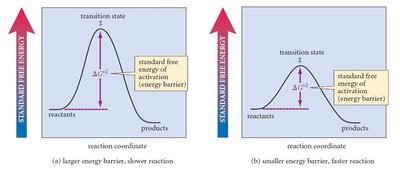
The peak represents the transition state; the height is the activation energy barrier ().
Example:
Large energy barrier: slower reaction.
Small energy barrier: faster reaction.
Reaction Coordinate
The reaction coordinate measures the change in positions of atoms during a reaction, tracking progress from reactants to products. Additional info: Reaction coordinate diagrams are essential for visualizing the energy profile and identifying the transition state in organic reactions. ----------------------------------------
