 Indietro
Chapter 7: The Reactions of Alkynes and Introduction to Multistep Synthesis
Guida di studio - Note intelligenti
 Appunti personalizzati basati sui tuoi materiali, ampliati con definizioni chiave, esempi e contesto.
Reactions of Alkynes and Multistep Synthesis
Introduction to Alkynes
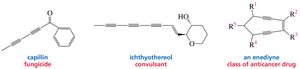
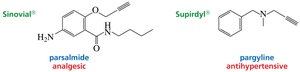
Alkynes are hydrocarbons characterized by the presence of a carbon–carbon triple bond. They play a significant role in both natural products and synthetic drugs, and their unique reactivity makes them valuable intermediates in organic synthesis.
General Formula: CnH2n-2
Occurrence: Alkynes are found in nature and are also present in various pharmaceuticals.
Nomenclature of Alkynes
Basic Naming Principles
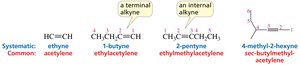
The IUPAC system is used to name alkynes, ensuring the triple bond receives the lowest possible number in the parent chain. Common names are also used for simple alkynes.
Suffix: The suffix "-yne" is used to denote the presence of a triple bond.
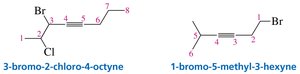
Numbering: The chain is numbered to give the triple bond the lowest possible number.
Compounds with Multiple Functional Groups
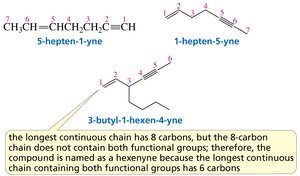
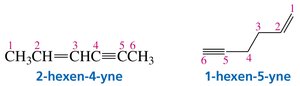
When a molecule contains more than one functional group, the chain is numbered to give the lowest possible numbers to the functional groups. If both a double and a triple bond are present, the double bond takes priority in numbering if there is a tie.

Functional Group Priorities
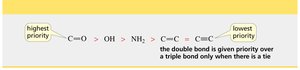
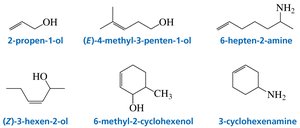
Functional groups are prioritized in nomenclature. Hydroxyl (OH) and amino (NH2) groups have higher priority than double or triple bonds.
Structure and Bonding in Alkynes
Bonding and Geometry
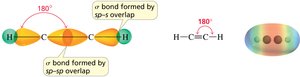
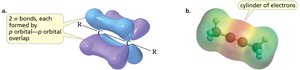
The triple bond in alkynes consists of one sigma (σ) bond and two pi (π) bonds. The carbon atoms involved in the triple bond are sp-hybridized, resulting in a linear geometry with a bond angle of 180°.
σ Bond: Formed by sp–sp overlap.
π Bonds: Formed by p–p orbital overlap, creating a cylinder of electron density around the bond axis.
Physical Properties of Alkynes
Boiling Points and Trends
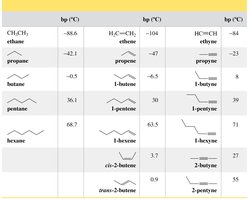
Alkynes, like other unsaturated hydrocarbons, have boiling points that increase with molecular weight. Their boiling points are generally similar to those of alkenes with comparable molecular weights.
Compound | Boiling Point (°C) |
|---|---|
Ethane | -88.6 |
Propane | -42.1 |
Butane | -0.5 |
1-Butyne | 8 |
1-Pentyne | 39 |
2-Pentyne | 55 |
1-Hexyne | 71 |
2-Hexyne | 89 |
Chemical Reactions of Alkynes
Electrophilic Addition Reactions
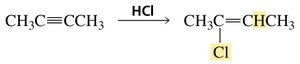
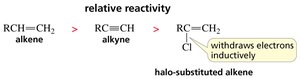
Alkynes undergo electrophilic addition reactions similar to alkenes, but with distinct regioselectivity and the possibility of multiple additions due to the presence of two π bonds.
First Step: Addition of an electrophile to the triple bond forms a vinyl cation intermediate.
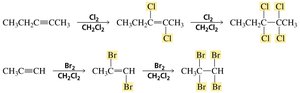
Second Step: A second equivalent of electrophile can add, leading to a tetra-substituted product.

Regioselectivity and Stereochemistry
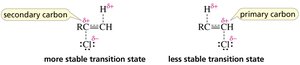
The addition to terminal alkynes is regioselective, favoring the formation of the more stable carbocation or transition state. The reaction can be stopped after the addition of one equivalent if the intermediate is less reactive than the starting alkyne.
Halogenation and Hydration
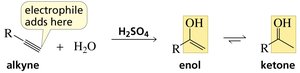
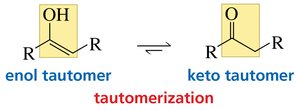
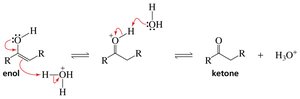
Alkynes react with halogens (Cl2, Br2) and water (in the presence of acid) to give dihalides and ketones, respectively. Hydration of alkynes proceeds via enol intermediates, which tautomerize to ketones.
Hydroboration–Oxidation
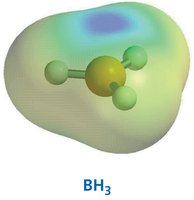
Hydroboration–oxidation of alkynes provides an alternative route to aldehydes or ketones, depending on the alkyne's structure. Borane (BH3) acts as an electrophile in this reaction.

Hydrogenation: Complete and Partial
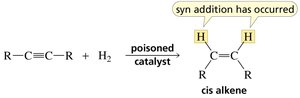
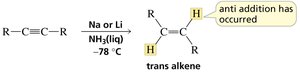
Alkynes can be hydrogenated to alkanes using Pd/C catalysts. Partial hydrogenation to cis-alkenes is achieved with poisoned catalysts (e.g., Lindlar's catalyst), while anti addition (trans-alkenes) is achieved with sodium or lithium in liquid ammonia.


Acidity and Alkylation of Alkynes
Acidity of Terminal Alkynes
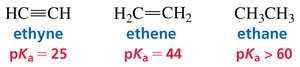
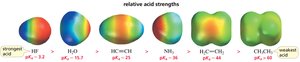
Terminal alkynes are more acidic than alkenes and alkanes due to the high s-character of the sp-hybridized carbon. The pKa of ethyne (acetylene) is about 25.
Deprotonation and Alkylation
A strong base, such as sodium amide (NaNH2), is required to deprotonate terminal alkynes, forming acetylide ions. These ions can undergo alkylation with alkyl halides, forming new carbon–carbon bonds.




Multistep Synthesis Using Alkynes
Retrosynthetic Analysis and Synthesis Examples
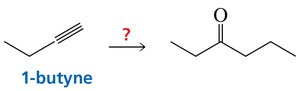
Alkynes are versatile intermediates in multistep organic synthesis. Retrosynthetic analysis helps in planning the synthesis of complex molecules from simple alkynes via functional group transformations and carbon–carbon bond formation.
Key Steps: Deprotonation, alkylation, hydration, and reduction.
Applications: Synthesis of ketones, alkenes, and other functionalized molecules.


Summary of Learning Objectives
Name alkynes and draw their structures from IUPAC names.
Predict products of electrophilic addition, hydration, hydroboration–oxidation, halogenation, and hydrogenation of alkynes.
Use alkynes as starting materials in multistep syntheses.
Predict stereochemistry of alkene products from alkyne reduction.
